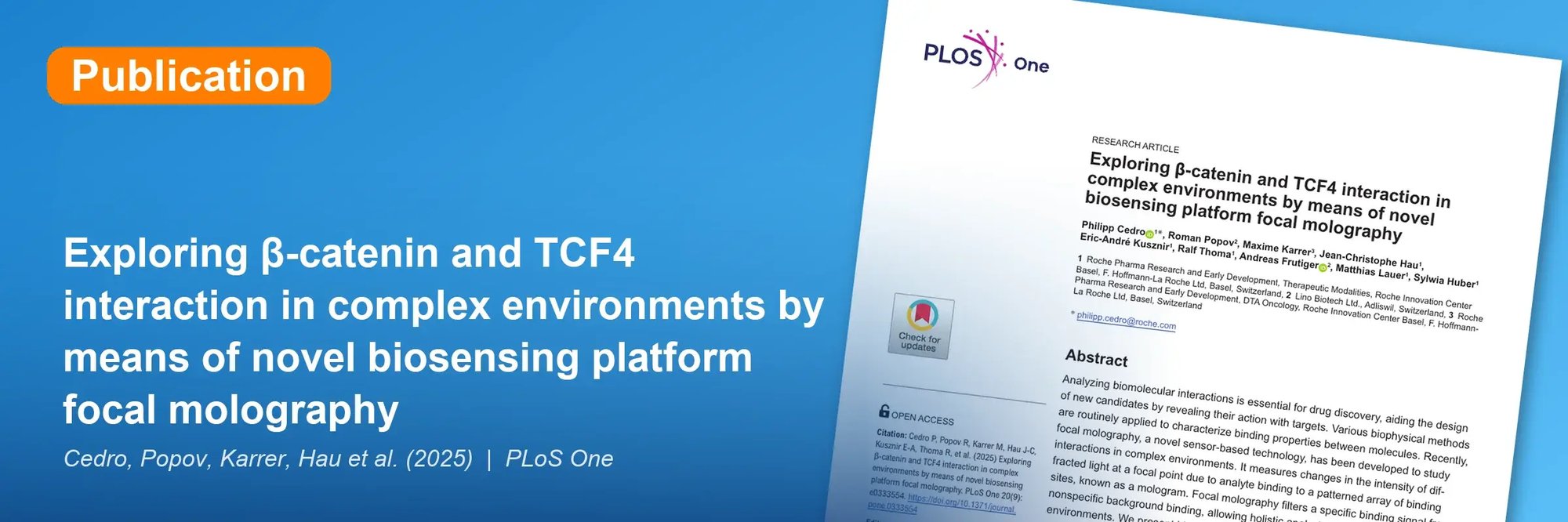
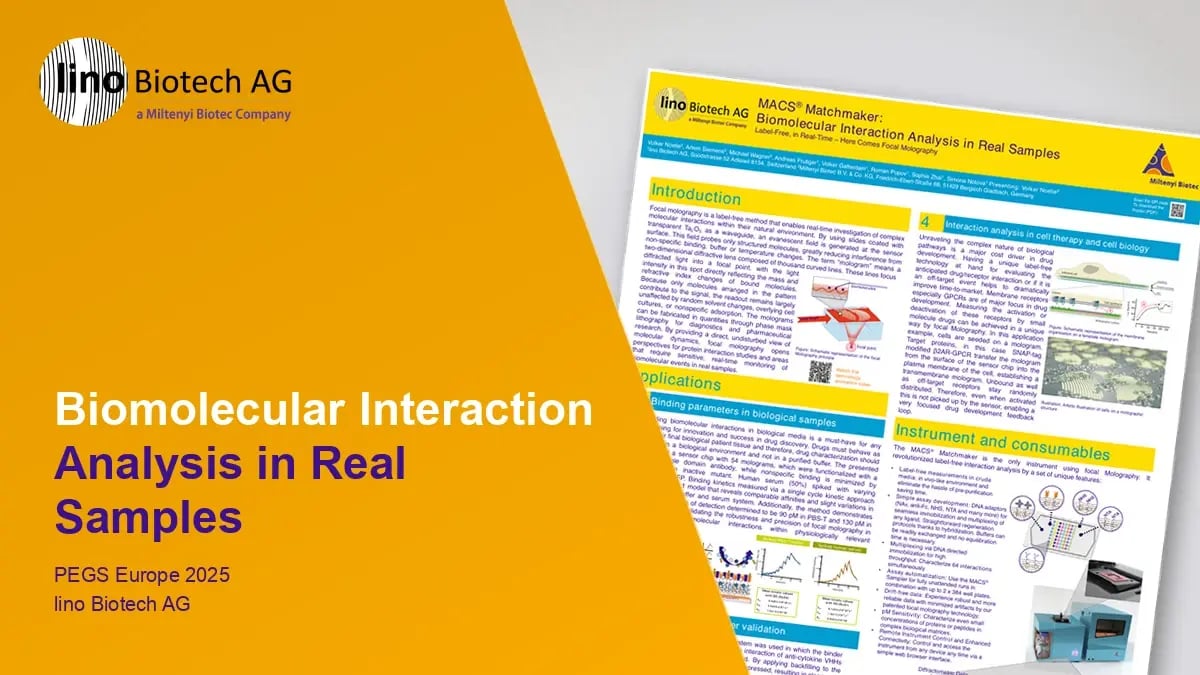
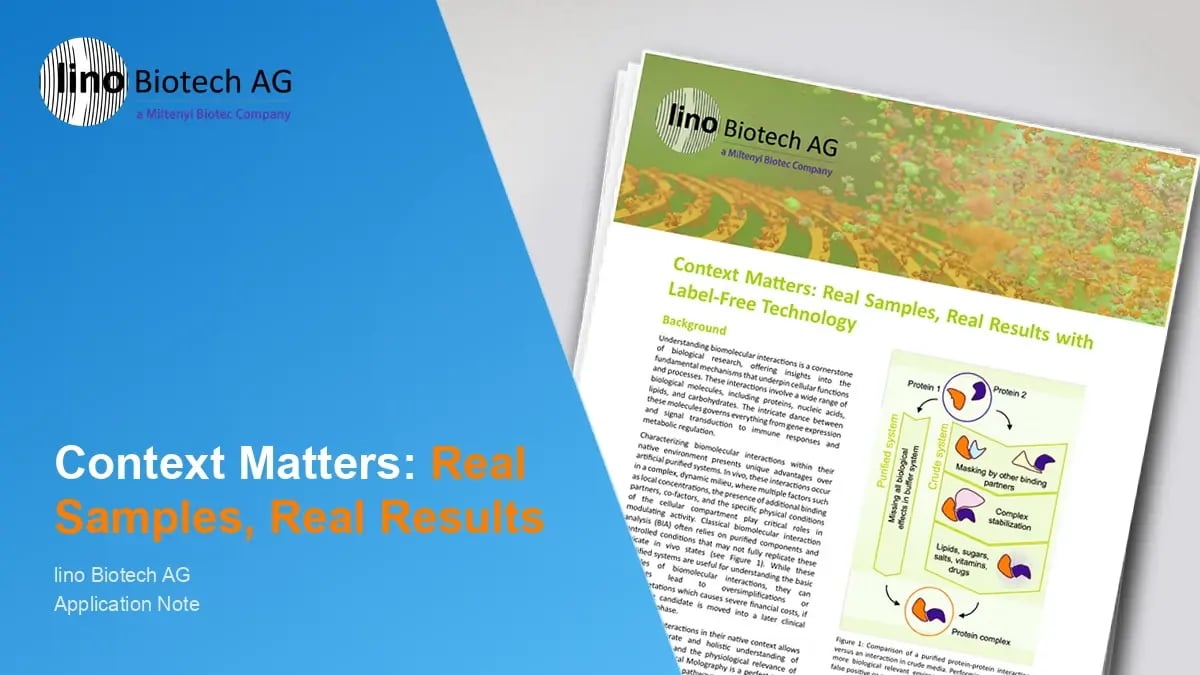
Focal molography reproducibly determines β-catenin/TCF4 binding affinities in cell lysate, where surface plasmon resonance is limited to buffer due to non-specific binding.
The Challenge
The interaction between β-catenin and the transcription factor TCF4 is the central downstream switch of the Wnt signaling pathway. When dysregulated, this protein-protein interaction drives colorectal and other cancers, making it a long-standing oncology target. The flat, extended interface has resisted classical drug discovery, and validating inhibitors in physiologically relevant matrices like cell lysate is critical. Refractometric biosensors such as SPR struggle there: non-specific adsorption from lysate components creates baseline drift that masks the specific signal.
The Approach
The authors used focal molography on the MACS® Matchmaker to characterize the binding of recombinant β-catenin (armadillo repeat domain) to the TCF4(7-30) peptide. The peptide was immobilized on the mologram surface via tetrazine-TCO bioorthogonal click chemistry. KD and IC50 were determined in both running buffer and crude RKO cell lysate, and benchmarked head-to-head against SPR (Biacore).
Key Results
- Direct lysate measurement: Focal molography determined KD and IC50 for the interaction in both buffer and cell lysate. SPR was restricted to buffer because non-specific binding obscured the signal in lysate
- Buffer agreement: KD in buffer was 79-160 nM by focal molography and 96-121 nM by SPR. The values agree within a factor of two across three sensors and three runs
- Lysate KD: In RKO cell lysate, focal molography returned KD values of 100-140 nM, only marginally higher than in buffer
- Competition assay: IC50 from a small-molecule competition was 110-200 nM (buffer) and 140-170 nM (lysate) by focal molography. That agrees well with the 95-115 nM measured by SPR in buffer
- Background rejection: Lysate components adsorbed equally to ridges and grooves of the backfilled sensor, producing no diffractive signal, while specific binding generated a clean response
Why It Matters
β-Catenin/TCF4 is a flagship "undruggable" oncology target, and screening campaigns increasingly need to operate in physiologically relevant samples rather than purified buffer. Focal molography removes the non-specific-binding bottleneck that has kept SPR-based PPI workflows tied to clean buffers. It opens a route to direct affinity and inhibition measurements in crude cell lysate, and to faster, more predictive hit validation for difficult drug targets.
Cedro, P., Popov, R., Karrer, M., Hau, J.-C., Kusznir, E.-A., Thoma, R., Frutiger, A., Lauer, M., & Huber, S. (2025). Exploring β-catenin and TCF4 interaction in complex environments by means of novel biosensing platform focal molography. PLoS One, 20(9), e0333554. https://doi.org/10.1371/journal.pone.0333554