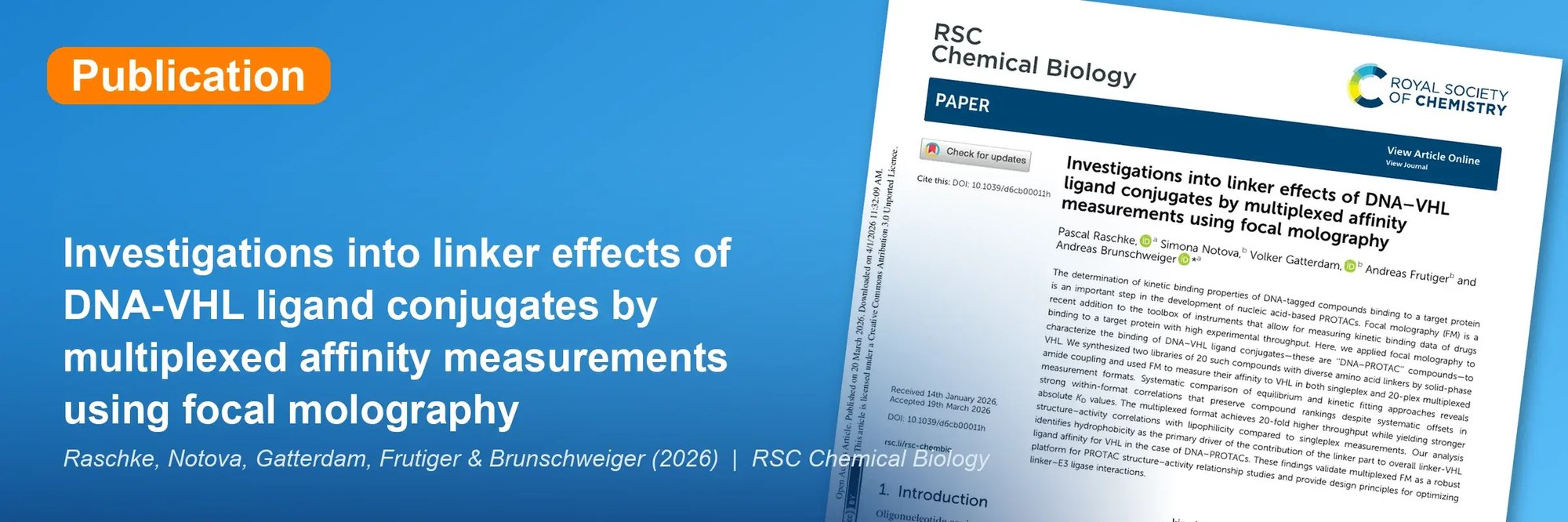
Multiplexed focal molography identifies hydrophobicity as the primary driver of linker-mediated binding affinity in DNA-encoded PROTAC building blocks targeting the E3 ligase VHL.
The Challenge
Proteolysis-targeting chimeras (PROTACs) are a class of therapeutic molecules that work by hijacking the cell's own protein disposal system. A PROTAC consists of two binding modules connected by a molecular linker. One end binds a disease-relevant target protein, the other recruits an E3 ubiquitin ligase, an enzyme that tags proteins for destruction. Von Hippel-Lindau (VHL) is the most widely used E3 ligase in PROTAC design. Understanding how the linker between these two modules affects binding to VHL is critical for designing effective degraders. Conventional biosensing methods measure compounds one at a time, which makes systematic optimization slow.
The Approach
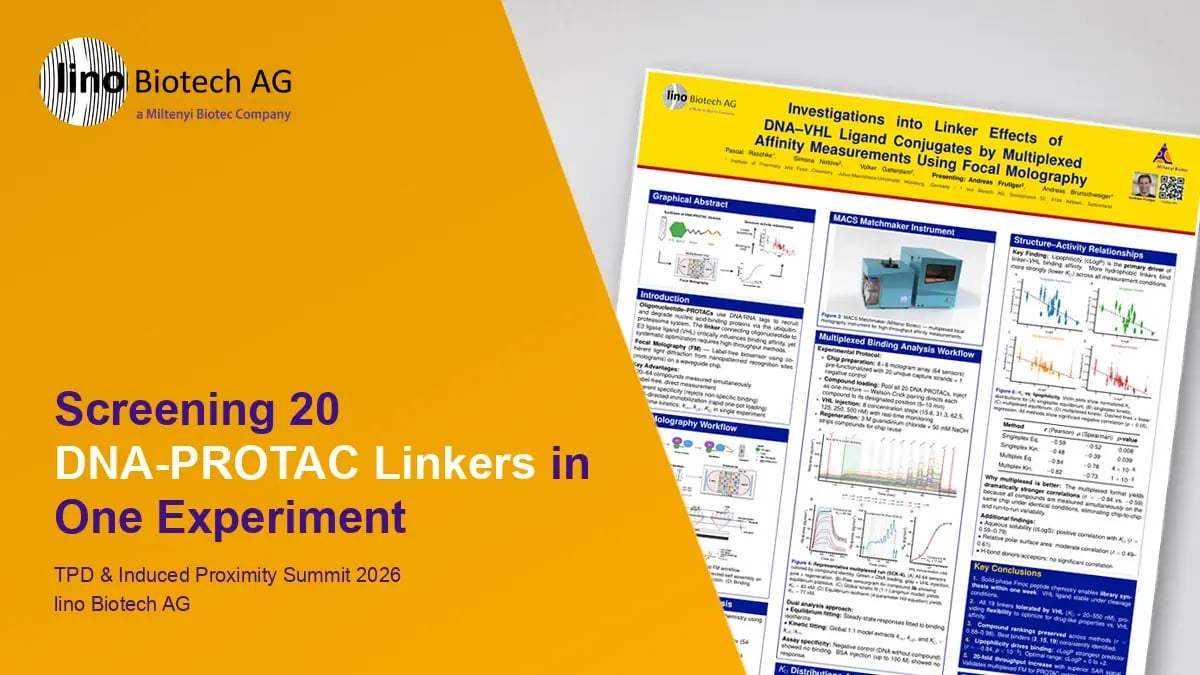
The authors synthesized 20 DNA-tagged VHL ligand conjugates, each with a different amino acid linker that mimics the connector used in PROTAC molecules. They measured them with focal molography on the MACS® Matchmaker. Each compound was immobilized on a single sensor chip via DNA-directed immobilization (DDI). How strongly all 20 linker variants bind to VHL protein was then measured in real time, in one experiment. Both singleplex and 20-plex multiplexed formats were compared.
Key Results
- Affinity range: Dissociation constants (KD) spanned 20 nM to 550 nM across 20 compounds, confirming that all tested linker structures are tolerated by VHL
- Compound ranking preserved: The three strongest binders (compounds 3, 15, and 19) were consistently identified across all four measurement methods
- 20-fold throughput gain: The multiplexed format measured all 20 compounds simultaneously on one chip, eliminating run-to-run variability inherent to sequential singleplex processing
- Lipophilicity drives affinity: Higher linker hydrophobicity correlated with stronger VHL binding across all methods, identifying c log P as the dominant structure-activity predictor
- Optimal design window: Compounds with c log P values between 0 and +2 offer the best balance between binding affinity and drug-like physicochemical properties
Why It Matters
These findings establish multiplexed focal molography as a validated platform for PROTAC linker structure-activity relationship studies. Screening 20 linker variants at once reduces the experimental cycle from sequential week-long campaigns to a single measurement. That directly accelerates medicinal chemistry optimization in targeted protein degradation programs. Because every compound is measured on the same sensor chip in real time, ranking decisions are not confounded by inter-experiment drift. That drift is a recurring source of noise in sequential SPR or BLI workflows. The same DNA-directed immobilization strategy generalizes beyond VHL to other E3 ligases and to DNA-encoded library hit validation. That makes the MACS® Matchmaker a broadly applicable tool for label-free, kinetic affinity triage in degrader and small-molecule discovery campaigns.
Raschke, P., Notova, S., Gatterdam, V., Frutiger, A., & Brunschweiger, A. (2026). Investigations into linker effects of DNA-VHL ligand conjugates by multiplexed affinity measurements using focal molography. RSC Chemical Biology, Advance Article. https://doi.org/10.1039/D6CB00011H



 Mar, 2026
 Jul 2026
 Jun, 2026