


Why on-DNA validation closes the gap that NGS leaves open.
How DEL screening worksA DNA-encoded library (DEL) is a pool of millions to billions of small molecules, each covalently linked to a unique DNA barcode that records which building blocks were used during its combinatorial synthesis. The library is incubated with a target, non-binders are washed away, and the remaining barcodes are amplified by PCR and sequenced by next-generation sequencing (NGS). Enriched barcodes point to the chemical building blocks that produced binders. 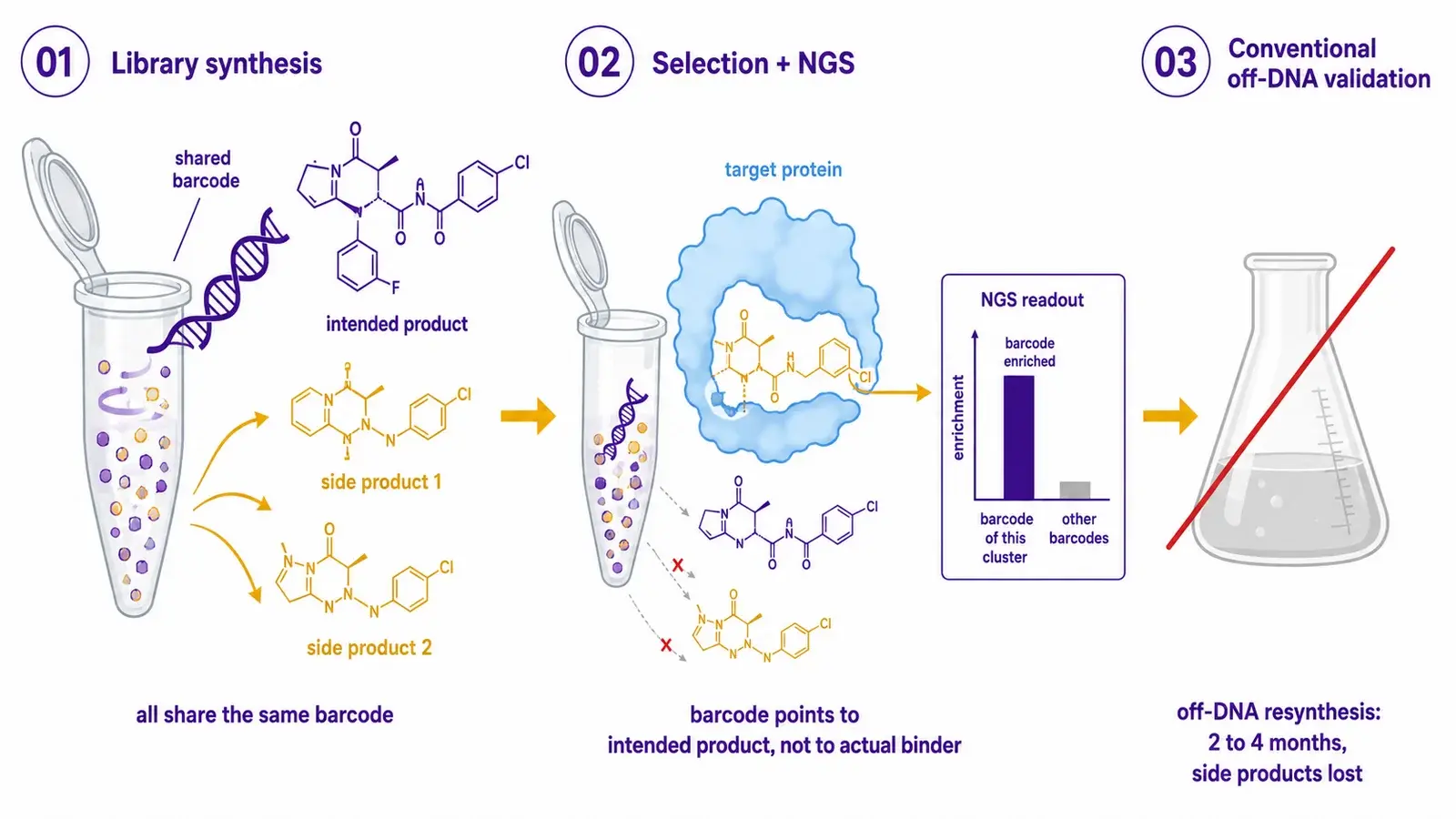 The barcode encodes the intended product, not the molecule that actually bound the target. All chemical species formed during the same synthesis step share the same barcode: intermediates, side products, on-DNA degradants, and the desired compound. Hit calling from sequencing alone cannot distinguish them. | Why off-DNA synthesis often misses the real binderThe conventional resolution is off-DNA synthesis: rebuild the assumed hit by traditional medicinal chemistry, then characterize. The route is fundamentally different from the original library route. Aqueous DNA-compatible chemistry is replaced by organic solvents, different stoichiometries, different reaction times. A different impurity profile is produced, and any side-product binder that drove the original enrichment is silently absent. Each off-DNA synthesis cycle takes 2 to 4 months per compound and costs a chemistry FTE per hit. Attrition rates of 60 to 80 percent are common because many off-DNA synthesized "hits" no longer bind, or bind weakly because the actual binding species was a side product that off-DNA synthesis failed to reproduce. |
From NGS readout to validated kinetic profile.
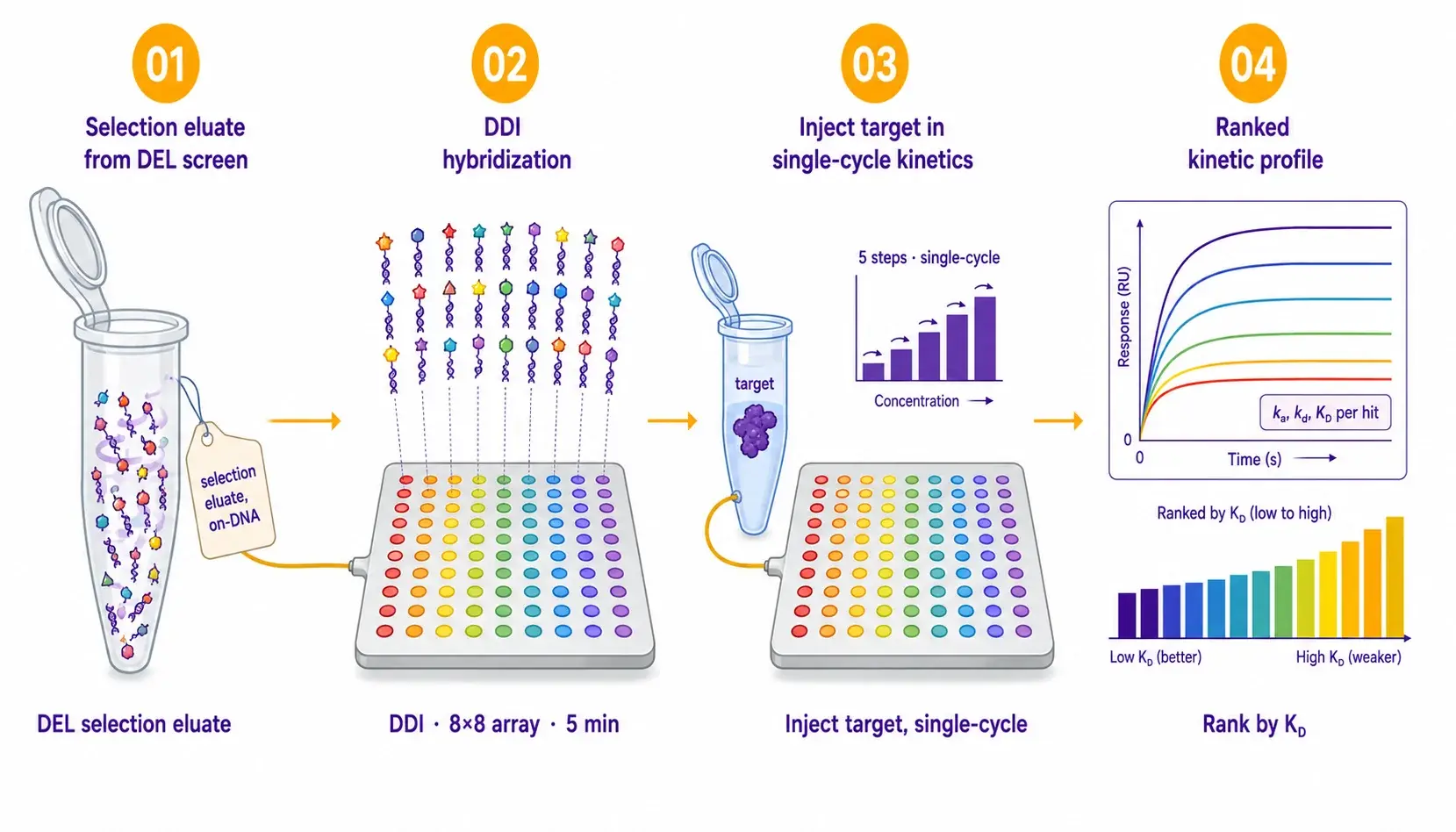
The 8×8 mologram array is loaded once via DDI of the on-DNA hit pool, often the selection eluate itself or a focused validation panel. The target protein is then injected in single-cycle kinetics format, and equilibrium plus kinetic KD are extracted in the same run for all spots simultaneously.
 | Protocol details
|