


Targeted protein degradation and the linker SAR bottleneck.
How PROTACs and molecular glues workPROTACs (proteolysis-targeting chimeras) and molecular glues are heterobifunctional or monovalent small molecules that recruit an E3 ubiquitin ligase to a protein of interest (POI). The resulting ternary complex (POI · degrader · E3) is ubiquitinated and shuttled to the 26S proteasome for degradation. Unlike inhibitors, degraders act catalytically and have access to scaffolding proteins, transcription factors, and other historically undruggable targets. 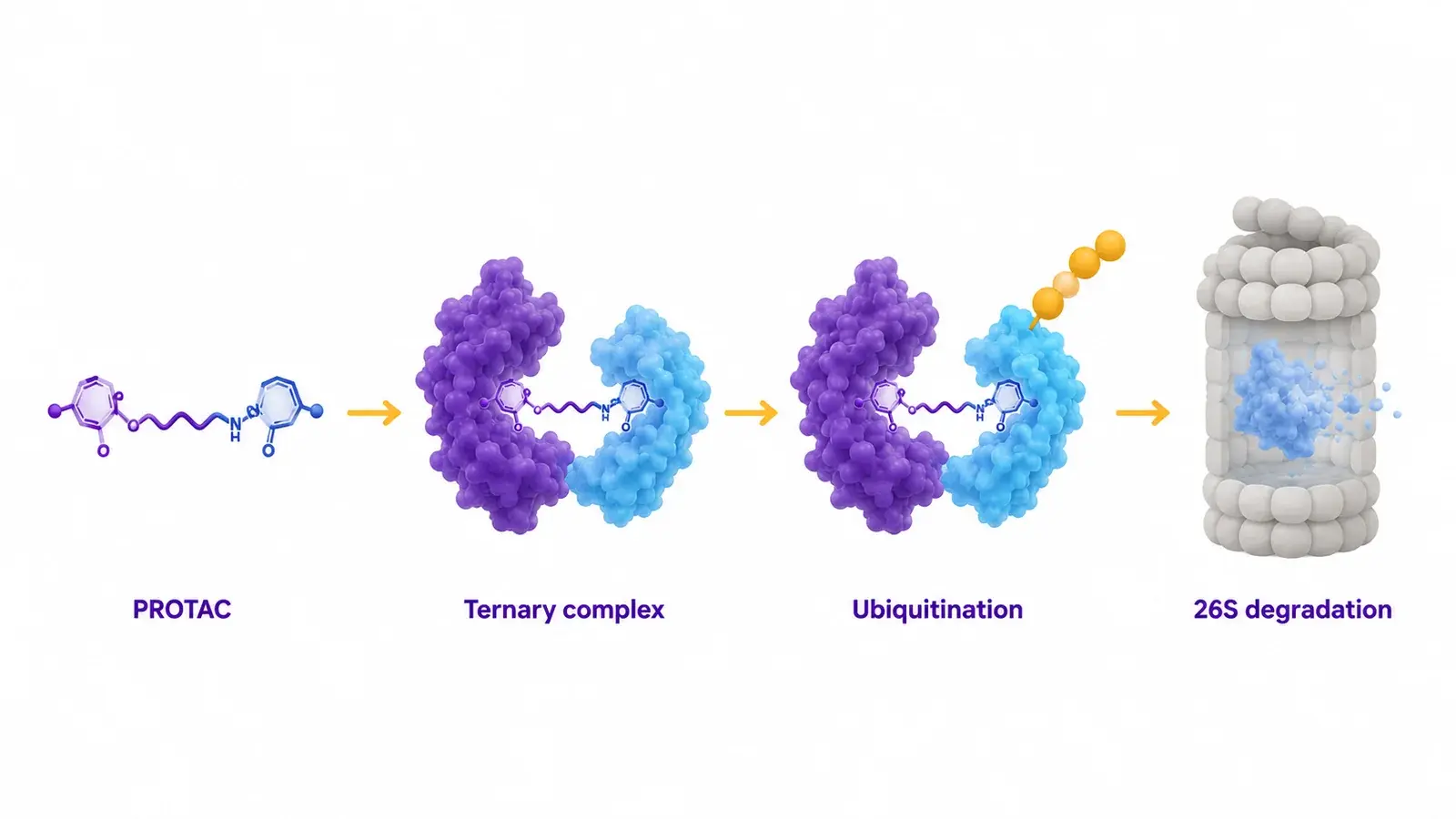 The linker that bridges the E3 ligand and the POI ligand is the central design parameter. Length, rigidity, and lipophilicity govern ternary complex geometry, cooperativity (α), and ultimately the cellular degradation efficiency. Small linker changes routinely produce 10-fold to 100-fold shifts in DC50, so systematic linker SAR is non-negotiable in lead optimization. | Why linker SAR is hard to measureConventional biophysics characterizes one compound per chip per day. A 32-compound linker series therefore consumes weeks of instrument time, with chip-to-chip drift adding variance that obscures the underlying SAR. Buffer-only KD values frequently fail to predict cellular degradation because cooperativity is matrix-dependent and many E3 ligases lose stability after purification. Cellular degradation assays read the integrated outcome but provide no biophysical interpretation. Designers are left without kinetic feedback on which step (binding, cooperativity, geometry) drove the change. The result is iterative empirical screening when a single multiplexed kinetic measurement could resolve the design space in one run. |
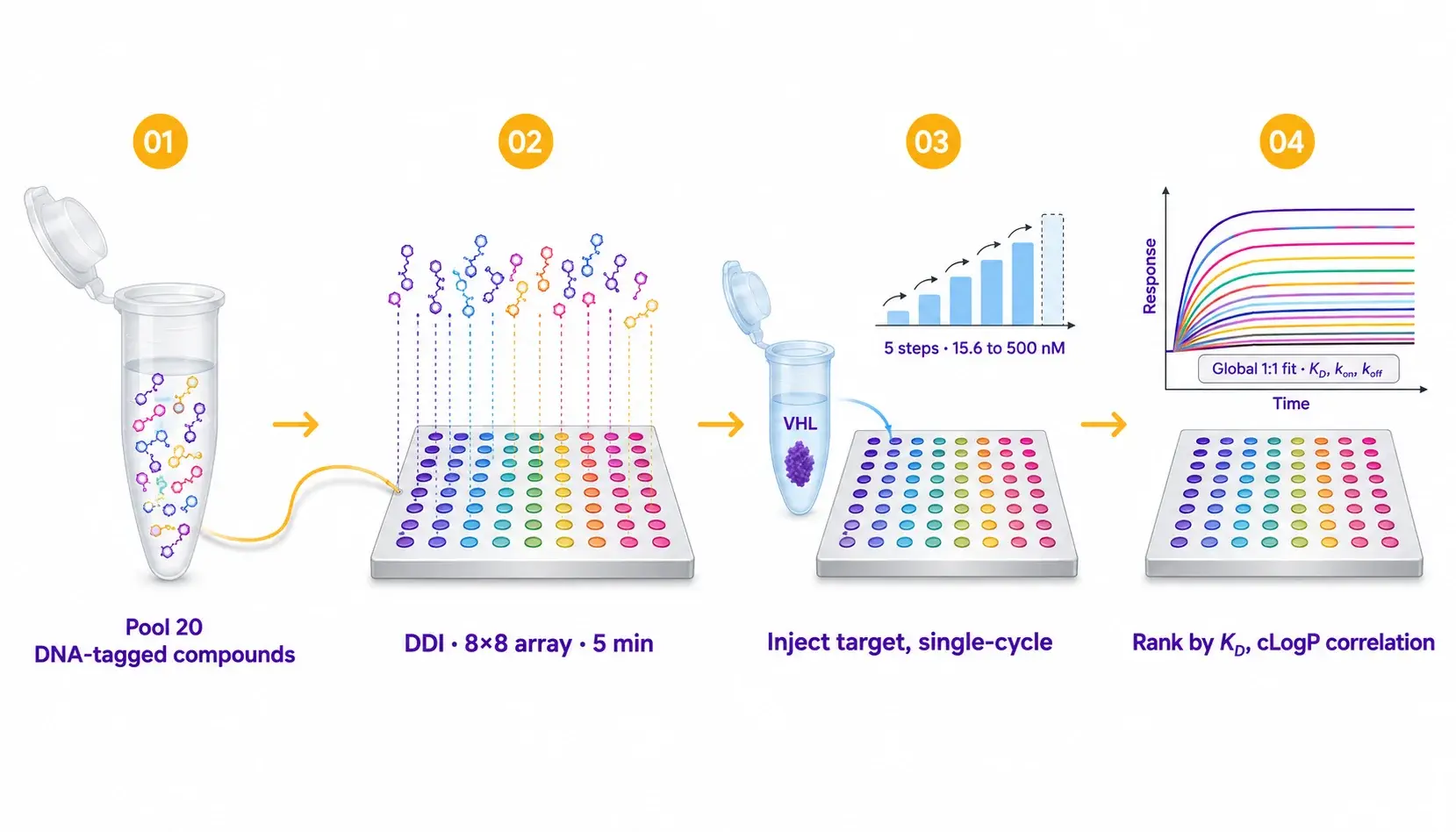
From DNA-tagged compound library to ranked SAR.
The 8×8 mologram array is loaded once via DDI of the pooled compound mix. The target protein (or lysate containing it) is then injected at five ascending concentrations in a single-cycle kinetics format. Both equilibrium and kinetic KD are extracted in the same run, and physicochemical descriptors (cLogP, cLogS, polar surface area) are correlated with binding directly.
 | Protocol details
|