


Profile all seven human Fc receptors on one chip in about one hour.
The Fc Receptor Panel measures FcγRI, FcγRIIa, FcγRIIb, FcγRIIIa, FcγRIIIb, FcεRI, and FcεRII (CD23) in parallel on a single ready-to-use chip. Each receptor has 8 within-chip replicates, and a built-in oligo-only reference spot reports non-specific binding.
7 Fc receptors per chip | 8× Replicates per receptor | ~1h Real-time kinetics across the panel | DDI Pre-conjugated, ready-to-use |
The Fc receptor family and why a single-experiment panel matters.
Activating, inhibitory, and the effector-function profileThe Fcγ receptor family translates antibody binding into cellular effector outputs. FcγRI, FcγRIIa and FcγRIIIa are activating receptors. They drive antibody-dependent cellular cytotoxicity (ADCC), the lysis of antibody-coated target cells by natural killer cells and macrophages. They also drive antibody-dependent cellular phagocytosis (ADCP), the engulfment of antibody-opsonized particles. FcγRIIIb is GPI-anchored and lacks its own intracellular signaling domain; it acts through neutrophils rather than by direct signaling. FcγRIIb is the family's only inhibitory receptor and sets the activating-to-inhibitory ratio that underlies most current Fc-engineering campaigns. FcγRIIa carries the H131/R131 polymorphism and FcγRIIIa carries the V158/F158 polymorphism. Both are clinically relevant variants that alter response rates to rituximab, cetuximab, and other approved IgG therapeutics. Comprehensive analytical data on the full FcγR panel is increasingly expected in regulatory submissions for Fc-engineered IgGs and biosimilar comparability under ICH Q5E. | The IgE branch and immune-complex characterizationTwo further Fc receptors are central to allergy biologics, IgE-format diagnostics, and any program with an IgE arm. FcεRI is the high-affinity IgE receptor on mast cells and basophils that triggers allergic effector function. FcεRII (CD23) is a lower-affinity IgE receptor that regulates IgE production and antigen presentation. Both engage the IgE Fc region directly. Anti-IgE biologics, IgE-format diagnostics, and bispecific or fusion formats with an IgE component all need direct FcεRI and CD23 binding data. Ideally that data is measured side by side with the same molecule's FcγR profile. This panel pairs the activating and inhibitory FcγRs with FcεRI and CD23 on a single chip. A characterization that used to take several platforms and several weeks becomes a one-hour multiplex experiment. |
Sequential SPR runs into walls. The Fc panel is built around them.
Modern antibody engineering tunes the entire Fc-receptor profile, not just one receptor at a time. Regulators increasingly expect comprehensive analytical Fc data across the full receptor family. Generating that data on conventional surface plasmon resonance (SPR) means weeks of per-receptor method development and chip-to-chip variability across the panel. Conventional SPR detects refractive-index changes, so specific binding arrives mixed with non-specific adsorption, buffer artifacts, and temperature drift. Focal molography uses a fundamentally different detection geometry: only specifically bound mass that is spatially coherent with the mologram pattern contributes to the readout. Signal and noise separate by detection geometry rather than by subtraction.
⏱ Multi-week SPR → ~1 hour panel Conventional SPR runs each receptor on its own chip on its own day. MACS® Matchmaker carries FcγRI, FcγRIIa, FcγRIIb, FcγRIIIa, FcγRIIIb, FcεRI, and CD23 pre-conjugated on one 8-plex chip. All seven receptors are measured simultaneously in a single antibody injection series. | ∿ Drift-limited → 8 within-chip replicates FcγRII/III and CD23 sit at micromolar KD, where multi-hour SPR drift accumulates over the long association phases needed to fit them. MACS® Matchmaker reports KD, kon, and koff as the geometric mean over 8 replicate molograms per receptor. That gives confidence intervals from a single experiment and averages drift out across replicates. |
≈ Non-specific binding (NSB) floor → coherent detection floor Sub-twofold biosimilar comparability and Fc-engineered variant ranking depend on differences smaller than the typical NSB floor of SPR. MACS® Matchmaker reads specifically bound mass by detection geometry. Non-specific binding is incoherent with the mologram pattern and does not contribute to the coherent readout. An 8th oligo-only spot is included on every chip as a built-in reference spot. | ⚙ Method dev. per receptor → pre-conjugated, ready Each SPR receptor needs its own immobilization optimization, regeneration screen, and validation cycle. MACS® Matchmaker loads all seven Fc receptors plus the oligo reference onto the chip in about 10 minutes via DNA-directed immobilization. No in-house coupling, no per-receptor method development, one standard regeneration for the whole panel. |
Where the Fc Receptor Panel delivers value.
The same chip and protocol address four distinct workflows across the antibody and immune-complex development process.
Discovery Ranking Fc-engineered candidates Fc engineering tunes the activating-to-inhibitory profile through point mutations in the Fc region. Variants must be ranked across the full receptor family, including the FcγRIIa H131/R131 and FcγRIIIa V158/F158 polymorphisms. For dual-format biologics they must also be ranked against any IgE-related counterbalance. A multiplex panel reveals the whole engineered profile in one experiment per variant. | Biosimilar Comparability Binding equivalence under ICH Q5E Demonstration of FcγR binding equivalence between a biosimilar and its reference is a key element of analytical comparability under ICH Q5E. The affinity differences that must be resolved are often less than twofold, at or below the practical noise floor of conventional surface plasmon resonance. Coherent mass detection plus 8 within-chip replicates is specifically designed for this analytical challenge. |
Mechanistic profiling antibodies, immune complexes, IgE biologics For many programs, the relevant question is not how a single Fc receptor binds. It is how the whole receptor network responds to the same molecular state: free drug, target-bound, antigen-loaded immune complex. The panel captures this state-dependent receptor footprint. It is particularly informative for anti-IgE biologics and bispecific or fusion formats with an IgE component. | Glycoengineering Reading a selective FcγRIII shift The conserved N-glycan at Asn297 sets how strongly an immunoglobulin G (IgG) engages the activating receptors. Removing its core fucose raises FcγRIIIa binding without changing a single amino acid. The effect is receptor-selective: it moves the FcγRIII arm and leaves FcγRI and the FcγRII family close to where they were. A glycoengineering campaign therefore has to demonstrate a pattern across the family, not a single number. The inhibitory arm has to be shown to stay put. The panel reads all seven receptors from one injection series under identical conditions, with 8 within-chip replicates per receptor. The selectivity of the shift is visible in the measurement rather than assembled from separate runs. |
One injection series. Seven receptors. Eight replicates each.
The chip is loaded once with the pre-conjugated Fc-receptor and oligo-only ligand mix via DNA-directed immobilization. Each antibody or immune complex then runs a single ascending-concentration injection series in which all seven Fc receptors and the oligo reference are read simultaneously. One guanidinium regeneration step clears the whole panel between samples, with no per-receptor method development required.
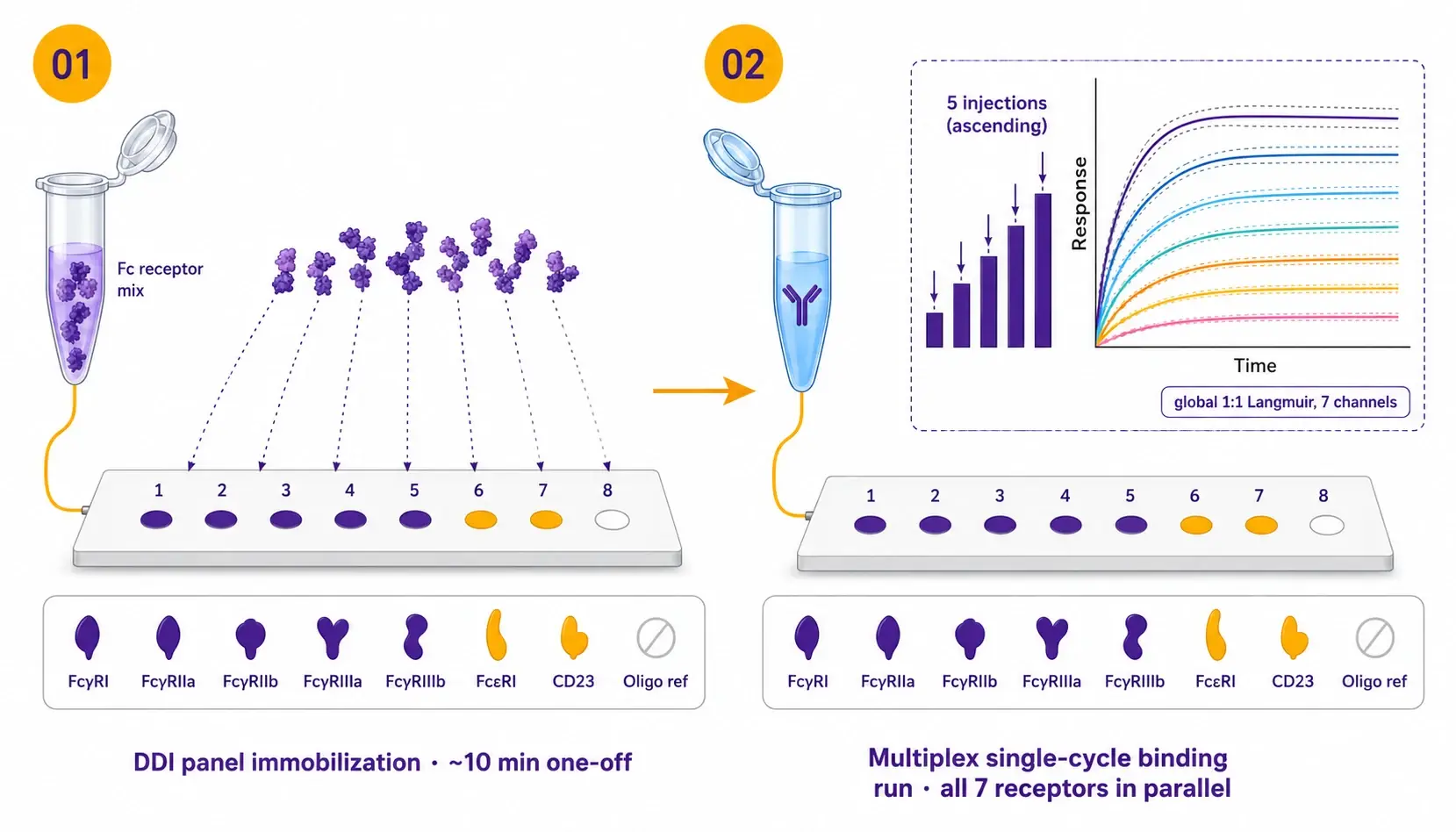 | Protocol details
|
Seven receptors. Eight replicates. One hour.
See the Fc Receptor Panel on a real antibody. Your antibody. Book a 30-minute demo with one of our application scientists.
What makes MACS® Matchmaker the purpose-built solution for this workflow.
7 receptors The seven human Fc receptors in one run FcγRI, FcγRIIa, FcγRIIb, FcγRIIIa, FcγRIIIb, FcεRI, and FcεRII (CD23) profiled under identical assay conditions in the same injection series. This removes the inter-assay variability of sequential chip runs. | 8 replicates Within-chip statistics from a single experiment Sensorgrams from the 8 replicate molograms per receptor are median-aggregated before fitting; the reported KD is the geometric mean across the 8 replicate fits. | ~1 hour Real-time kinetics across the full panel Single-cycle ascending-concentration kinetics on the multiplex chip. One standard guanidinium regeneration clears the panel between antibodies. |
No prep Chips ship pre-conjugated and ready to use The Fc Receptor Panel loads onto the sensor chip in approximately 10 minutes. All seven receptors plus an oligo-only reference hybridize in parallel to their capture strands via DNA-directed immobilization. No in-house coupling, no surface optimization, no batch-to-batch ligand variability. | pg/mm² A direct measurement of specifically bound mass Coherent mass density is not a proxy for binding. It is a direct physical readout of the mass that binds coherently to the mologram pattern. It feeds directly into 1:1 Langmuir kinetic analysis without refractive-index conversion. | Built-in NSB ref Every chip is self-validating An 8th oligo-only construct with no captured Fc receptor occupies one position on every chip. Authentic Fc-mediated signals on positions 1 to 7 should produce no response on this spot: a built-in non-specific-binding integrity check on every run. |
MACS® Matchmaker vs. competing HT-SPR platforms.
High-throughput SPR platforms excel at screening many antibodies against one receptor, a complementary application. The comparison below addresses the multi-receptor Fc-panel workflow specifically.
| Parameter | MACS® Matchmaker | Biacore SPR / Octet BLI / Carterra HT-SPR |
|---|---|---|
| Full Fc panel (FcγR + IgE arm) | ✓ All 7 receptors in parallel, ~1 hour, 1 chip | Sequential, multiple days, multiple chips |
| Replicates per receptor | ✓ 8 within-chip molograms | Not built-in; requires repeat runs |
| Non-specific binding | ✓ Incoherent with the pattern; 8th oligo reference as integrity check | Subtracted via reference channel |
| Signal readout | ✓ Coherent mass density (pg/mm²) | Refractive index units (proxy) |
| Surface preparation | ✓ Pre-conjugated, ready to use | In-house ligand arraying required |
| FcγR allotype coverage | ✓ H131 and F158 on the standard panel; further allotypes configurable per program | Each variant requires its own chip |
| Sub-twofold ICH Q5E resolution | ✓ Coherent detection floor | Constrained by NSB residual |
See the panel resolve a Fab-to-Fc allosteric coupling on a real biologic.
An application note profiles four states of the anti-IgE biologic omalizumab on the Fc Receptor Panel. The states are free omalizumab, free IgE, the binary IgE/omalizumab complex, and the ternary complex with allergen bound. The panel resolves how the receptor footprint shifts from state to state. One IgE receptor interaction persists on the binary complex and switches off once the allergen loads it. Complete dataset, fits, methods and citable references are in the application note.