
Skip to content

search   cart   my account   contact


Validate DEL hits on-DNA, in 90 minutes.

Characterize 54 to 64 hits from a DNA-encoded library (DEL) selection in parallel on a single chip, directly from the selection eluate. No off-DNA resynthesis. No purified target. Full kinetic ranking in one run.

Book a 30-min demo →

Scientific Background

Why on-DNA validation closes the gap that NGS leaves open.

How DEL screening works

A DNA-encoded library (DEL) is a pool of millions to billions of small molecules, each covalently linked to a unique DNA barcode that records which building blocks were used during its combinatorial synthesis. The library is incubated with a target, non-binders are washed away, and the remaining barcodes are amplified by PCR and sequenced by next-generation sequencing (NGS). Enriched barcodes point to the chemical building blocks that produced binders.
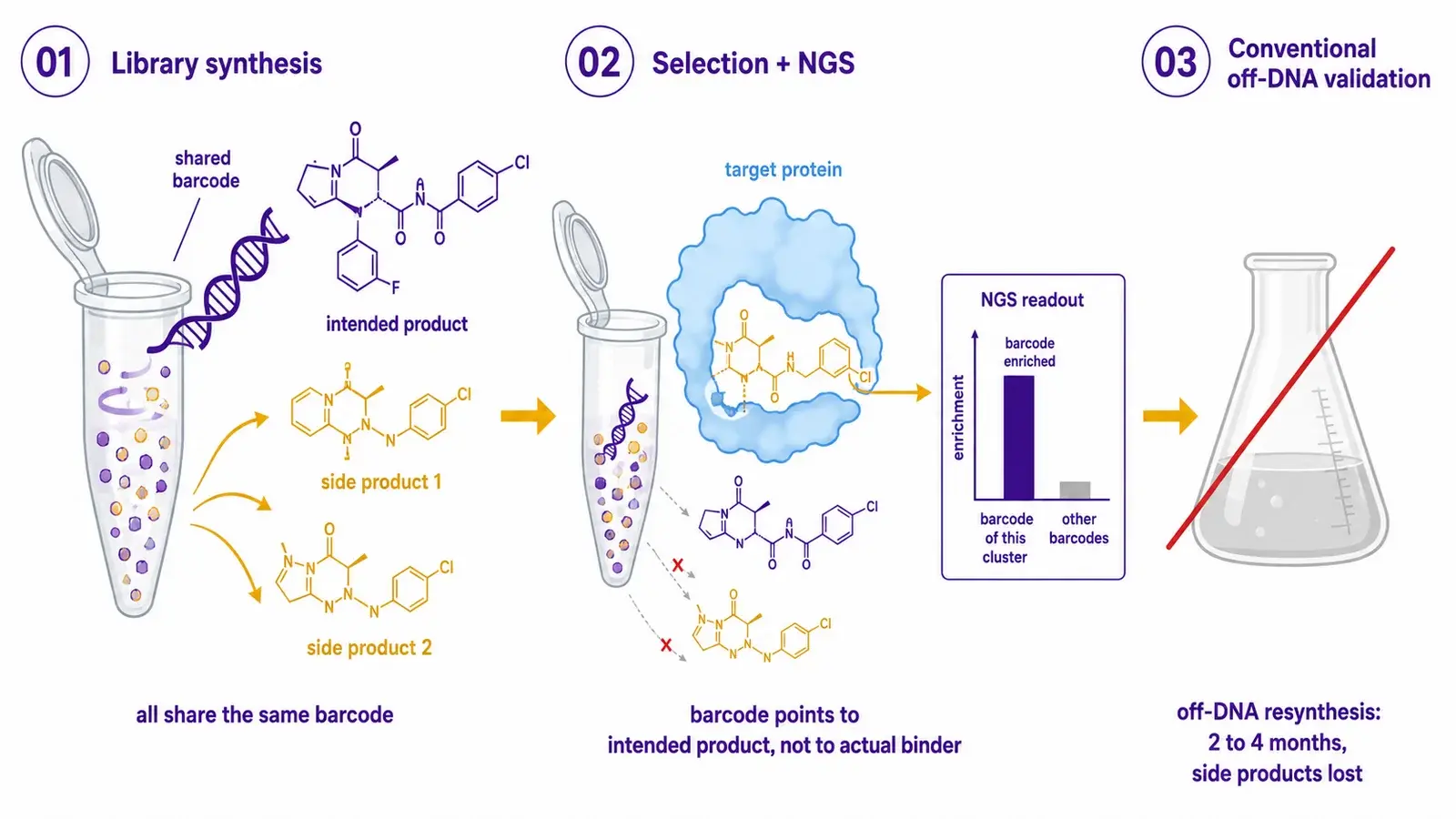
DEL selection: from library pool to enriched barcodes

The barcode encodes the intended product, not the molecule that actually bound the target. All chemical species formed during the same synthesis step share the same barcode: intermediates, side products, on-DNA degradants, and the desired compound. Hit calling from sequencing alone cannot distinguish them.

Why off-DNA resynthesis often misses the real binder

The conventional resolution is off-DNA resynthesis: rebuild the assumed hit by traditional medicinal chemistry, then characterize. The route is fundamentally different from the original library route. Aqueous DNA-compatible chemistry is replaced by organic solvents, different stoichiometries, different reaction times. A different impurity profile is produced, and any side-product binder that drove the original enrichment is silently absent.

Each resynthesis cycle takes 2 to 4 months per compound and costs a chemistry FTE per hit. Attrition rates of 60 to 80 percent are common because many resynthesized "hits" no longer bind, or bind weakly because the actual binding species was a side product that resynthesis failed to reproduce.

The Problem & Our Approach

One chip. 64 hits. Crude eluate. No resynthesis.

DEL hit validation demands many compounds, native DNA tags, and the freedom to measure directly in the messy output of selection. MACS® Matchmaker addresses each constraint by making DNA-directed immobilization (DDI) the native binding step, rather than an off-target afterthought.

Months of off-DNA chemistry → 90-minute panel

Off-DNA resynthesis takes 2 to 4 months per hit. MACS® Matchmaker runs 54 to 64 hits in parallel on a single chip, in approximately 90 minutes, with the original on-DNA construct as the binding partner.

NGS endpoint → full kinetic profile

Sequencing returns enrichment counts. MACS® Matchmaker returns k_a, k_d, and KD for each hit, so true binders, slow-off binders, and enrichment artifacts are separable on kinetic grounds, not on read count alone.

Purified target → crude selection eluate

DDI captures the on-DNA hit on the chip surface; the target itself is the analyte and can be presented in selection buffer, cell lysate, or other crude matrices. No purification, no detergent screen, no immobilization chemistry per target.

Sequence disclosure → IP-protected ligation

The DNA Ligation Kit ligates a generic immobilization adapter to the proprietary DEL barcode without exposing the sequence to the chip vendor. The original barcode never leaves the customer's lab.

Applications in Focus

Where MACS® Matchmaker accelerates DEL discovery.

The same chip and protocol address three workflows that span the full DEL discovery pipeline.

On-DNA hit validation

Confirm enriched DEL hits with full kinetic characterization, directly from selection eluate, before committing medicinal chemistry resources to off-DNA resynthesis. Standard workflow at Philochem (CAIX) and the central use case at large-pharma DEL platforms.

DEL on Cells

Cell-based DEL selection on cell-surface targets (G-protein-coupled receptors, ion channels, tumor antigens) produces hits that interact with native receptor topology. The MACS® Matchmaker measures these on-DNA constructs against KO-controlled cell lysate, preserving the avidity and matrix complexity of the original selection.

On-DNA SAR for adjacent modalities

DNA-tagged PROTACs, peptides, glues, and ADC-DEL constructs share the on-DNA binding-validation problem. Multiplexed kinetics on the mologram array delivers structure-activity feedback before resynthesis. See the PROTAC application page for the linker-SAR workflow.

Workflow

From NGS readout to validated kinetic profile.

The 8×8 mologram array is loaded once via DDI of the on-DNA hit pool, often the selection eluate itself or a focused validation panel. The target protein is then injected in single-cycle kinetics format, and equilibrium plus kinetic KD are extracted in the same run for all spots simultaneously.
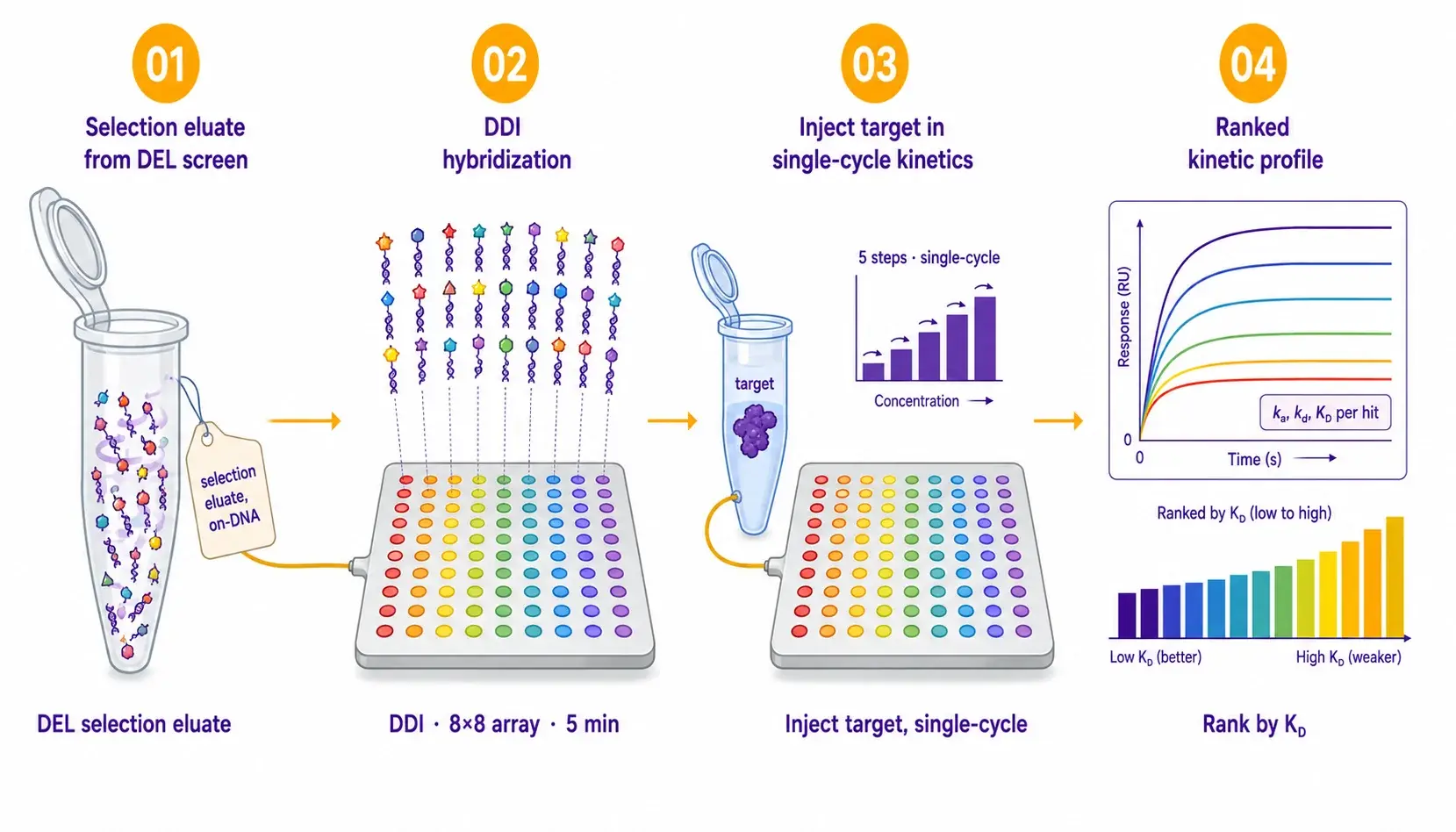
From NGS readout to validated kinetic profile.
Protocol details
  • Total time
    ~90 min
    chip loaded once per panel
  • Compound capacity
    54 to 64 hits per chip
    8×8 mologram array
  • Sample matrix
    Crude selection eluate
    serum, plasma, or cell lysate also supported
  • Throughput
    Up to 1,536 interactions per day
    with the MACS® Sampler add-on

From NGS hit to confirmed binder, in one run.

Send us your selection eluate or a focused on-DNA validation panel. Get k_a, k_d, KD for 54 to 64 hits back in days, not months.

Book a demo →Send my eluate →

Key Capabilities

What makes MACS® Matchmaker the purpose-built platform for DEL hit validation.

54 to 64
Multiplexed channels per chip

DDI writes the entire on-DNA hit panel onto an 8×8 mologram array in a single pooled injection. Each mologram is a fully independent kinetic measurement.

<0.05 pg/mm²/min
Drift-free baseline

Coherent mass detection produces a baseline floor that is independent of bulk refractive-index drift. Low-affinity hits in the µM regime are resolvable in the same run as high-affinity hits in the nM regime.

Crude eluate
Native sample matrix

Selection eluate, cell lysate, serum, plasma, CSF, and urine are all compatible. No target purification or detergent optimization is required because non-specific binding is rejected by detection geometry.

Label-free
DNA tag is the immobilization handle

The on-DNA construct is the native binding partner. No fluorescent or biotin tag is added to the compound, so DNA-tag chemistry and downstream synthetic steps remain untouched.

IP-protected
DNA Ligation Kit

A generic immobilization adapter is ligated to the proprietary DEL barcode in the customer lab. The barcode sequence never leaves the user's premises and is not visible to the chip or the vendor.

1,536/day
MACS® Sampler throughput

The Sampler add-on automates chip loading and analyte injection so 24 chips of 64 measurements each, totaling 1,536 hit-target interactions, can be processed in a single 24-hour campaign.

Platform Comparison

MACS® Matchmaker vs. competing DEL hit validation routes.

ParameterMACS® MatchmakerCarterra HT-SPRBiacore SPRASMS / Off-DNA Resynth
On-DNA compatibility Native, DDI is the immobilizationOff-DNA onlyOff-DNA onlyOff-DNA only by definition
Time per validation cycle ~90 min for 64 hitsHours for 1 panelDays per hit2 to 4 months per hit
Sample matrix Crude selection eluatePurified target onlyPurified target onlyPurified analyte only
Side-product recovery Native (the on-DNA species is the analyte)LostLostLost
Multiplexing 54 to 64 in parallel384 (one ligand panel)4 to 81
Kinetic readout k_a, k_d, KD per hitk_a, k_d, KD per hitk_a, k_d, KD per hitEndpoint, no kinetics
IP / sequence disclosure DNA Ligation Kit, sequence stays in-houseNot applicable (off-DNA)Not applicable (off-DNA)Not applicable
Application Notes

Two peer-quality DEL Application Notes plus the published CAIX case.

The general DEL hit characterization Application Note (2024_1) introduces the on-DNA workflow, kinetic readouts, and the MACS® Matchmaker chip layout. The CAIX collaboration with Philochem (Application Note 2024_3) demonstrates the complete on-DNA validation panel for a clinically relevant tumor target. Both AppNotes include sensorgram libraries, KD distributions, and citable methods.

Request both AppNotes →
FAQ

Questions we hear most often.

Q.Do I really need to skip off-DNA resynthesis?
Not at every stage, but the bottleneck is at the validation step. Off-DNA resynthesis is unavoidable for medicinal-chemistry follow-up, but it is the wrong tool for separating true hits from enrichment artifacts. On-DNA validation lets you discard the artifacts before committing 2 to 4 months and a chemistry FTE per hit.
Q.How does this compare to Carterra HT-SPR?
Carterra HT-SPR runs many compounds against a purified target on a 384-spot array; it is a strong off-DNA platform. MACS® Matchmaker runs the on-DNA construct itself, in selection eluate, and accepts the original barcode without resynthesis. The two platforms occupy adjacent niches: HT-SPR for purified-target screening, MACS® Matchmaker for on-DNA validation in crude matrices.
Q.Can the platform run DEL on Cells (cell-based DEL selections)?
Yes. Cell-based DEL hits typically derive from selections on whole cells or cell lysate, and the validation has to preserve the same matrix complexity. KO-controlled lysate as the analyte against the on-DNA hit panel on the chip is a routine workflow, used at Würzburg (Brunschweiger group) and Bonito Biosciences.
Q.Is my DEL barcode visible to lino Biotech or to the chip vendor?
No. The DNA Ligation Kit ligates a generic immobilization adapter to the proprietary barcode in the customer's lab. Only the adapter hybridizes to the chip; the original barcode sequence is never transmitted, displayed, or stored outside the user's premises.
Q.What kinetics range is accessible?
KD from low picomolar to mid-micromolar in a single panel. Drift-free baseline below 0.05 pg/mm²/min keeps low-affinity hits resolvable in the same run as high-affinity hits, so a focused panel does not require pre-sorting by potency.
Q.Does this also work for adjacent modalities like PROTACs and peptides?
Yes. DNA-tagged PROTACs, peptides, molecular glues, and ADC-DEL constructs all share the on-DNA validation workflow. For PROTAC linker SAR specifically, see the dedicated PROTAC application page.