

On-DNA Kinetics at Philochem: What SPR Cannot Deliver
Concrete kinetic wins at Philochem
Nicholas Favalli is Group Leader in the Chemistry R&D team at Philochem AG, a Zurich-based pharmaceutical company specialized in small-molecule cancer therapeutics. He describes how his team uses focal molography for DEL hit validation.
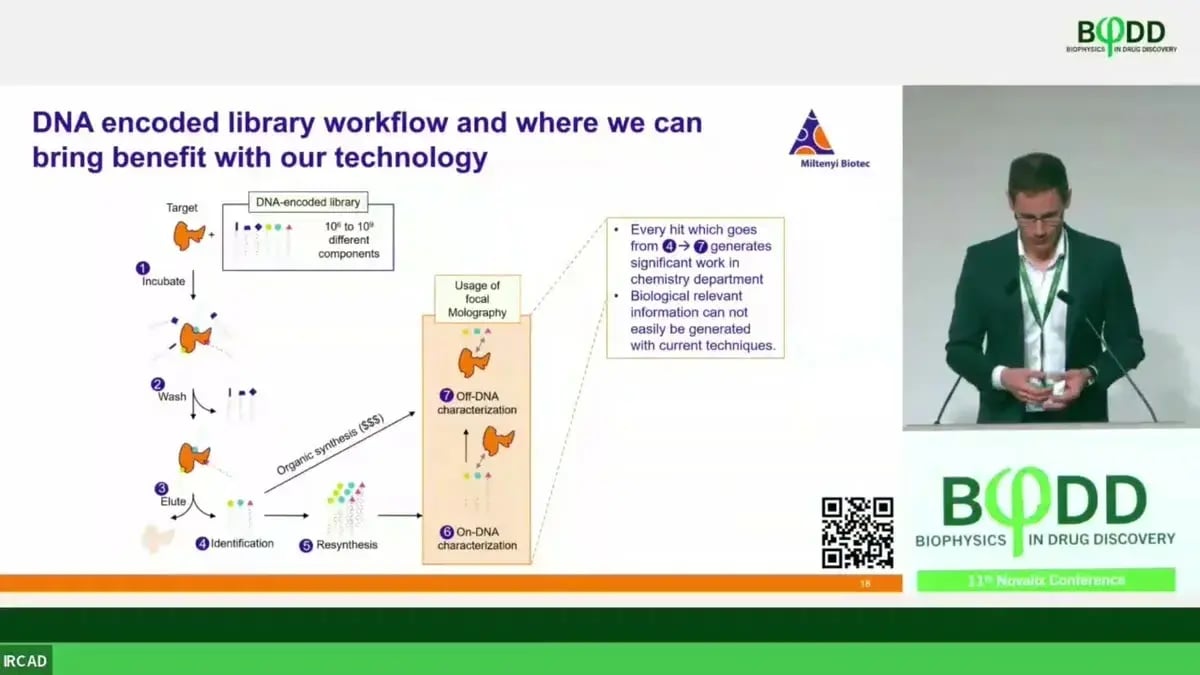
The DEL screening bottleneck
Philochem synthesizes libraries of millions to billions of compounds and screens them via affinity selection against targets of interest. A single selection can return thousands of hits, far too many to synthesize off-DNA, and off-DNA synthesis itself is cumbersome.
Where DNA-tag chemistry breaks conventional methods
On-DNA validation with conventional biophysics runs into two hard problems:
- Fluorescence polarization: dissociation constants (KD) come out a factor of 10 or more higher than the same molecule without DNA. The cause is steric hindrance from the tag.
- Conventional SPR: DNA is negatively charged, so chip immobilization of the compound is unstable. When the protein is immobilized on the chip instead, koff appears much faster because the DNA does not interact well with the chip surface.
Why focal molography solves this
Focal molography exploits the DNA tag for annealing to the chip. The same tag that limits conventional SPR immobilization is now the coupling mechanism. Kinetic parameters kon and koff can be measured directly on-DNA. This delivers kinetic profiles that conventional SPR could not resolve and identifies molecules that fluorescence polarization missed.
Usability in daily practice
Favalli emphasizes that the MACS Matchmaker instrument is very user-friendly. Sample preparation is loading vials with target protein or DNA pool into a rack, and the process is fully automated from there. Focal molography will be an orthogonal methodology at Philochem, complementing the fluorescence polarization and ELISA methods already established in-house.