

The strategic case for on-DNA hit validation
Joshua Alper is a biophysics leader with career experience at small biotechs and large pharma companies. He explains why DNA-encoded libraries (DELs) have become one of the key drivers of modern drug discovery. DELs enable scientists to screen billions of compounds against a single target in one tube, which makes them a very high-throughput screening technology.
Why traditional off-DNA validation slows discovery
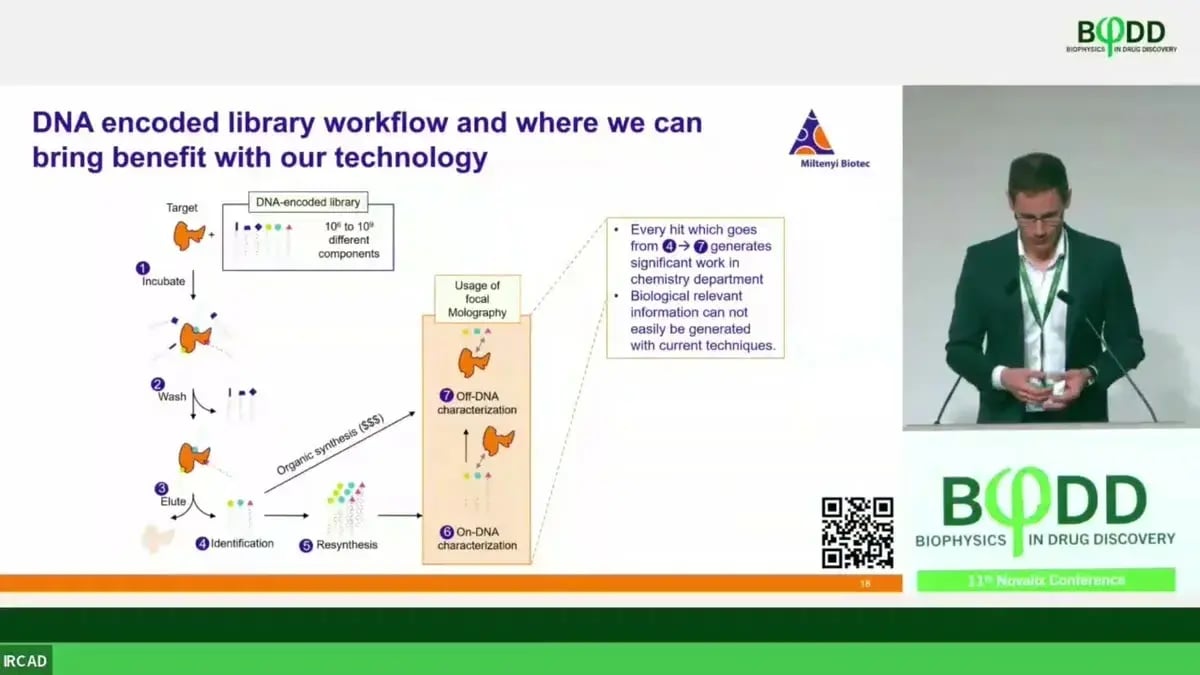
The traditional way of evaluating DEL hits is to synthesize the compounds off-DNA and quantify their binding. This process has real challenges: the library is made on-DNA in aqueous chemistry, but off-DNA synthesis follows a completely different procedure. For medicinal chemists, developing a new synthesis route becomes a long lead-time item that delays the pace of validation.
Why on-DNA binding confirmation matters
When you retain the DNA tag from library synthesis, you can:
- Reuse existing building blocks and known synthesis procedures
- Accelerate validation across many hits by resynthesizing only the single molecule on-DNA
- Flip the SPR geometry: capture the small molecule via the DNA tag and measure the larger protein binding to it. This produces a much larger signal than immobilizing the protein.
Complex-matrix advantage
Traditional SPR techniques struggle with quantitative measurements in cell lysates, blood serum, or on cells. Alper argues that hit assessments should be done in the sample closest to the biological context. Avoiding purification steps that risk protein aggregation raises the likelihood of a successful biophysical readout. Focal molography offers additional promise here as part of a DEL on-DNA binding confirmation workflow.
Looking ahead
As low-hanging drug-discovery targets get used up, less-well-understood targets, often with strong genetic evidence but no known binders, activators, or inhibitors, become the frontier. DELs plus on-DNA binding confirmation provides an avenue to accelerate discovery in this space.