Antibodies are essential in biology and medicine for recognizing, neutralizing, and destroying pathogens. They also serve as key tools in research and diagnostics (ELISA, immunohistochemistry, flow cytometry). Because of their highly specific binding they are widely used in drug development and therapy, particularly monoclonal antibodies for cancer. Their characterization is often done by biomolecular interaction analysis to study drug-target interactions, their kinetics and affinity.
Immobilization of antibodies on the biosensor can be challenging and time consuming. Many times, an antibody needs to be specifically labeled or covalently immobilized on the sensor surface, and this might affect the functionality of them self. Moreover, once immobilized, regeneration of such surface can be difficult and may influence the antibody's binding properties in subsequent assays.
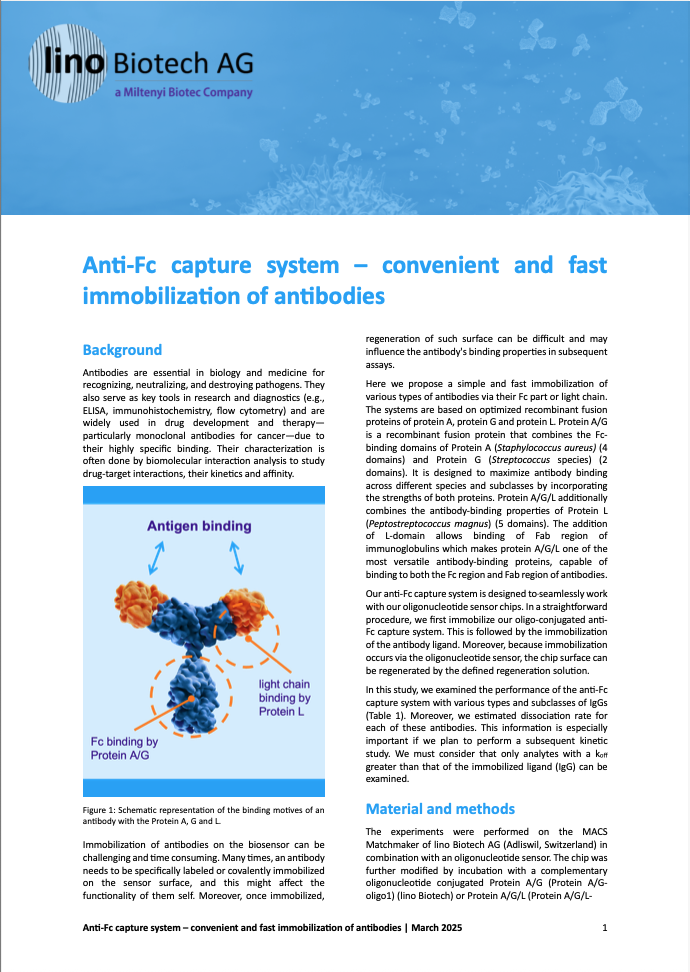
Here we propose a simple and fast immobilization of various types of antibodies via their Fc part or light chain. The systems are based on optimized recombinant fusion proteins of protein A, protein G and protein L. Protein A/G is a recombinant fusion protein. It combines the four Fc-binding domains of Protein A (Staphylococcus aureus) with the two of Protein G (Streptococcus species). It is designed to maximize antibody binding across different species and subclasses by incorporating the strengths of both proteins. Protein A/G/L additionally combines the antibody-binding properties of Protein L (Peptostreptococcus magnus) (5 domains). The added L domain also binds the Fab region of immunoglobulins. That makes protein A/G/L a very versatile antibody-binding protein: it binds both the Fc and the Fab region.
Our anti-Fc capture system is designed to work directly with our oligonucleotide sensor chips. In a straightforward procedure, we first immobilize our oligo-conjugated anti-Fc capture system. This is followed by the immobilization of the antibody ligand. Moreover, because immobilization occurs via the oligonucleotide sensor, the chip surface can be regenerated by the defined regeneration solution.
In this study, we examined the performance of the anti-Fc capture system with various types and subclasses of IgGs. Moreover, we estimated dissociation rate for each of these antibodies. This information is especially important if we plan to perform a subsequent kinetic study. We must consider that only analytes with a koff greater than that of the immobilized ligand (IgG) can be examined.



 Nov 10, 2025
 Jan, 2025
 Jul 2026