


Catch a mismatched biosimilar before you commit to it.
Analytical similarity is normally decided late, in the noise between two separate measurements. This one puts both molecules in the same run, so a difference shows up while changing course is still cheap.
Up to 64 Biosimilar candidates per chip | 1 Commercial benchmark on the same chip | 100% Undiluted plasma or serum | ~30 min Per head-to-head comparison |
What a biosimilar is, and why similarity has to be proven
A copy of a medicine that cannot be copied exactlyWhen the patent on a biological medicine expires, other manufacturers may develop their own version of it. That version is called a biosimilar, and the original it copies is called the reference product or originator. The word "similar" is doing real work here. A small-molecule generic is chemically identical to its original by construction: the same formula gives the same substance. A biological drug is not a small molecule but a large protein, grown in living cells. Two manufacturers using different cell lines, different feed and different purification will never produce something identical atom for atom. Differences in sugar chains, in charge and in how the protein folds are unavoidable. So the regulatory question is never whether the copy is identical. It is whether the differences that remain are small enough not to matter in a patient. | Similarity is measured, not arguedBecause a protein drug cannot be pinned down by a chemical formula, authorities require a head-to-head comparison against the reference product. For Europe and the United States this is laid down in the international guideline ICH Q5E. The package has to show that the two molecules behave the same where behavior decides the outcome: - Target binding, whether the biosimilar grabs its intended target with the same strength - Fc gamma receptor engagement, the contacts that recruit immune cells and drive killing of a target cell - FcRn binding, the neonatal Fc receptor, which recycles antibodies back into circulation and therefore sets how long the drug survives in the body - Higher-order structure, the folded shape of the protein Each of those is its own assay on its own instrument. Every one of them has to be run twice: once on the reference product and once on the candidate. |
Equivalence is decided in the noise between two runs
The differences that matter in a comparability exercise are small. The variability of the methods used to find them often is not.
2 Every error enters twice Measure the originator, then measure the biosimilar, then compare. Chip lot, sensor surface, immobilization density, reference channel, buffer batch, operator and day all enter the comparison twice, once through each measurement. | ± A wider margin, less sensitivity The equivalence test has to accommodate all of that spread. The margin widens, and it blunts exactly the sensitivity the exercise was meant to have. |
½ Sub-twofold is where it matters The differences that decide clinical behavior are the ones most easily buried in inter-run spread. Teams compensate with replicates, which multiplies material, instrument time and analyst effort per lot. | ∞ It never stops Comparability returns at every process change, every scale-up, every site transfer, every new lot, for the life of the product. A slow or material-hungry assay is paid for again and again, and the queue sits on the release path. |
Where conventional methods fall short
None of these are bad methods. They are all built on comparing two separate measurements.
| Method | Limitation for a comparability exercise |
|---|---|
| Surface plasmon resonance (SPR) | Originator and biosimilar occupy different flow cells or different cycles, so chip-to-chip and cycle-to-cycle variability enters the comparison. pH-switch protocols for FcRn add a refractive-index artifact on top of the binding signal. |
| Biolayer interferometry (BLI) | Tip-to-tip variability sets the floor on how small a difference can be called. Throughput limits how many receptors and conditions one package can cover. |
| ELISA and HTRF | Endpoint readouts. Two molecules with the same equilibrium constant but different kinetics read as equivalent. |
| Cell-based potency assays | Functionally meaningful but high variance, slow, and unable to attribute a difference to a specific molecular interaction. |
| Mass spectrometry and peptide mapping | Excellent at primary structure and glycan profile. Blind to whether a detected chemical difference has any consequence for binding behavior in a physiological matrix. |
Where the differential measurement applies
Anywhere the question is whether two molecules are the same, rather than how strong one of them is.
Biosimilar development Support analytical similarity Screen candidate clones and process variants against the reference product early, while switching course is still cheap. Carry the surviving candidate into the full orthogonal package. The null hypothesis of the measurement is the claim itself. | Process change Compare against retained material Site transfers, scale-up, a new cell bank, a changed raw material. Post-change material is compared against retained pre-change reference on the same mologram, so the answer does not depend on reproducing a historical run. | Engineered variants Read the difference on purpose The same construction with the opposite expectation. Here a signal is the desired result. It says the engineering changed binding behavior, and its sign says in which direction. |
Bring us both molecules. We will tell you whether they cancel.
A feasibility study runs the three-configuration protocol on your reference product and your candidate, and returns the differential result with the artifact term separated out.
What is biosimilar comparability testing?
One conclusion, assembled from many separate numbersBiosimilar comparability testing is the analytical demonstration that a follow-on biologic behaves like its reference product. Today that demonstration is assembled from separate measurements on separate instruments. The conclusion rests on showing that two independently measured numbers fall inside an agreed equivalence margin. That construction is what this page is about. It is not wrong, but it spends its sensitivity on reconciling measurements rather than on the molecules. | What focal molography changesA mologram is not a spot. It is a submicron pattern of ridges and grooves. The quantity it reports is coherent: it is built from the difference in bound mass between the two. Place one molecule on the ridges and the other in the grooves, and the two are compared physically rather than arithmetically. The measurement asks one question directly: is there anything here that does not cancel? |
How the differential mologram works
Both molecules are loaded by DNA-directed immobilization (DDI). The ridges carry a multiplexed sequence, the grooves carry the chip-wide backfill sequence. Three configurations are measured, and reading them together separates a real molecular difference from an immobilization artifact without requiring either to be absent.
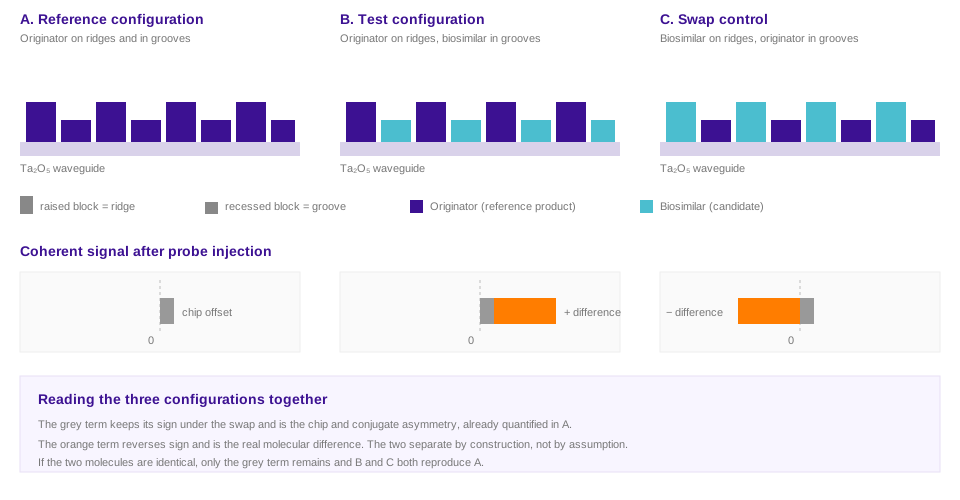 | Protocol details
|
Protocol details
Everything the comparison needs, on the instrument and the consumables you already run for target binding.
| Parameter | Value |
|---|---|
| Immobilization | DNA-directed immobilization (DDI). The ridges carry a multiplexed sequence, the grooves carry the chip-wide backfill sequence, so the reference product sits under every mologram on the chip. |
| Conjugation | Both molecules are prepared as oligonucleotide conjugates with the AminoLink or ThioLink conjugation kit, the standard DDI preparation step. |
| Sensor | Oligo|Oligo, the sensor configuration built for complex biological matrices. |
| Configurations per comparison | Three: A reference (originator against itself), B test (originator against biosimilar), C swap (biosimilar against originator). |
| Probe | Supplied by you. lino Biotech does not sell a probe panel for this assay. Useful choices are the intended target and structurally related family members, which rule out cross-reactivity. Biological matrices such as cell lysate, plasma, serum or other patient-derived fluids are a third option. |
| Total time | Approximately 30 minutes per head-to-head comparison: about 10 minutes of DDI immobilization plus a 10 to 15 minute analyte injection. |
| Material per molecule | 100 µL at up to 500 nM, per molecule and per configuration. For a 150 kDa IgG that is on the order of 7.5 µg. The concentration is chosen so the DDI immobilization runs quickly. |
| Readout | Coherent mass density in pg/mm² as the differential term, with kon and koff of the difference where the kinetics resolve. |
| Smallest resolvable difference | Being characterized. The readout resolves mass differences far below the level at which a comparability exercise makes decisions. In practice the floor is therefore set by how reproducibly the two molecules are immobilized, not by the sensor. It is established for your specific molecule pair in the feasibility study. |
| Chip capacity | Up to 64 molograms, so up to 64 candidates against the one immobilized reference. |
A null measurement, not a comparison of two numbers
Null test Zero is the expected result Detecting a small signal is easier than resolving a small difference between two large numbers. Identity is read as absence: the measurement expects zero and reports any departure from it. | Referencing Common-mode noise cancels physically Ridges and grooves sit micrometers apart and experience the same temperature, bulk refractive index and matrix at the same instant. Drift and lot effects act on both sides and drop out of the coherent term. | Single run One injection, one answer No second run to align, no reference channel to subtract in software, and no inter-run variance term to carry into the equivalence statistics. |
Matrix Undiluted plasma and serum Focal molography rejects matrix noise intrinsically, so the probe can be a physiologically relevant fluid rather than a buffer chosen to keep the sensor quiet. | Probe-agnostic Any probe, same logic The construction does not depend on knowing which interaction to interrogate. The question is whether the two molecules respond identically to whatever is injected. | Tolerance An imperfect chip still answers Configuration A measures the chip's own asymmetry first, so the criterion is an unchanged signal rather than an absolute zero. Manufacturing tolerance stops gating the result. |
What the measurement can and cannot tell you
What it answersWhether the candidate and the reference product respond identically to the injected probe, in a single physical measurement, and in which direction any difference goes. It is a screen with high sensitivity to difference. Its strength is that a negative result is informative rather than merely uninformative. | What it does not answerIt does not attribute a detected difference to a structural cause. A non-cancelling signal says the two molecules are not equivalent to the probe, not which residue, glycan or charge variant is responsible. Attribution remains the job of mass spectrometry, peptide mapping and glycan analysis. For research use only. Not for diagnostic or therapeutic procedures. |
Differential mologram versus separate-measurement comparability
The comparison addresses the head-to-head comparability workflow specifically, not binding characterization in general.
| Parameter | MACS Matchmaker, differential mologram | SPR, BLI, ELISA, separate measurements |
|---|---|---|
| What is measured | ✓ The difference between the two molecules, directly | Two independent values, compared afterwards |
| Inter-run variability | ✓ Does not enter, both molecules are in the same run | Enters twice and widens the equivalence margin |
| Reference subtraction | ✓ Physical, at submicron distance | In software, from a separate channel or cycle |
| Expected result at identity | ✓ No coherent signal | Two numbers inside a margin |
| Artifact separation | ✓ Built into the protocol via the swap control | Addressed by replication and controls |
| Matrix | ✓ Undiluted plasma or serum | Buffer, diluted or depleted matrix |
| Attribution of a difference | ✓ Not provided, orthogonal methods required | Not provided either, same limitation |
| Regulatory precedent | ✓ New construction, no established pathway | SPR is the entrenched reference method |
Related applications and further reading
The differential measurement sits alongside the receptor panels used in the same comparability package.
Fc Receptor Panel Effector-function comparability Seven Fc gamma receptors and FcRn on one chip, with the allotype variants that comparability packages ask for. The natural companion when the question moves from "are they the same" to "which receptor differs". Open the Fc Receptor Panel | FcRn Species Panel PK bridging across species FcRn binding at pH 6.0 and pH 7.4 across the preclinical species, without the refractive-index artifact that pH-switch protocols introduce on other platforms. Open the FcRn Species Panel | Plasma Protein Binding Stickiness in undiluted plasma The same undiluted-matrix workflow applied to off-target plasma binding, for candidates that need a PK-liability readout rather than a head-to-head comparison. Open Plasma Protein Binding |
Frequently asked questions
Two molecules. One mologram. One answer.
Send us your reference product and your candidate, and we will run the differential comparison on the MACS Matchmaker.