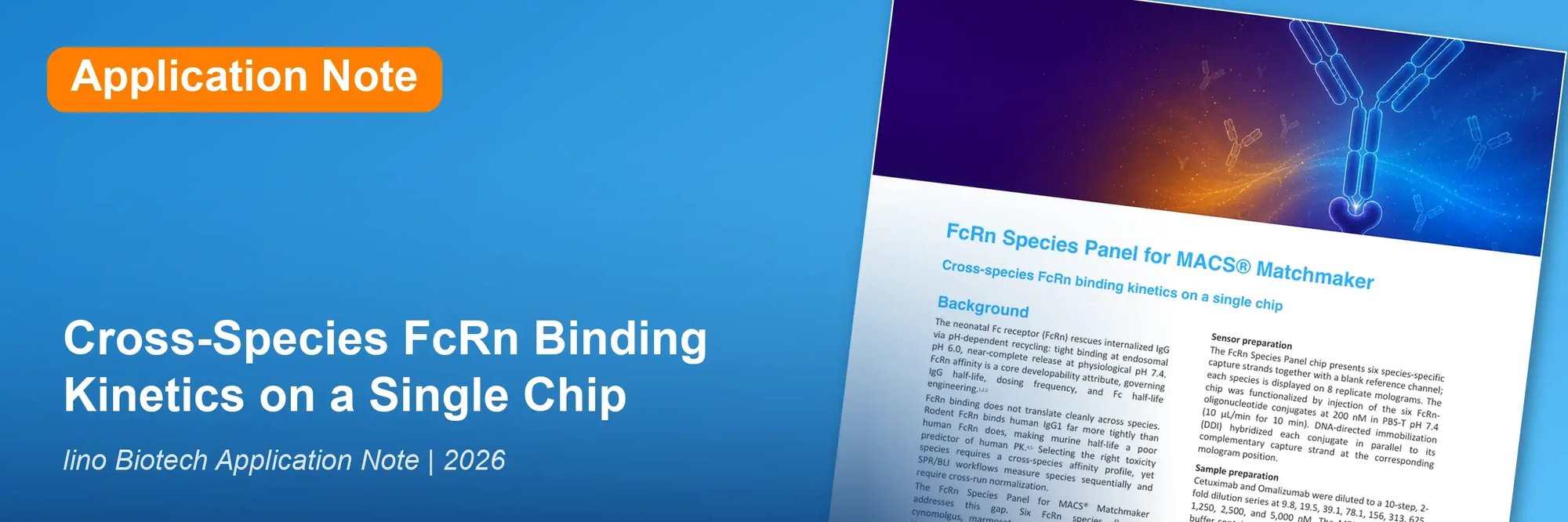
The FcRn Species Panel for MACS® Matchmaker resolves cross-species FcRn binding kinetics for therapeutic IgG1 antibodies across six species on a single focal molography chip, from one concentration series per pH.
The Challenge
The neonatal Fc receptor (FcRn) sets the half-life of IgG antibodies through pH-dependent recycling: it binds IgG in the acidic endosome (pH 6.0) and releases it back into circulation at physiological pH (7.4). Cross-species FcRn affinity is a core developability attribute, and it is what lets pharmacokinetics measured in preclinical species translate to humans. Rodent FcRn binds human IgG1 more tightly than human FcRn does, so species selection matters, yet conventional SPR and BLI workflows measure one species at a time and require cross-run normalization.
The Approach
FcRn ectodomains from six species (human, cynomolgus, marmoset, rat, minipig, and mouse) plus a blank reference channel were co-immobilized via DNA-directed immobilization (DDI) onto spatially encoded molograms, eight replicate molograms per species on one regenerable chip. Two IgG1 antibodies, Cetuximab and Omalizumab, were run as single-cycle-kinetics (SCK) dilution series at pH 6.0 (binding) and pH 7.4 (release).
Key Results
- Six species on one chip: the full species panel plus a blank reference is measured in a single run, with eight replicate molograms per species giving within-chip statistics.
- pH-dependent recycling captured: strong binding at pH 6.0 and near-complete release at pH 7.4, the hallmark of FcRn-driven IgG recycling, resolved on the same chip.
- Cross-species affinity resolved: at pH 7.4, cynomolgus FcRn bound Cetuximab with a KD near 3.9 µM and rat, minipig, and mouse fell between 0.6 and 1.8 µM, while human and marmoset showed no saturable binding (KD > 5 µM).
- Species-translation insight: rodent FcRn retains measurable IgG1 binding at physiological pH where human FcRn does not, flagging the gap that undermines naive PK extrapolation from rodent models.
- One series per pH: full kinetics come from a single SCK concentration series per pH, with no cross-run normalization between species.
Why It Matters
FcRn affinity governs IgG half-life, dosing frequency, and Fc half-life engineering, and mismatched cross-species affinity is a common reason preclinical pharmacokinetics fail to translate. By reading out all six species within one chip and one experiment, the FcRn Species Panel lets antibody engineers rank species and Fc variants at the scale developability screening demands.
lino Biotech Application Note, 2026. FcRn Species Panel for MACS® Matchmaker: cross-species FcRn binding kinetics on a single chip.



 Jun, 2026
 Jun, 2026
 May 28, 2026