


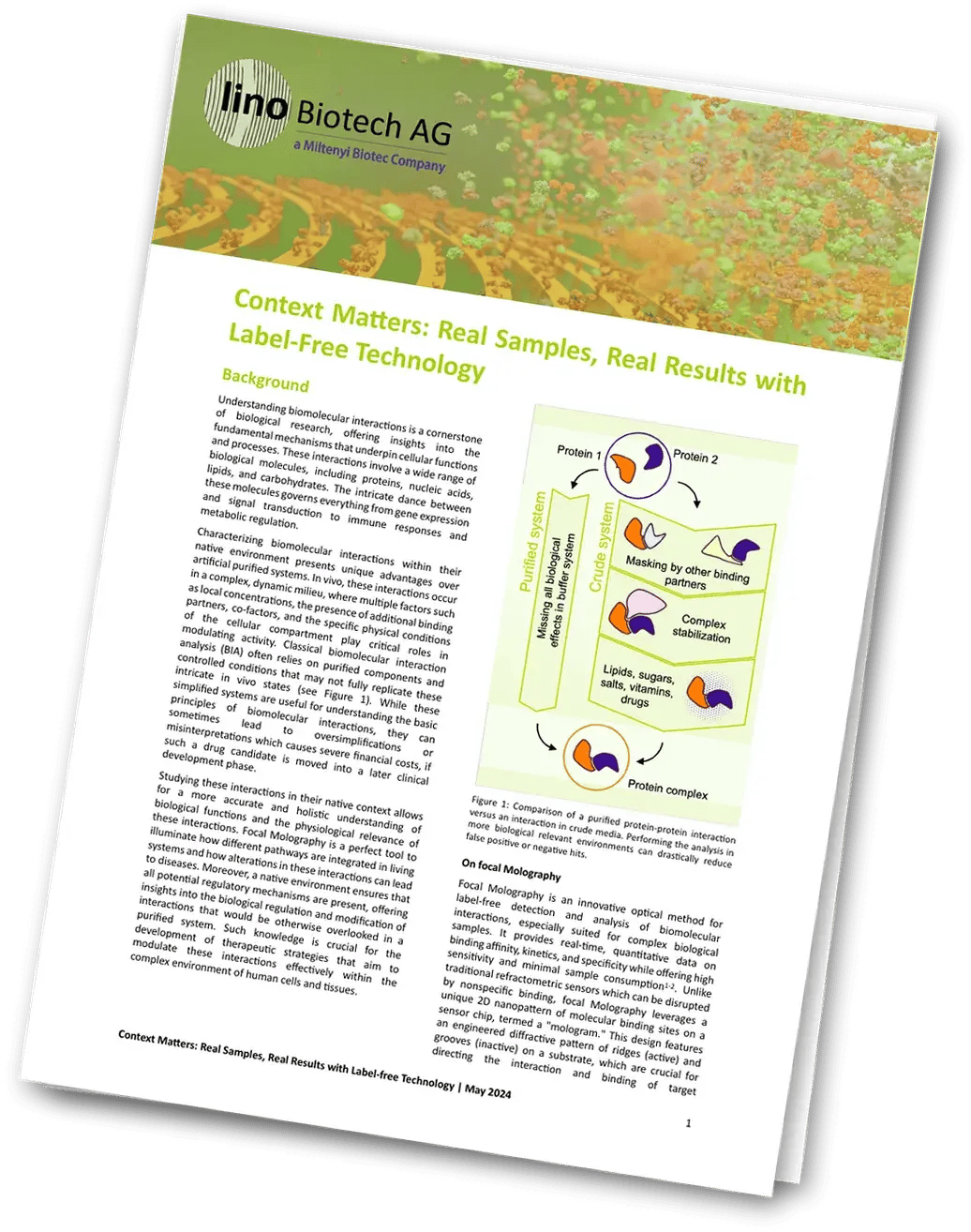
Context Matters - Real Samples, Real Results with Label-free Technology
Comparable kinetics in PBS-T buffer and human serum, label-free with focal molography
Get the application noteFocal molography measures binding kinetics directly in 50% human serum, label-free, with results comparable to PBS-T buffer. This application note shows it with an anti-GFP nanobody (VHH) binding to GFP.
The Challenge: Purified Systems Miss the Native Context
Classical biomolecular interaction analysis relies on purified components. In vivo, local concentrations, additional binding partners, co-factors, and physical conditions all change how an interaction behaves. Data from simplified systems can lead to misinterpretations, and these become expensive when a drug candidate moves into later clinical development.
The Approach: Same Kinetic Assay in Buffer and Human Serum
An anti-GFP VHH was immobilized by DNA-directed immobilization (DDI) on a sensor chip with 54 molograms. An inactive VHH mutant was backfilled into the grooves of the molograms to prevent ordered non-specific binding. Single-cycle kinetics with 0.125 to 32 nM GFP were run in PBS-T and in 50% human serum under identical conditions. The data were fitted with a Langmuir 1:1 model.
Key Results in PBS-T and 50% Human Serum
- Affinity holds in serum: KD of 1.2 nM in PBS-T and 2.6 nM in 50% human serum.
- Kinetics stay close: kon values are very similar. koff is slower in PBS-T, which could be caused by serum components associating with the target.
- Sensitive in serum: limit of detection of 90 pM in PBS-T and 130 pM in 50% human serum.
- Replicates: kinetic parameters from 54 sensorgrams, with three low-signal outliers removed from the serum data, and the limit of detection from 18 sensorgrams per condition.
Why It Matters for Drug Discovery
Only molecules bound in the ordered pattern of the mologram contribute to the signal. Random binding to the sensor surface and changes in buffer composition are invisible to the detection principle. Measuring in a more biologically relevant environment can reduce false positive and false negative hits.
More from our resource library you may like
 Oct 2026
High-throughput thermodynamic fingerprinting of protein–ligand interactions by DNA-directed focal molography
Oehninger, J., Notova, S., & Frutiger, A. (2026). PLOS One, 21(10), e0354008. https://doi.org/10.1371/journal.pone.0354008
Download after a short form
 Oct 2026
Same target, different stickiness: polyreactivity of therapeutic antibodies
Six clinical antibodies, including two same-target pairs, ranked by polyreactivity against an eight-ligand panel on one focal molography chip. Briakinumab scored 69-fold above ...
Download after a short form
 Oct 2026
One on-DNA ligand against many targets: selectivity profiling for DEL hit validation
On-DNA oncoFAP profiled against human, mouse and canine FAP and five unrelated proteins on one focal molography chip layout. Full kinetics on every species variant, flat responses ...
Download after a short form