


Ultra-Stable Molecular Sensors by Sub-Micron Referencing and Why They Should Be Interrogated by Optical Diffraction—Part I. The Concept of a Spatial Affinity Lock-in Amplifier

Frutiger et al. introduce the spatial affinity lock-in, a design principle for sensitive molecular sensors even without any stabilization. Part I gives the theory, and Part II shows the experimental demonstration.
The Challenge: Why Label-Free Sensors Need Stable Conditions
Label-free optical biosensors such as surface plasmon resonance (SPR) are sensitive and well established. Yet they need stabilization and constant conditions, even with reference channels. The paper uses tools from signal processing to explain this cross-sensitivity.
The Approach: From the Time-Domain Lock-In to a Spatial Lock-In
The spatial affinity lock-in is analogous to the well-established time-domain lock-in. Instead of a signal in time, it modulates the binding signal at a high spatial frequency. This separates binding from low spatial frequency environmental noise in Fourier space.
Key Findings of the Spatial Affinity Lock-In Concept
- Separation in Fourier space: binding signal and environmental noise sit at different spatial frequencies, so they can be told apart.
- Diffraction as readout: direct sampling in Fourier space through diffraction has advantages over sampling in real space, as SPR sensors with distributed reference do.
- Universal principle: the concept applies as a general design rule for sensitive molecular sensors.
Why It Matters for Sensor Design
The concept explains the working principle behind diffractometric biosensors. The authors suggest that simple, miniaturized and non-stabilized sensors might reach the performance of large laboratory instruments. This could open new uses in label-free analysis of molecular binding.
More videos and webinars
 23:26
Sep 2026
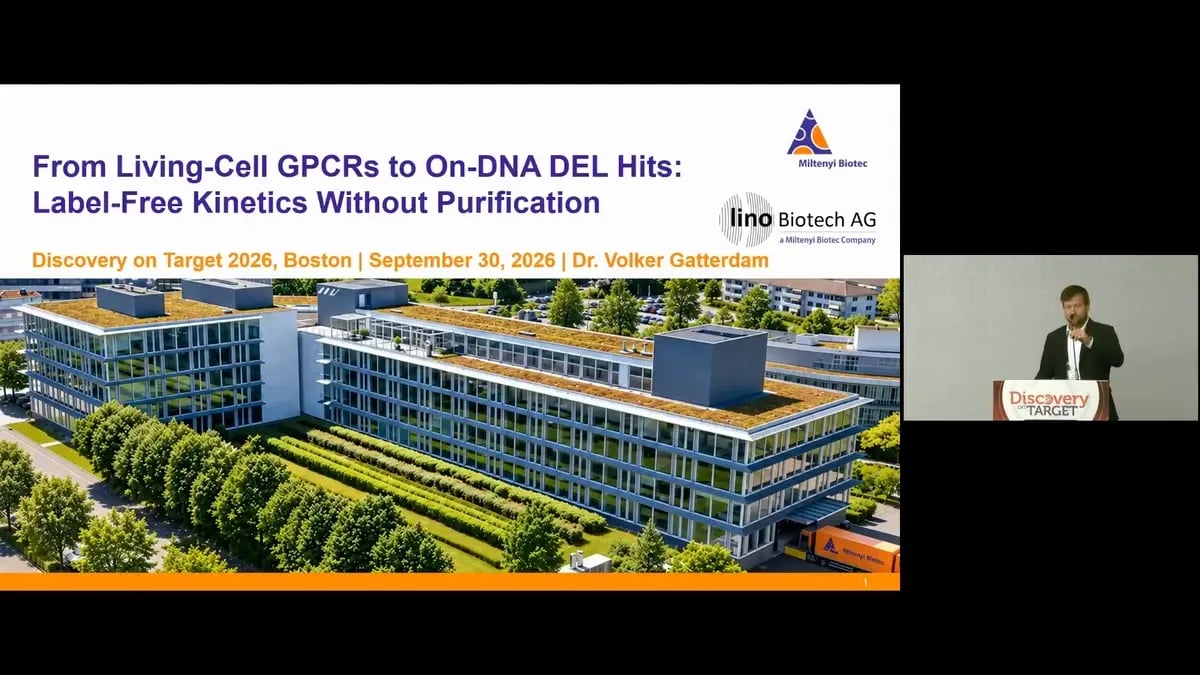
Discovery on Target 2026: From Living-Cell GPCRs to On-DNA DEL Hits
Dr. Volker Gatterdam
Label-free kinetics on GPCRs in living cells and on-DNA validation of DEL hits, measured in crude matrices without purification. Recorded at Discovery on Target 2026 in Boston.
 14:19
Sep 9, 2026
Development of an Fc-Capturing Protein for High-Throughput Screening at Miltenyi Biotec
Artem Siemens
Recorded at the 3rd focal Molography User Meeting, Artem Siemens (Miltenyi Biotec) shows how a homodimeric capture nanobody, immobilized by DNA-directed immobilization (DDI), ...
Watch after a short form
 31:56
Sep 9, 2026
Focal molography for the Fc receptor profiling of therapeutic anti-IgE antibodies
Dr. Paul Engeroff
A multiplex Fc receptor panel on focal molography maps where omalizumab, ligalizumab and their immune complexes with IgE and allergen bind, across all human Fc gamma and IgE ...
Watch after a short form