


The definition and classification of biosensors were discussed in our previous blog post “What is a Biosensor?”. But what exactly is a biosensor used for? Read more about the following two examples of label biosensors.
Label-based Biosensor: The Pregnancy Test
A well-known example of a label-based biosensor is the pregnancy test. It is a particular implementation of a so-called lateral flow assay, LFA. It is a masterpiece of simplicity and accuracy, with a reported 99 percent. Few biosensors match that. Its success is mainly based on that it reports only a yes-no answer (pregnant vs non-pregnant) and no exact quantification is required.
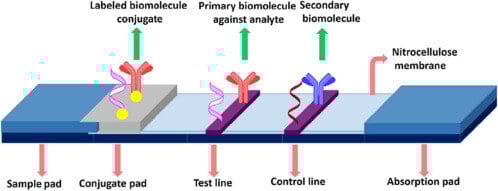
The pregnancy test or any lateral flow assay is composed of three areas, each of which with its own function. When a pregnant woman’s urine is applied to the test, it first travels to the reaction zone by capillary forces. There, a hormone produced only in pregnancy, hCG (human chorionic gonadotropin), binds to antibodies specific to that hormone. These antibodies have an enzyme (horseradish peroxidase, HRP) attached to them. Once hCG has bound to these antibodies, the sample with the hCG-antibody complex travels on along the strip to the test zone.
There, the hCG-antibody complex binds another antibody also specific for hCG. This antibody has a coloring agent attached to it; typically, it is a gold nanoparticle (colloidal gold is typically reddish in color). Once both antibodies have bound hCG, the HRP enzyme on the first antibody activates the coloring agent. The signal is amplified enzymatically and a color change appears: the first line on the pregnancy test. The last zone through which the sample flows through is the control zone. There, any free (unbound) antibodies are bound by a third antibody with a dye molecule. When binding occurs, the second strip appears, thus confirming the positive result and that the test wasn’t faulty.
Go to How do pregnancy tests work? – Tien Nguyen for an animated explanation of the pregnancy test.
Did you know? Gold nanoparticles, used as a coloring agent in the pregnancy test, are not a modern invention. In fact, gold nanoparticles were used already during medieval times: to color glass windows in churches. Trapped gold nanoparticles in a glass matrix create a ruby color.
The Glucose Meter
As the name suggests, the glucose monitor is a biosensor that monitors glucose levels in the blood. More precisely, it measures the amount of glucose in a person’s blood at a given time point.
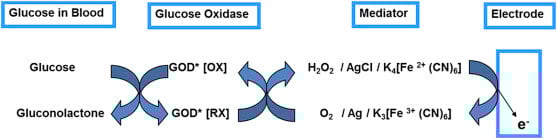
The glucose meter senses glucose (the compound of interest, or analyte) by using an enzyme that naturally reacts to it: glucose oxidase. When a drop of blood is applied to a glucose strip, the glucose in the sample reacts with the glucose oxidase in the strip. The strip itself is pushed into the insertion in the glucose meter, where it is in contact with an interface with an electrode. As glucose and glucose oxidase react, the electrons formed in the reaction generate an electric current (see figure). The electrode senses this current. The glucose meter then shows a number on its display, which corresponds to the strength of the electric current sensed by the electrode.
Did you know? The glucose monitor, otherwise referred to as the “glucometer”, was the first biosensor ever invented. Its technology is attributed to Leland Clark who began working on the oxygen electrode in 1956 and Anton H. Clemens who later developed the device.
References
- MIT School of Engineering, » How do glucometers work?
- Koczula, K.M. and Gallotta, A., 2016. Lateral flow assays. Essays in biochemistry, 60(1), pp.111-120.
- Bahadır, E.B. and Sezgintürk, M.K., 2016. Lateral flow assays: Principles, designs and labels. TrAC Trends in Analytical Chemistry, 82, pp.286-306.