


Characterizing small molecule hits from DNA-encoded library screenings by focal molography
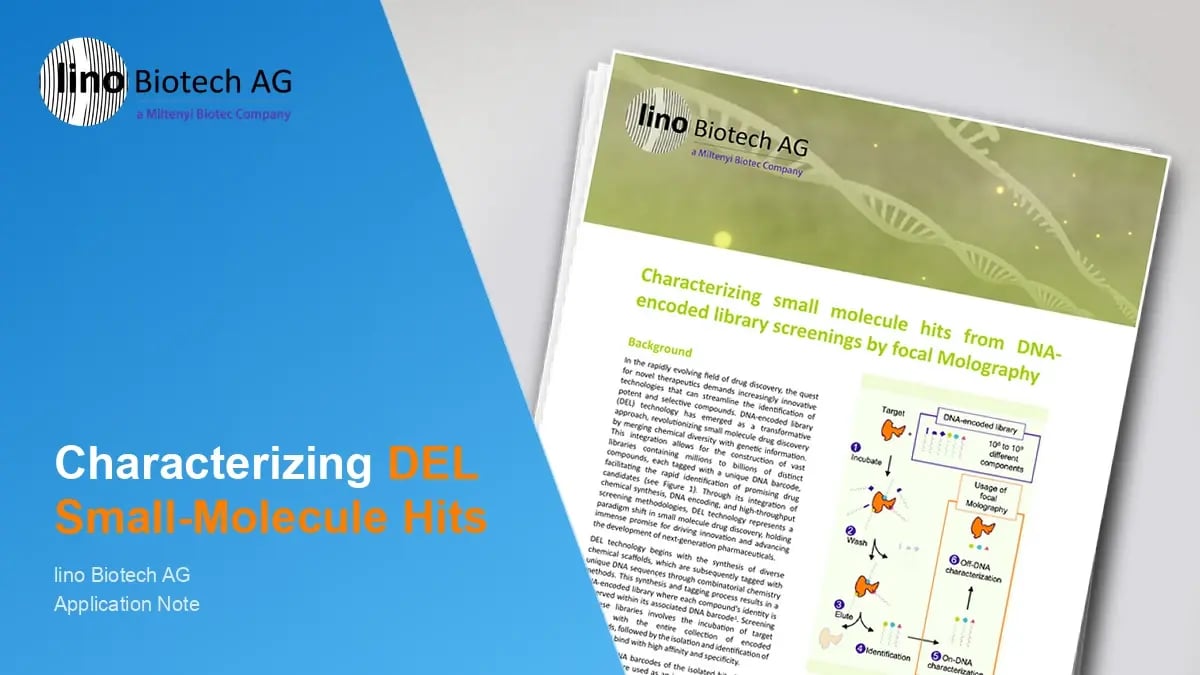
Focal molography uses the DNA barcode of a small molecule as its immobilization tag. DNA-encoded library (DEL) hits can therefore be measured directly on the sensor chip. This application note shows the workflow with biotin and desthiobiotin as model compounds.
The Challenge: Characterizing DEL Hits After the Screen
A DEL holds millions to billions of compounds, each tagged with a unique DNA barcode. A screen finds the binders, but it does not give their kinetics. Hits are then usually made by off-DNA synthesis and tested one at a time for affinity and activity.
The Approach: DNA-directed Immobilization and Single-Cycle Kinetics
The sensor chip carried 20-base-pair oligonucleotides. Complementary strands with biotin or desthiobiotin (300 nM, 10 minutes) were captured by DNA-directed immobilization (DDI). Single-cycle kinetics in PBS-T used streptavidin up to 10 nM and monovalent streptavidin up to 1000 nM. The data were fitted with a Langmuir 1:1 model, and the sensor chip could be regenerated with 50 mM NaOH.
Key Results for Biotin and Desthiobiotin Binding
- Biotin and streptavidin: KD of 4.9 × 10⁻¹⁶ M, in line with the literature value of 10−16 M. No dissociation was visible, and at this affinity the sensorgram may not fit the model perfectly.
- Desthiobiotin and streptavidin: KD of 2.6 × 10⁻¹¹ M with a detectable dissociation rate, in line with the literature value of 10−11 M.
- Biotin and monovalent streptavidin: KD of 6.8 × 10⁻⁸ M, a much weaker interaction than with tetravalent streptavidin.
- Stable DDI layer: the signal changed by less than 1 pg/mm² during a wash of more than four hours at 250 µL/min.
Why It Matters for DEL Hit Validation
A sensor chip with 54 molograms can take up to 54 uniquely barcoded DEL hits in a single injection. One titration series of the target protein then gives kon, koff and KD for all of them. Off-target binding can be checked by injecting protein mixtures, tissue extracts, cell lysates or sera.
More resources
 Oct 2026
High-throughput thermodynamic fingerprinting of protein–ligand interactions by DNA-directed focal molography
Oehninger, J., Notova, S., & Frutiger, A. (2026). PLOS One, 21(10), e0354008. https://doi.org/10.1371/journal.pone.0354008
Download after a short form
 Oct 2026
Same target, different stickiness: polyreactivity of therapeutic antibodies
Six clinical antibodies, including two same-target pairs, ranked by polyreactivity against an eight-ligand panel on one focal molography chip. Briakinumab scored 69-fold above ...
Download after a short form
 Oct 2026
One on-DNA ligand against many targets: selectivity profiling for DEL hit validation
On-DNA oncoFAP profiled against human, mouse and canine FAP and five unrelated proteins on one focal molography chip layout. Full kinetics on every species variant, flat responses ...
Download after a short form