


Anti-biotin capture system: fast and easy solution for the immobilization and characterization of your biotinylated ligands
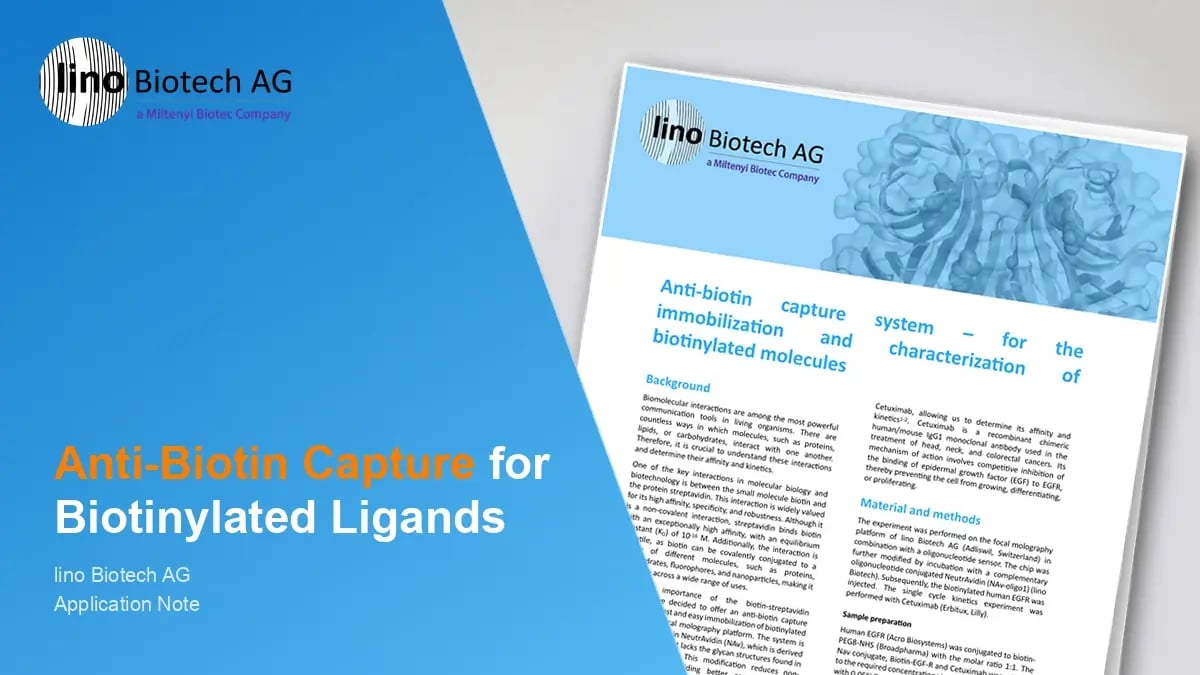
The anti-biotin capture system immobilizes biotinylated ligands on an oligonucleotide sensor chip through oligo-conjugated NeutrAvidin. This application note tests it with biotinylated human epidermal growth factor receptor (EGFR) and the therapeutic antibody cetuximab.
The Challenge: Fast Immobilization of Biotinylated Ligands
Biotin can be coupled to proteins, carbohydrates, fluorophores and nanoparticles, which makes it a practical handle for many ligands. For kinetic work, the capture layer must be simple to build and give a controlled ligand density. NeutrAvidin lacks the glycan structures of the original protein, which reduces non-specific binding.
The Approach: NeutrAvidin Adapter, Biotinylated EGFR and Cetuximab
NeutrAvidin-oligo (50 nM) was hybridized to the sensor chip, then 250 nM biotinylated EGFR was captured. Single-cycle kinetics in PBS-T used cetuximab from 0.078 to 5 nM at 250 µL/min, with a final dissociation of 70 minutes. The data from nine molograms in one flow chamber were fitted with a Langmuir 1:1 model.
Key Results for Cetuximab Binding to EGFR
- Capture ratio: a median of 0.5 biotinylated EGFR per NeutrAvidin, likely limited by the size of EGFR (110 kDa) against the adapter (66 kDa).
- Affinity: KD of 0.326 pM for cetuximab and EGFR, supported by at least 5% dissociation during the measurement.
- Ligand density: an effective 15 pg/mm², or 8.2 × 10⁷ sites/mm², about 0.4% of a protein monolayer.
Why It Matters for Antibody Characterization
Because capture runs through the oligonucleotide sensor chip, the surface can be regenerated with the defined regeneration solution. The low ligand density falls within the optimal range for kinetic studies. The result is a short route from a biotinylated ligand to affinity and kinetic data for analytes such as therapeutic antibodies.
More resources
 Oct 2026
High-throughput thermodynamic fingerprinting of protein–ligand interactions by DNA-directed focal molography
Oehninger, J., Notova, S., & Frutiger, A. (2026). PLOS One, 21(10), e0354008. https://doi.org/10.1371/journal.pone.0354008
Download after a short form
 Oct 2026
Same target, different stickiness: polyreactivity of therapeutic antibodies
Six clinical antibodies, including two same-target pairs, ranked by polyreactivity against an eight-ligand panel on one focal molography chip. Briakinumab scored 69-fold above ...
Download after a short form
 Oct 2026
One on-DNA ligand against many targets: selectivity profiling for DEL hit validation
On-DNA oncoFAP profiled against human, mouse and canine FAP and five unrelated proteins on one focal molography chip layout. Full kinetics on every species variant, flat responses ...
Download after a short form