


Anti-Fc capture system: convenient and fast immobilization of antibodies
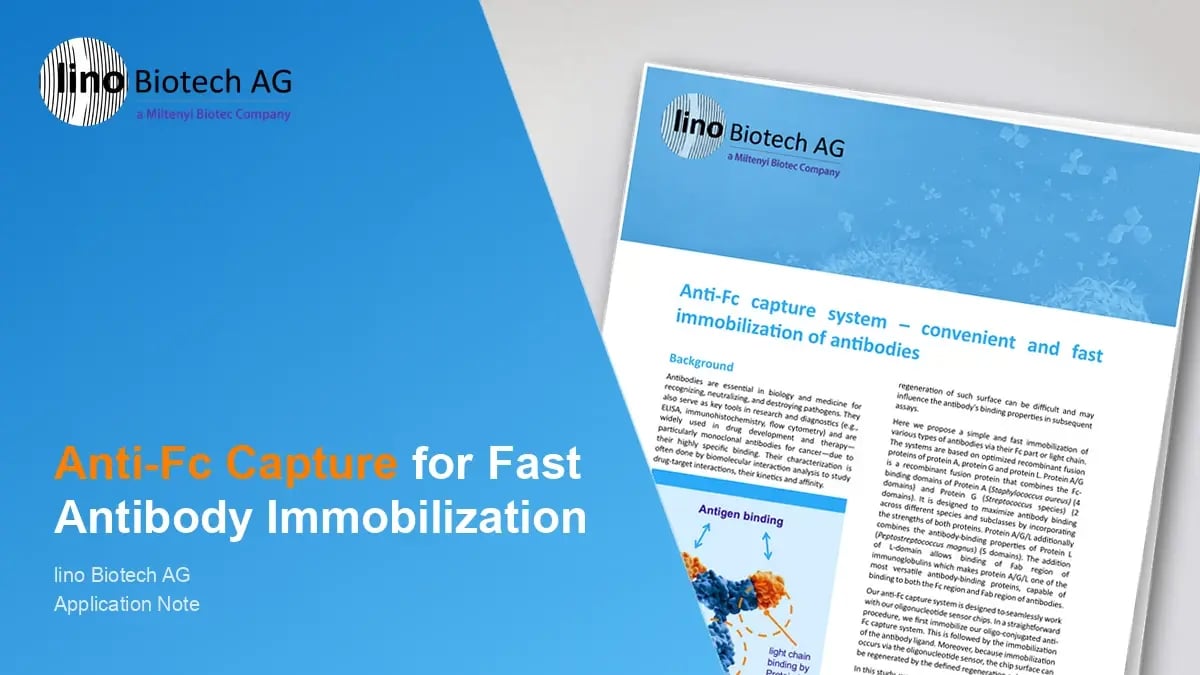
The anti-Fc capture system immobilizes antibodies on an oligonucleotide sensor chip through oligo-conjugated Protein A/G or Protein A/G/L. This application note tests both proteins against antibody types and subclasses from several species.
The Challenge: Immobilizing Antibodies Without Changing Them
Labeling or covalent coupling takes time and can affect antibody function. A covalently bound antibody can also be hard to regenerate. A capture layer avoids these steps, but it must hold many antibody species and subclasses for long enough to measure.
The Approach: Capture, Dissociation and Regeneration Cycles
Protein A/G-oligo or Protein A/G/L-oligo (50 nM) was hybridized to the sensor chip on a MACS Matchmaker. IgG (500 nM) was captured for 10 minutes, followed by 10 minutes of dissociation at 100 µL/min in PBS-T. Each cycle ended with regeneration, which removed the capture protein and the IgG, and the sensor chip was reused.
Key Results Across Antibody Species and Subclasses
- Protein A/G: active toward all tested antibodies except mouse IgM, hamster IgG lambda and goat IgG.
- Protein A/G/L: captured hamster IgG lambda and goat IgG, but not two mouse IgM subclasses, mouse IgG1 lambda or rat IgG2a lambda.
- Kappa chains: the added L domain did not change activity or off-rates much for kappa IgGs.
- Estimated koff: most captured IgGs fell in the 10−4 s−1 range, measured over 10 minutes.
Why It Matters for Antibody Screening
Neither protein offers a general advantage, except in specific cases shown in the note. Both suit a fast first screening, not a final characterization, because capture can alter the antibody–antigen interaction. Only analytes with a koff greater than that of the captured IgG can be examined.
More resources
 Oct 2026
High-throughput thermodynamic fingerprinting of protein–ligand interactions by DNA-directed focal molography
Oehninger, J., Notova, S., & Frutiger, A. (2026). PLOS One, 21(10), e0354008. https://doi.org/10.1371/journal.pone.0354008
Download after a short form
 Oct 2026
Same target, different stickiness: polyreactivity of therapeutic antibodies
Six clinical antibodies, including two same-target pairs, ranked by polyreactivity against an eight-ligand panel on one focal molography chip. Briakinumab scored 69-fold above ...
Download after a short form
 Oct 2026
One on-DNA ligand against many targets: selectivity profiling for DEL hit validation
On-DNA oncoFAP profiled against human, mouse and canine FAP and five unrelated proteins on one focal molography chip layout. Full kinetics on every species variant, flat responses ...
Download after a short form