


Anti-His-tag capture system: fast, reversible and convenient protein immobilization
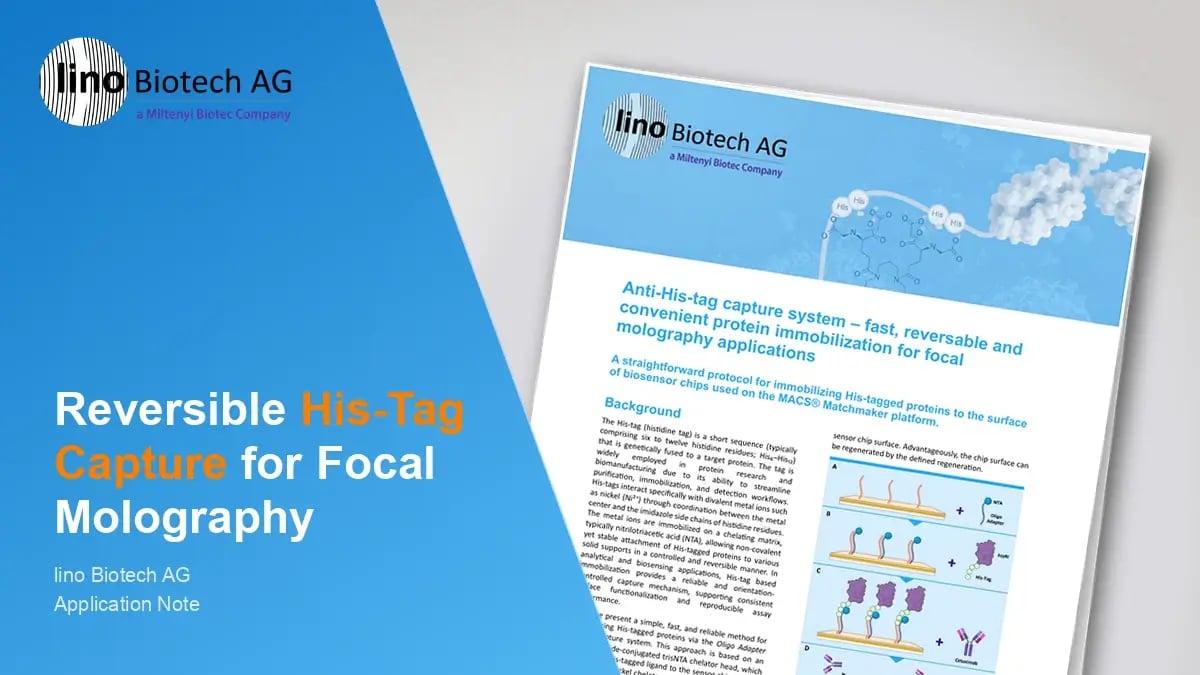
The anti-His-tag capture system immobilizes His-tagged proteins on an oligonucleotide sensor chip through the Oligo Adapter trisNTA. This application note tests it with human Fc gamma receptor I (FcγRI) and the therapeutic antibody cetuximab.
The Challenge: Reversible Capture of Recombinant Proteins
The His-tag is a widely used handle for recombinant proteins. It binds nickel ions held by a chelator such as nitrilotriacetic acid (NTA). For kinetic work, this capture must stay stable during the measurement, and the sensor chip surface should be regenerated afterward.
The Approach: Oligo Adapter trisNTA, FcγRI and Cetuximab
Oligo Adapter trisNTA (100 nM) was hybridized to an oligonucleotide sensor chip on a MACS Matchmaker and charged with 500 µM NiSO4. His-tagged FcγRI (100 nM) was captured next. Single-cycle kinetics in PBS-T used cetuximab from 3.91 to 1000 nM, with a final dissociation of 120 minutes. A parallel buffer injection corrected for the decay of the capture surface.
Key Results for Cetuximab Binding to FcγRI
- Affinity: KD of 9.0 ± 5.7 nM from a Langmuir 1:1 fit.
- Replicates: 63 molograms analyzed in a single flow chamber.
- Specific capture: FcγRI was captured through its His-tag after the adapter was loaded with Ni2+.
- Decay correction: the buffer control compensated for the slow loss of ligand from the capture layer.
Why It Matters for Recombinant Proteins
Many recombinant proteins already carry a His-tag, so this system needs no extra coupling chemistry. Multivalent binding between the trisNTA head and the His-tag strengthens the complex. The adapter is held by hybridization, so the sensor chip surface can be regenerated with the defined regeneration.
More resources
 Oct 2026
High-throughput thermodynamic fingerprinting of protein–ligand interactions by DNA-directed focal molography
Oehninger, J., Notova, S., & Frutiger, A. (2026). PLOS One, 21(10), e0354008. https://doi.org/10.1371/journal.pone.0354008
Download after a short form
 Oct 2026
Same target, different stickiness: polyreactivity of therapeutic antibodies
Six clinical antibodies, including two same-target pairs, ranked by polyreactivity against an eight-ligand panel on one focal molography chip. Briakinumab scored 69-fold above ...
Download after a short form
 Oct 2026
One on-DNA ligand against many targets: selectivity profiling for DEL hit validation
On-DNA oncoFAP profiled against human, mouse and canine FAP and five unrelated proteins on one focal molography chip layout. Full kinetics on every species variant, flat responses ...
Download after a short form