


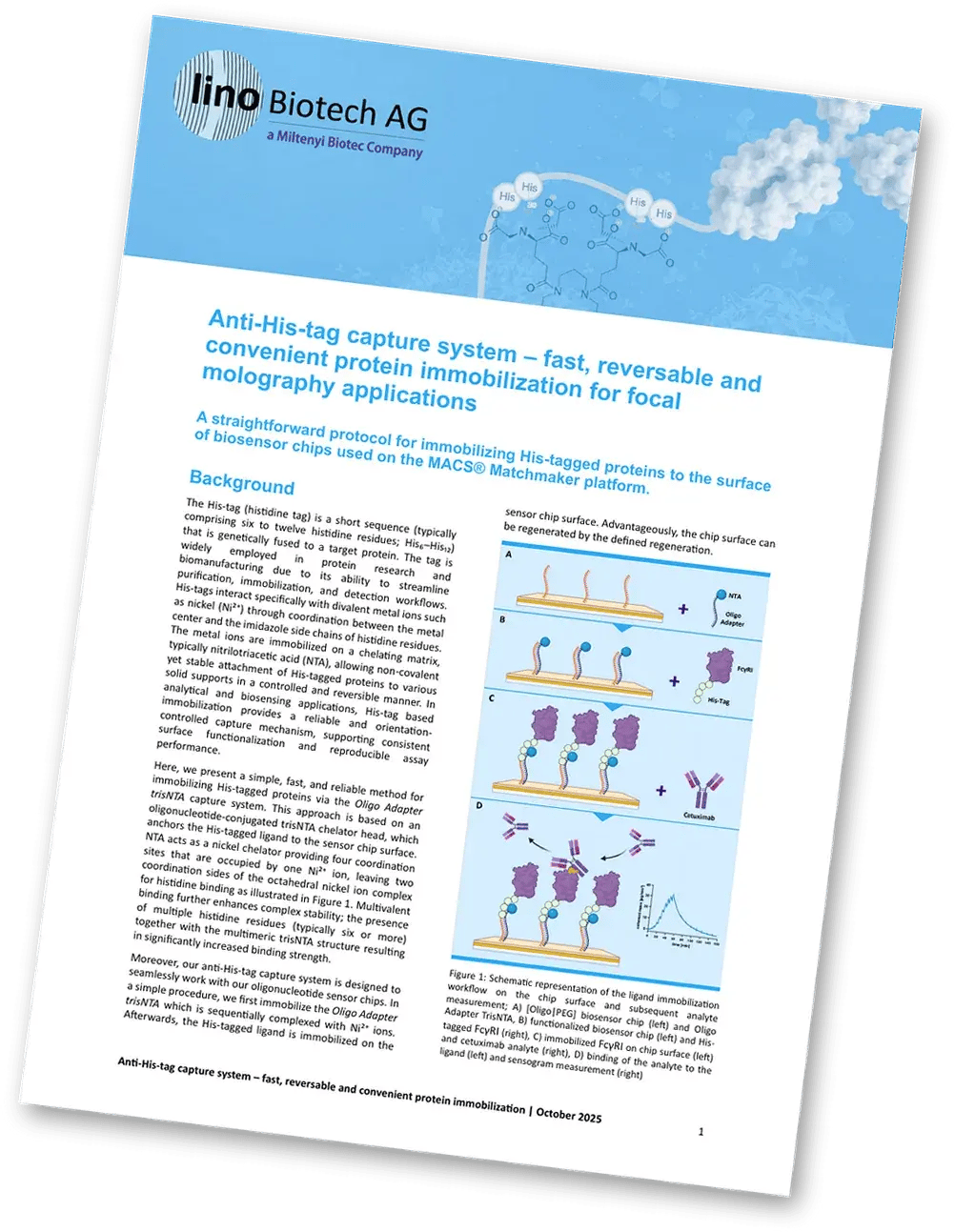
Anti-His-tag capture system: fast, reversible and convenient protein immobilization
Reversible capture of His-tagged proteins, tested with Fc gamma receptor I and cetuximab
Get the application noteThe anti-His-tag capture system immobilizes His-tagged proteins on an oligonucleotide sensor chip through the Oligo Adapter trisNTA. This application note tests it with human Fc gamma receptor I (FcγRI) and the therapeutic antibody cetuximab.
The Challenge: Reversible Capture of Recombinant Proteins
The His-tag is a widely used handle for recombinant proteins. It binds nickel ions held by a chelator such as nitrilotriacetic acid (NTA). For kinetic work, this capture must stay stable during the measurement, and the sensor chip surface should be regenerated afterward.
The Approach: Oligo Adapter trisNTA, FcγRI and Cetuximab
Oligo Adapter trisNTA (100 nM) was hybridized to an oligonucleotide sensor chip on a MACS Matchmaker and charged with 500 µM NiSO4. His-tagged FcγRI (100 nM) was captured next. Single-cycle kinetics in PBS-T used cetuximab from 3.91 to 1000 nM, with a final dissociation of 120 minutes. A parallel buffer injection corrected for the decay of the capture surface.
Key Results for Cetuximab Binding to FcγRI
- Affinity: KD of 9.0 ± 5.7 nM from a Langmuir 1:1 fit.
- Replicates: 63 molograms analyzed in a single flow chamber.
- Specific capture: FcγRI was captured through its His-tag after the adapter was loaded with Ni2+.
- Decay correction: the buffer control compensated for the slow loss of ligand from the capture layer.
Why It Matters for Recombinant Proteins
Many recombinant proteins already carry a His-tag, so this system needs no extra coupling chemistry. Multivalent binding between the trisNTA head and the His-tag strengthens the complex. The adapter is held by hybridization, so the sensor chip surface can be regenerated with the defined regeneration.
More from our resource library you may like
 Oct 2026
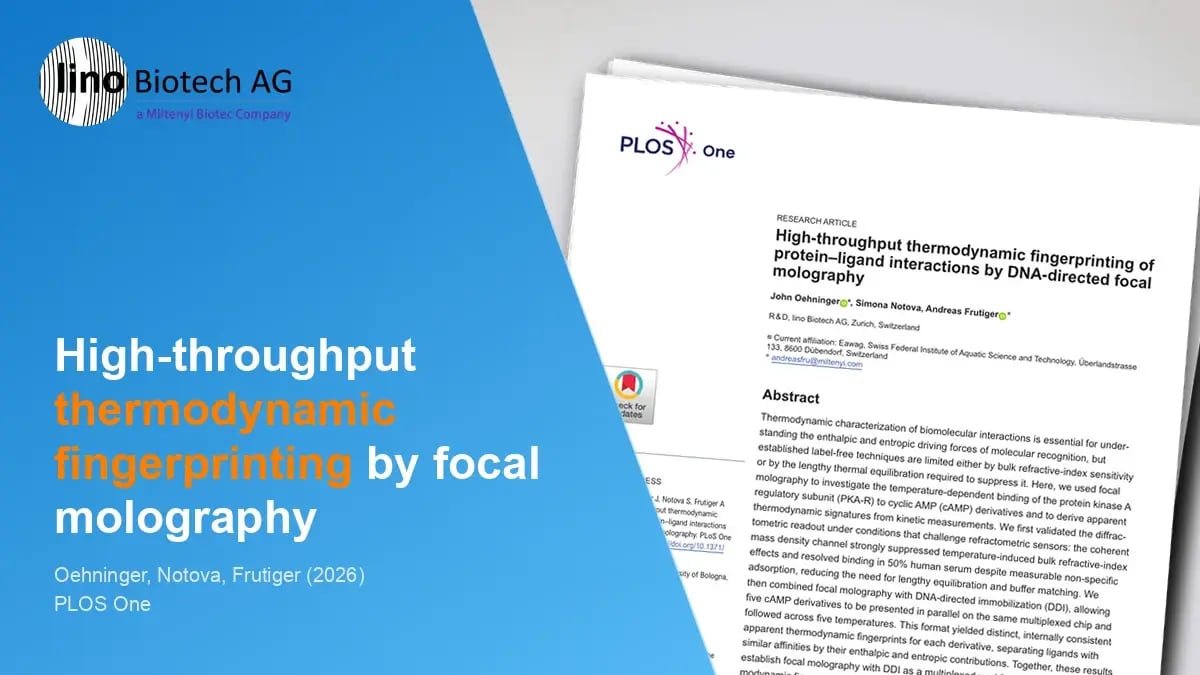
High-throughput thermodynamic fingerprinting of protein–ligand interactions by DNA-directed focal molography
Oehninger, J., Notova, S., & Frutiger, A. (2026). PLOS One, 21(10), e0354008. https://doi.org/10.1371/journal.pone.0354008
Download after a short form
 Oct 2026
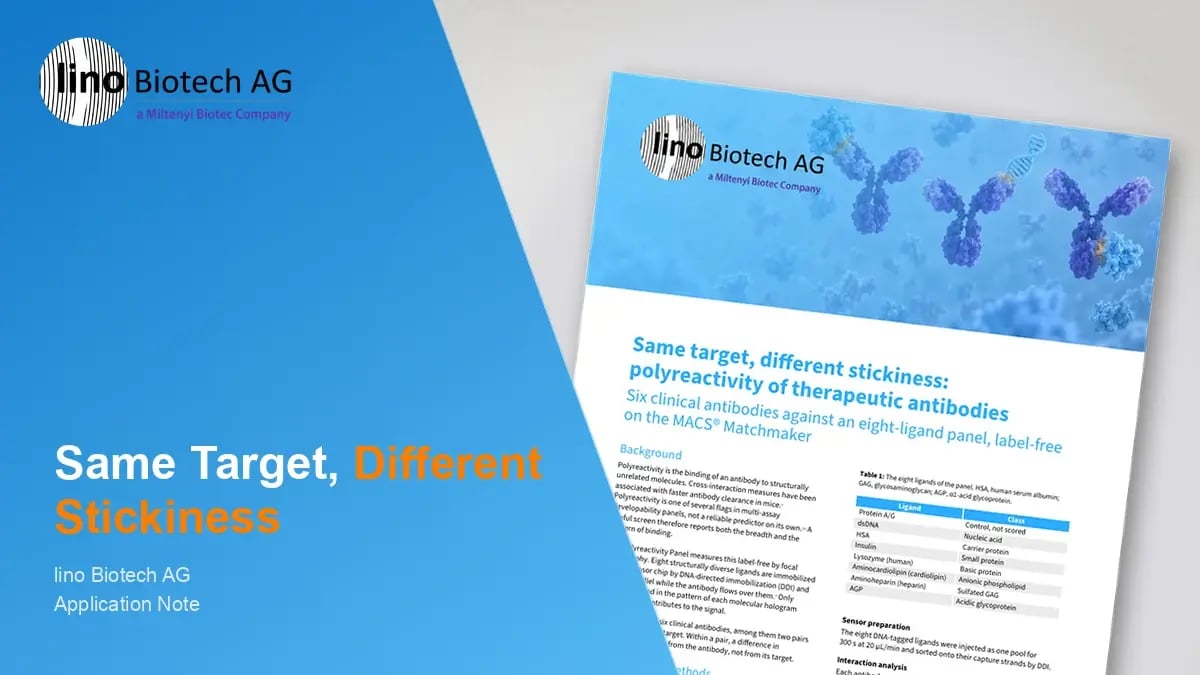
Same target, different stickiness: polyreactivity of therapeutic antibodies
Six clinical antibodies, including two same-target pairs, ranked by polyreactivity against an eight-ligand panel on one focal molography chip. Briakinumab scored 69-fold above ...
Download after a short form
 Oct 2026
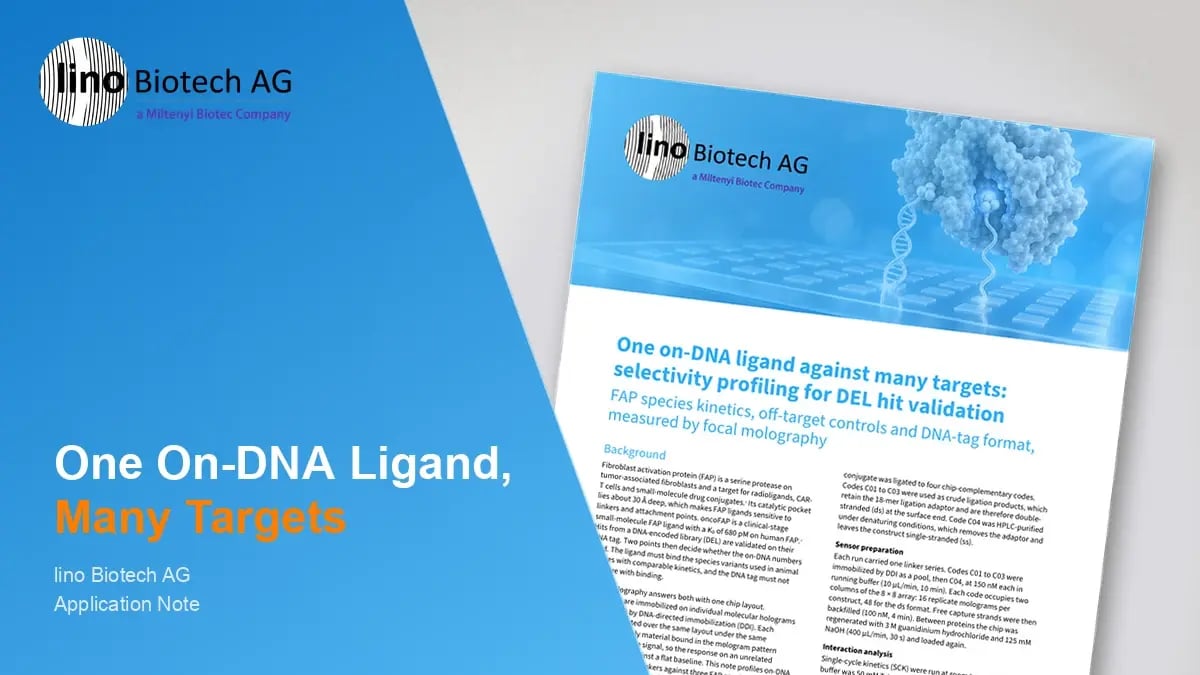
One on-DNA ligand against many targets: selectivity profiling for DEL hit validation
On-DNA oncoFAP profiled against human, mouse and canine FAP and five unrelated proteins on one focal molography chip layout. Full kinetics on every species variant, flat responses ...
Download after a short form