


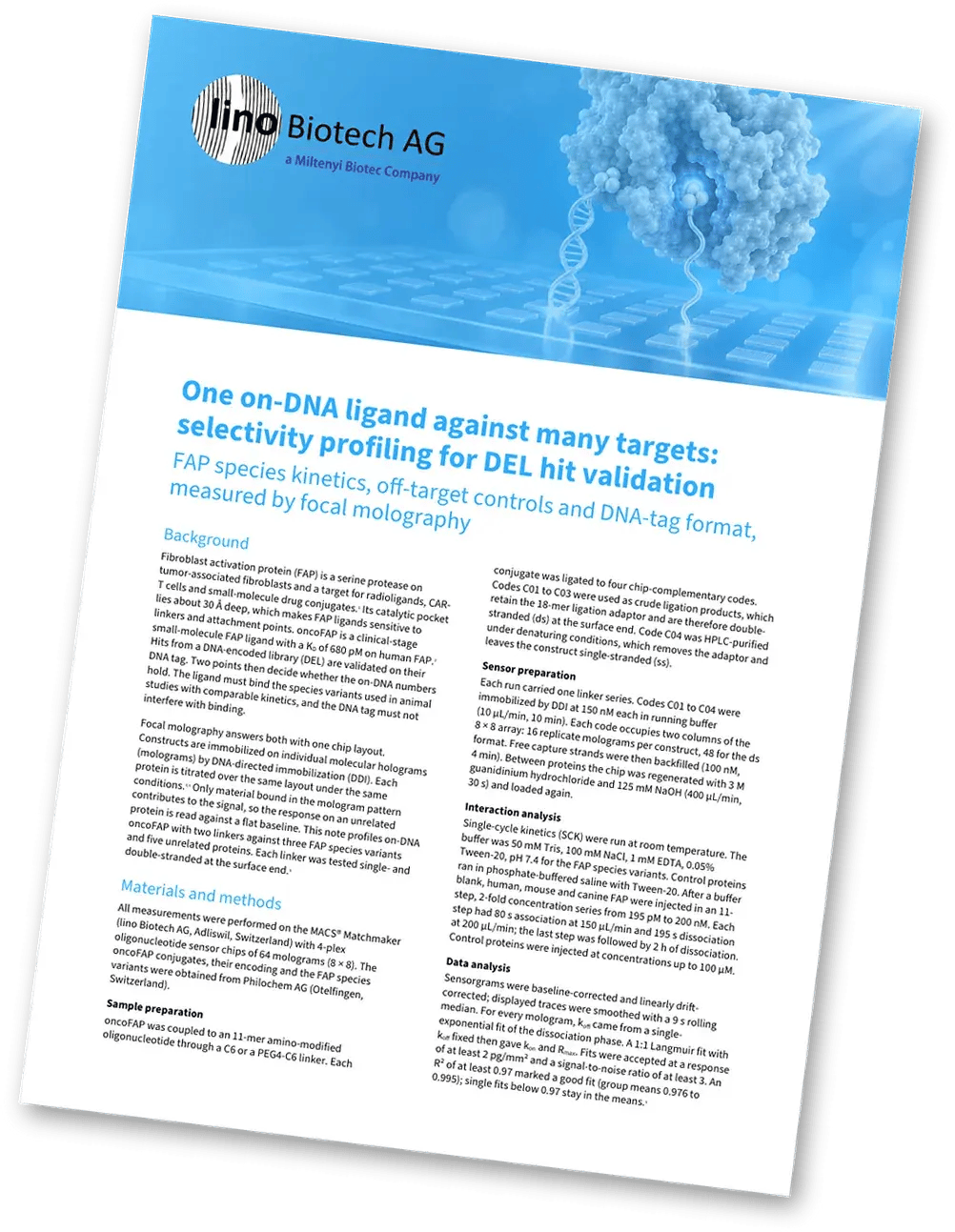
One on-DNA ligand against many targets: selectivity profiling for DEL hit validation
One on-DNA ligand, three species variants of its target and five unrelated proteins, profiled on one focal molography chip layout. The same runs show which DNA-tag format keeps the ligand able to bind.
Get the application noteThe Challenge
Fibroblast activation protein (FAP) is a target for radioligands, CAR-T cells and small-molecule drug conjugates. Its catalytic pocket lies about 30 Å deep, so FAP ligands are sensitive to linkers and attachment points. When a hit from a DNA-encoded library (DEL) is validated on its DNA tag, two questions decide whether the numbers hold: does it bind the species variants used in animal studies, and does the tag interfere with binding?
The Approach
The clinical-stage FAP ligand oncoFAP was coupled to DNA through a C6 or a PEG4-C6 linker, each single- and double-stranded at the surface end. The constructs were immobilized on individual molecular holograms (molograms) by DNA-directed immobilization (DDI). Human, mouse and canine FAP and five control proteins were titrated over the same layout by single-cycle kinetics.
Key Results
- Species profile: the single-stranded constructs bind human, mouse and canine FAP with KD values from 700 pM to 10 nM.
- Clean selectivity: no response above the 0.5 pg/mm² noise level on five control proteins, at concentrations up to 100 µM.
- A DNA-tag design rule: double-stranded constructs do not bind at all, while on human FAP linker length changes the rates only about two-fold.
- Self-referencing readout: the control traces stay flat without any reference subtraction.
Why It Matters
Focal molography readily supports ‘one-against-many’ profiling, providing rapid insights into target selectivity and cross-reactivity. The selectivity panel gives confidence that the signal is the target and nothing else. The duplex rule applies to any DEL follow-up on a deep binding pocket.
Data from Favalli N et al., Journal of Medicinal Chemistry (2026), in collaboration with Philochem AG. https://doi.org/10.1021/acs.jmedchem.6c01097
More from our resource library you may like
 Oct 2026
High-throughput thermodynamic fingerprinting of protein–ligand interactions by DNA-directed focal molography
Oehninger, J., Notova, S., & Frutiger, A. (2026). PLOS One, 21(10), e0354008. https://doi.org/10.1371/journal.pone.0354008
Download after a short form
 Oct 2026
Same target, different stickiness: polyreactivity of therapeutic antibodies
Six clinical antibodies, including two same-target pairs, ranked by polyreactivity against an eight-ligand panel on one focal molography chip. Briakinumab scored 69-fold above ...
Download after a short form
 Oct 2026
Parallel kinetic validation of DNA-encoded library hits
Twenty-four on-DNA hits from a DEL selection, validated in parallel against CAIX and the antitarget CAII on one focal molography chip. Four sub-nanomolar binders with ...
Download after a short form