


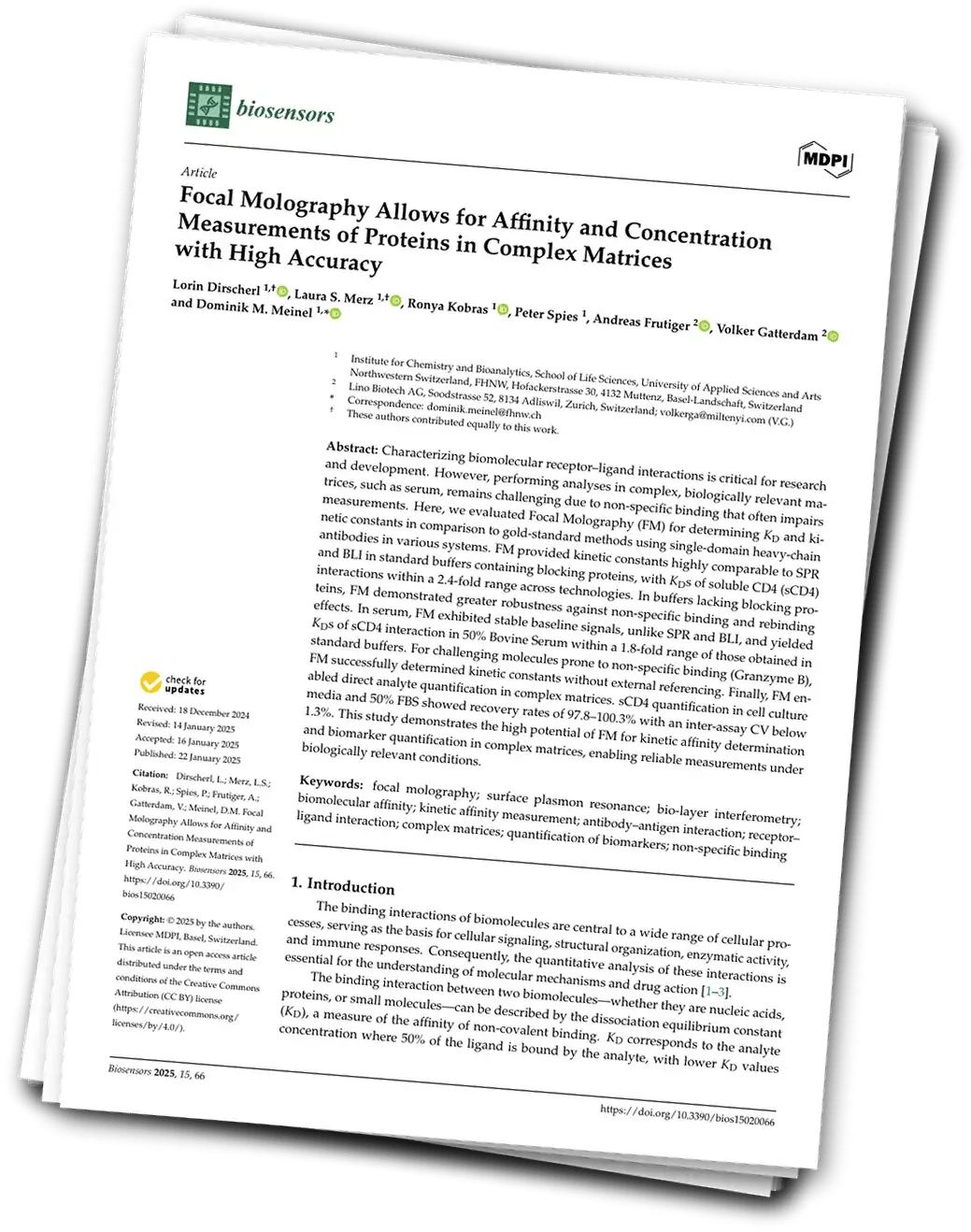
Focal Molography Allows for Affinity and Concentration Measurements of Proteins in Complex Matrices with High Accuracy
Focal molography with internal nanopattern referencing delivers accurate affinity, kinetic, and concentration measurements in cell culture media and serum. In these matrices, SPR and BLI struggle with non-specific binding and baseline drift.
Get the publicationThe Challenge
Affinity, kinetic, and concentration measurements in complex matrices such as serum, cell culture media, and supernatants are central to drug discovery, biomarker research, and bioprocessing. Yet gold-standard surface methods like SPR and BLI suffer from non-specific binding and baseline drift. They also require precisely analyte-depleted matched serum, samples that are often not available, affordable, or well matched in practice.
The Approach
The authors benchmarked focal molography head-to-head against SPR (Biacore) and BLI (Octet) for KD, kon, koff, and direct protein quantification. Four matrices were compared: PBST, PBST+C with blocking proteins, TexMACS cell culture medium, and 50% bovine serum. Three model systems were tested on the MACS® Matchmaker with DNA-directed immobilization (DDI) of single-domain heavy-chain antibodies. They were αCD4/sCD4, αGFP/GFP, and the challenging sticky target Granzyme B.
Key Results
- Cross-method agreement: KDs were within 1.9-fold of each other across focal molography, BLI, and SPR for αCD4/sCD4 in buffer with blocking proteins. In TexMACS cell culture medium they were within 2.4-fold. This confirms focal molography as quantitatively equivalent to SPR and BLI
- Stable measurements in 50% bovine serum: Focal molography kept stable baselines. It yielded KDs for sCD4 within 1.8-fold of standard-buffer values (48 nM vs 27 nM) without external referencing. SPR and BLI required analyte-depleted matched serum, and SPR even showed sign inversion during analyte injection
- Robustness to sticky non-specific binders: Granzyme B is a sticky target. Focal molography determined KD (18.3 nM), kon, and koff directly in cell culture medium using only internal referencing. SPR and BLI produced kinetic constants outside instrument specifications even after extensive biochemical matching and double referencing
- Direct quantification: sCD4 spiked at 50 nM was recovered at 97.8 to 100.3% accuracy in TexMACS and 99.0% in 50% FBS. The inter-assay CV was 1.2% across three experiments, and the LoD 2.6 nM in serum
- On-chip multiplexing capability: Using just 4 of 54 molograms per analyte still delivered intra-assay CVs below 10% and recoveries within ±10%. That allows simultaneous quantification of up to 13 analytes on a single chip
Why It Matters
These findings position focal molography as a platform for biophysical interaction analysis directly in biologically relevant matrices. Serum, supernatants, and cell culture media routinely defeat SPR and BLI. The internal-reference mechanism, intrinsic to the ridge/groove nanopattern, removes the need for analyte-depleted matched serum. It delivers reliable kinetics even for charged or sticky molecules that are otherwise inaccessible to surface-based techniques. Add direct label-free quantification at sub-nanomolar limits of detection and on-chip multiplexing of up to 13 analytes per chip. Focal molography then opens the door to reliable biomarker research, bioprocess monitoring, and drug-discovery workflows where sample complexity has forced compromises. For teams that used to pre-purify and buffer-exchange every sample, this is a fundamentally different starting point.
Dirscherl, L., Merz, L. S., Kobras, R., Spies, P., Frutiger, A., Gatterdam, V., & Meinel, D. M. (2025). Focal Molography Allows for Affinity and Concentration Measurements of Proteins in Complex Matrices with High Accuracy. Biosensors, 15(2), 66. https://doi.org/10.3390/bios15020066
More from our resource library you may like
 Oct 2026
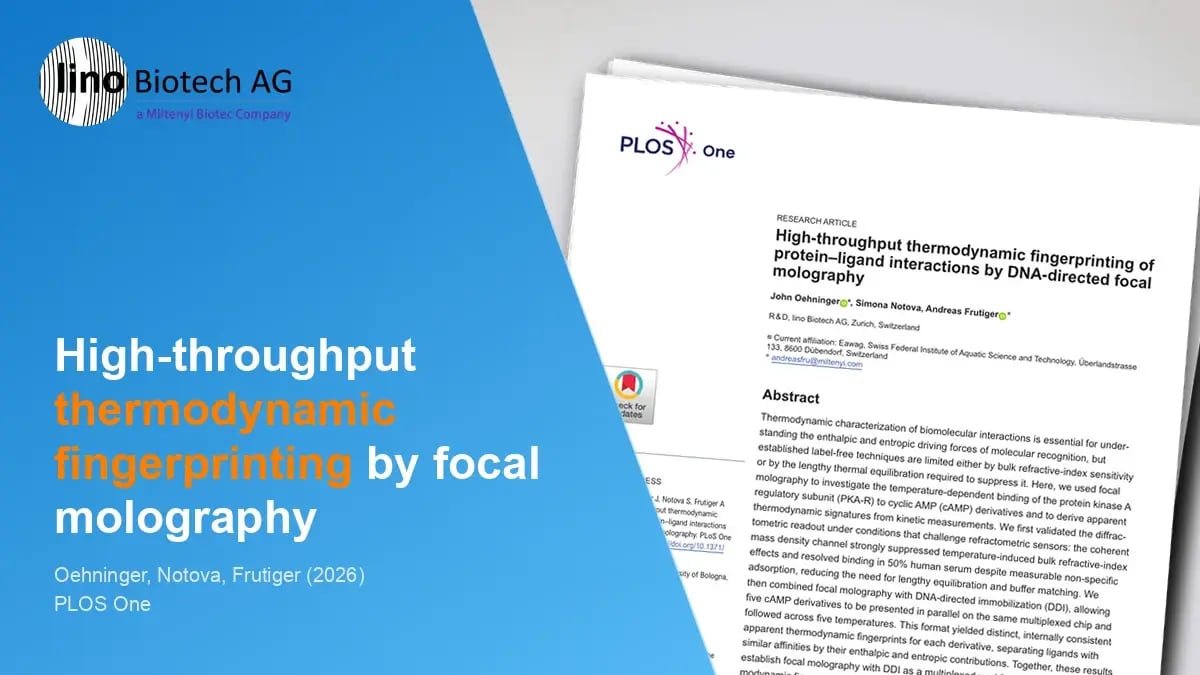
High-throughput thermodynamic fingerprinting of protein–ligand interactions by DNA-directed focal molography
Oehninger, J., Notova, S., & Frutiger, A. (2026). PLOS One, 21(10), e0354008. https://doi.org/10.1371/journal.pone.0354008
Download after a short form
 Oct 2026
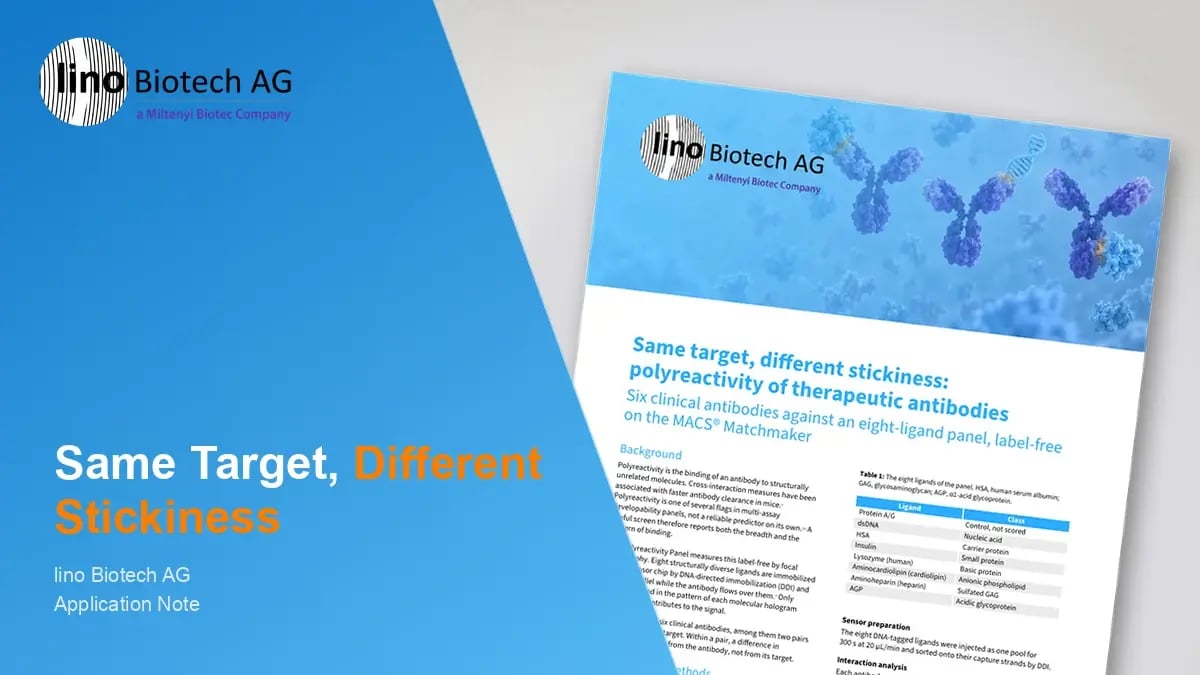
Same target, different stickiness: polyreactivity of therapeutic antibodies
Six clinical antibodies, including two same-target pairs, ranked by polyreactivity against an eight-ligand panel on one focal molography chip. Briakinumab scored 69-fold above ...
Download after a short form
 Oct 2026
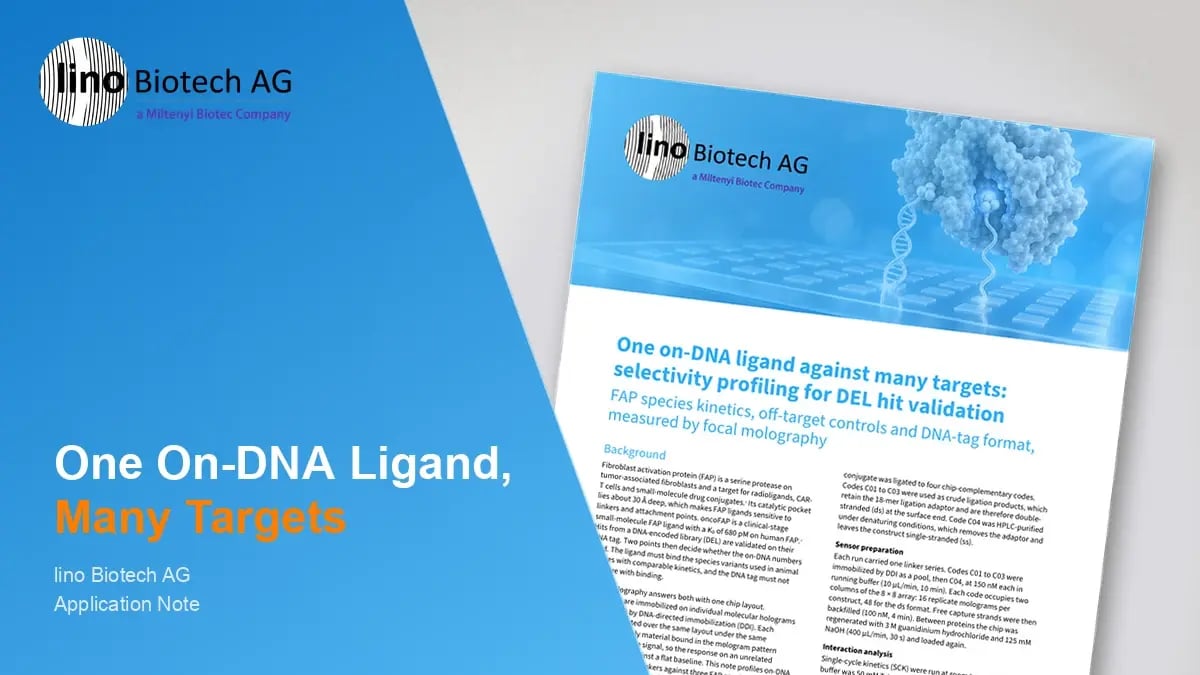
One on-DNA ligand against many targets: selectivity profiling for DEL hit validation
On-DNA oncoFAP profiled against human, mouse and canine FAP and five unrelated proteins on one focal molography chip layout. Full kinetics on every species variant, flat responses ...
Download after a short form