


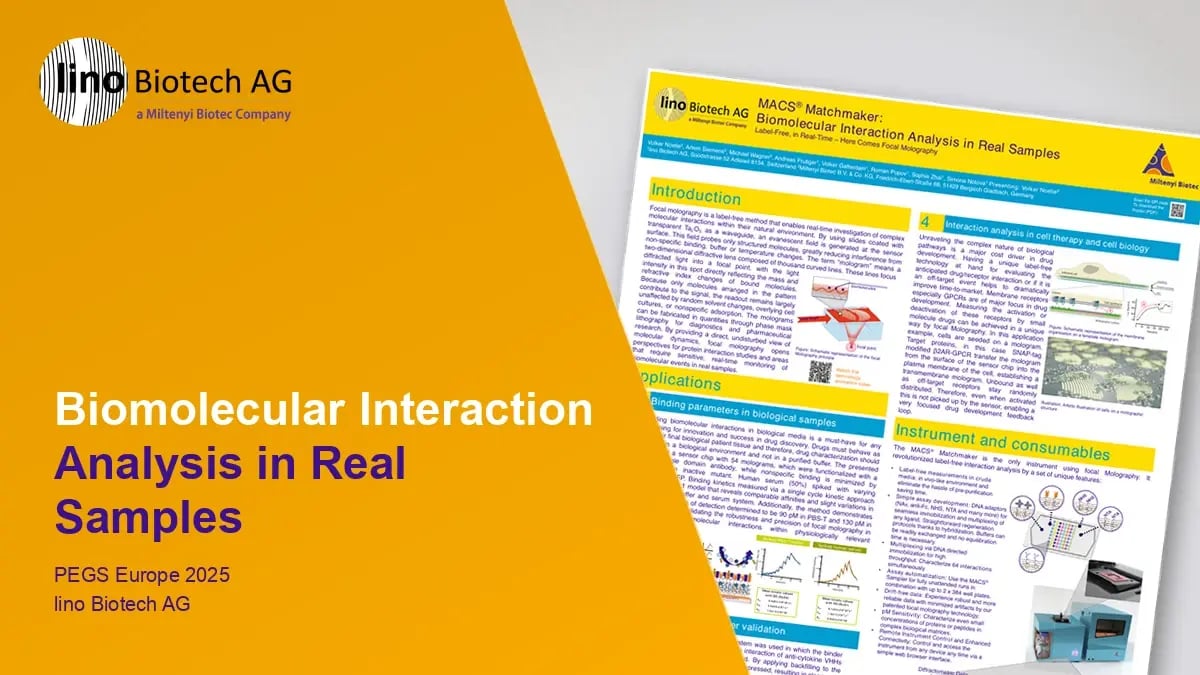
This poster gives four examples of focal molography on the MACS Matchmaker in real samples: serum kinetics, VHH validation, difficult proteins and cell biology. It was presented at PEGS Europe 2025 in Lisbon, Portugal (November 11 to 13, 2025).
The Challenge: Purified Systems Miss the Biological Context
Drug discovery often relies on purified systems that do not reflect the biological environment. Some proteins are also sticky or highly lipophilic, which makes them hard to measure. Both problems create data that may not hold up in later stages.
The Approach: Only Ordered Binding Creates a Signal
A mologram is a diffractive lens of about one thousand curved lines of binding sites on a Ta2O5 waveguide. Only molecules bound in this pattern focus light into the focal spot. The readout therefore stays largely unaffected by solvent changes, cells above the sensor or non-specific adsorption.
Key Results From the Four Application Examples
- Serum kinetics: a GFP-specific single domain antibody gave a mean KD of 1.2 nM in PBS-T (N = 54) and 2.6 nM in 50% human serum (N = 51).
- Sensitivity: limits of detection of 90 pM in PBS-T and 130 pM in human serum.
- Anti-cytokine VHH binders: VHH-Fc binders were captured through an Fc adapter, and backfilling suppressed non-specific binding of the cytokine analytes.
- Difficult proteins: backfilling also accounted for non-specific interactions with sticky, lipophilic proteins, in a comparison with an anti-Granzyme B VHH (Dirscherl et al., Biosensors 2025).
- Cell biology: SNAP-tag modified β2AR GPCRs carried the mologram into the plasma membrane of cells seeded on the sensor chip.
Why It Matters for Protein Research
Direct analysis in crude media such as serum, cell lysates and cell culture supernatants removes the need for pre-purification. The same measurement principle covers antibody binders, difficult proteins and membrane receptors. This helps researchers test molecules closer to the conditions where they must work.
More resources
 Oct 2026
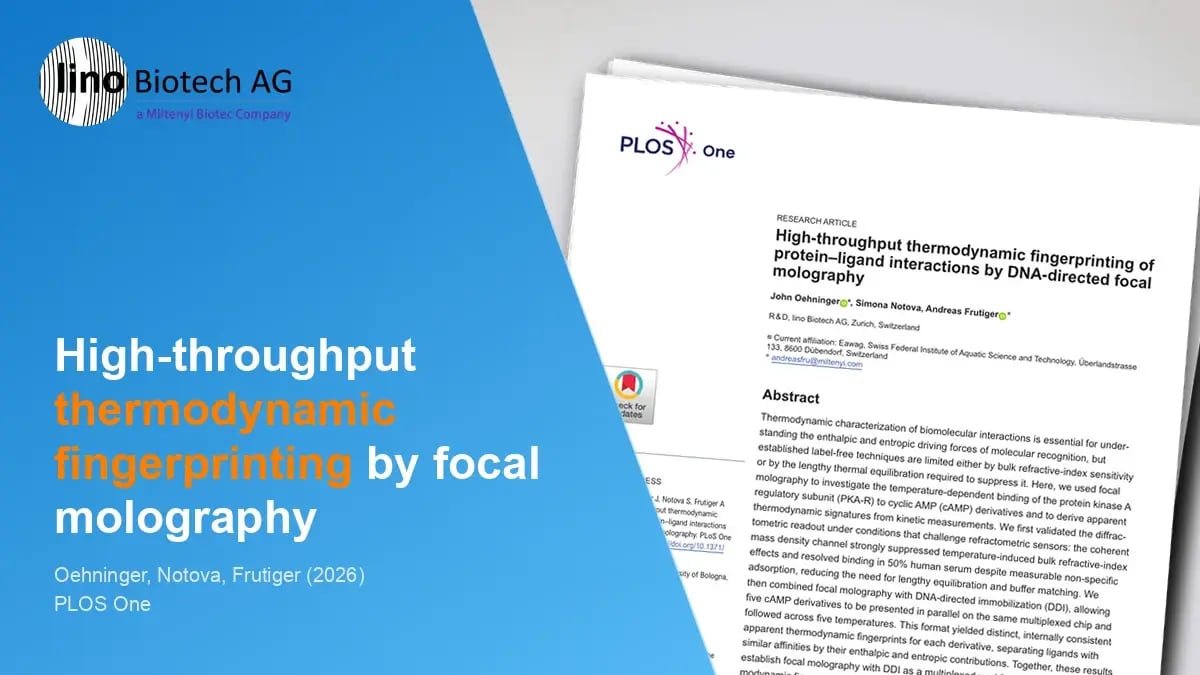
High-throughput thermodynamic fingerprinting of protein–ligand interactions by DNA-directed focal molography
Oehninger, J., Notova, S., & Frutiger, A. (2026). PLOS One, 21(10), e0354008. https://doi.org/10.1371/journal.pone.0354008
Download after a short form
 Oct 2026
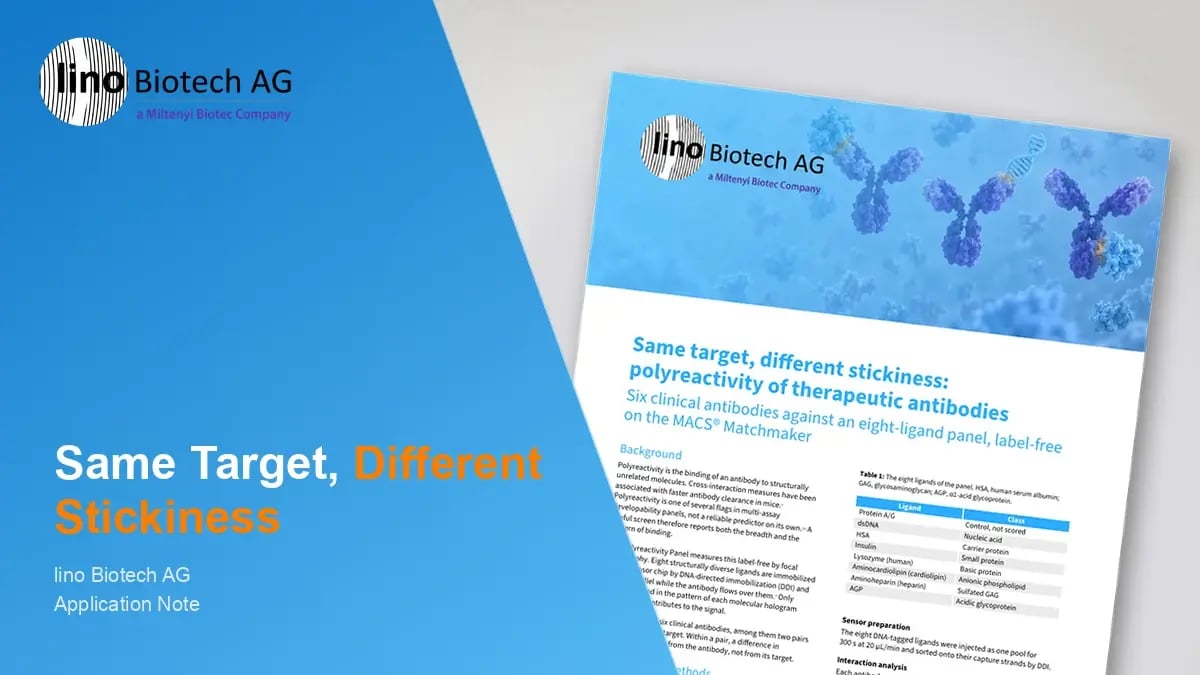
Same target, different stickiness: polyreactivity of therapeutic antibodies
Six clinical antibodies, including two same-target pairs, ranked by polyreactivity against an eight-ligand panel on one focal molography chip. Briakinumab scored 69-fold above ...
Download after a short form
 Oct 2026
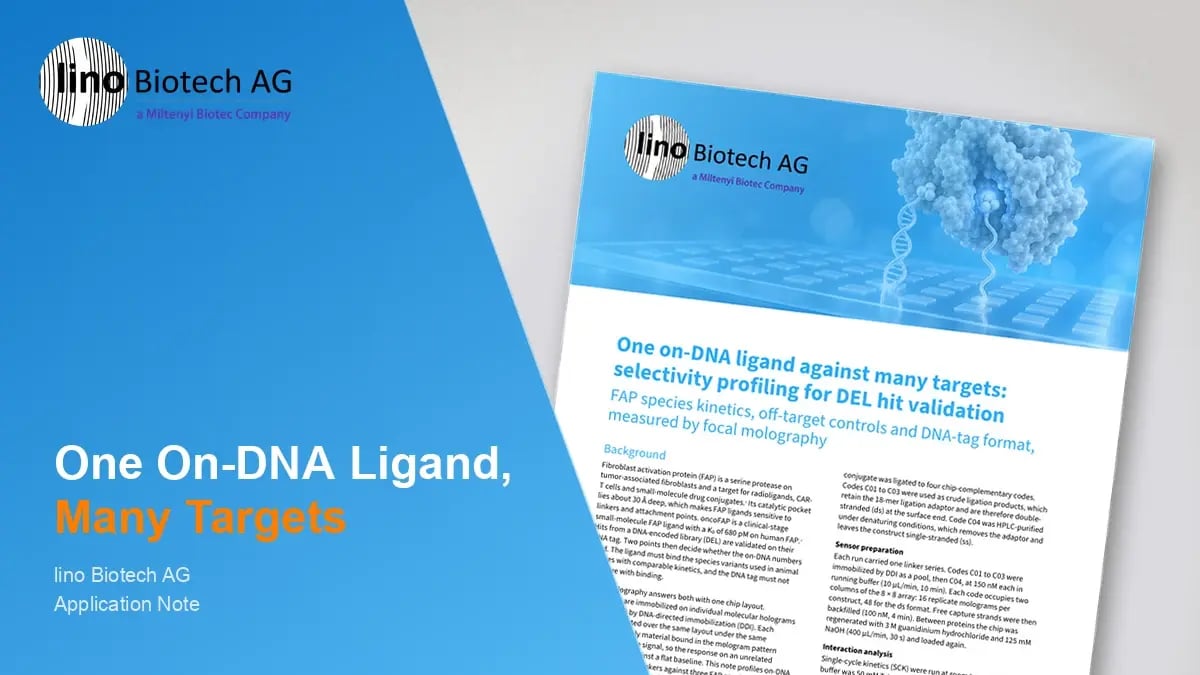
One on-DNA ligand against many targets: selectivity profiling for DEL hit validation
On-DNA oncoFAP profiled against human, mouse and canine FAP and five unrelated proteins on one focal molography chip layout. Full kinetics on every species variant, flat responses ...
Download after a short form