


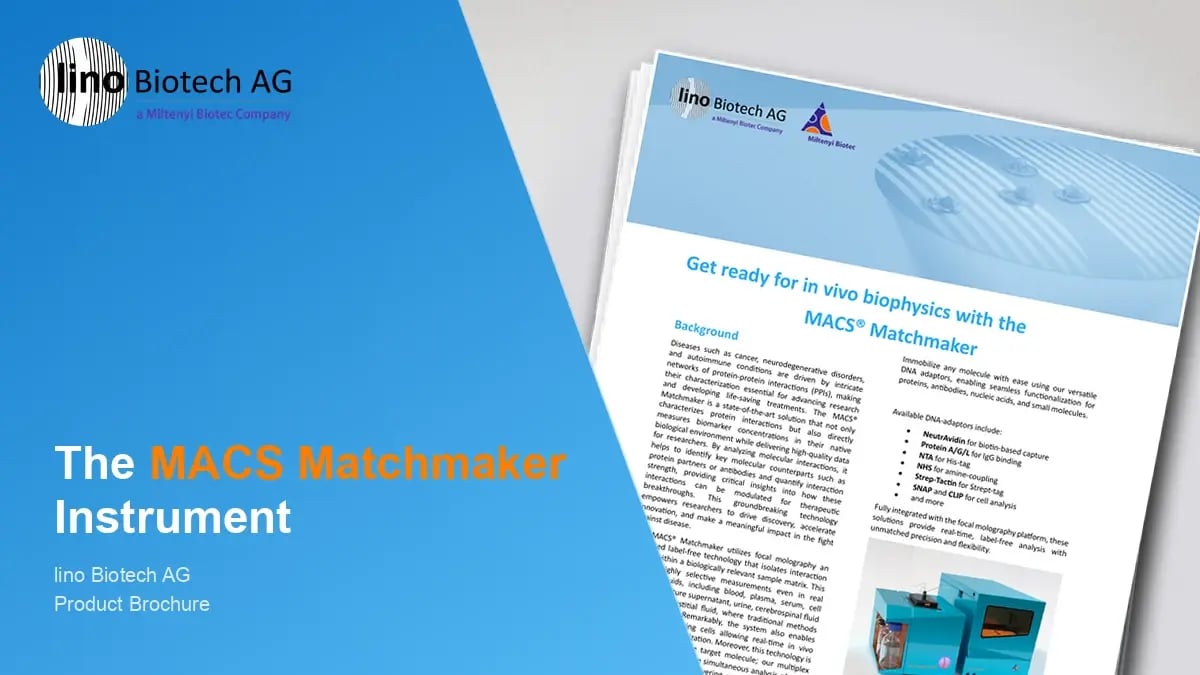
The MACS Matchmaker uses focal molography to measure biomolecular interactions label-free and in real time, including in complex biological samples. This brochure describes its applications, sensor chips, specifications and software.
What the MACS Matchmaker Measures
The instrument measures binding kinetics, affinity and biomarker concentration. Sample types include blood, plasma, serum, cell lysate, cell culture supernatant, urine, cerebrospinal fluid and interstitial fluid. A fluorescence and darkfield surface readout supports cell counting and calcium signaling assays.
Sensor Chips and Immobilization
Click Chemistry sensor chips give covalent, high-stability immobilization and suit applications with limited ligand. DNA sensor chips use DNA-directed immobilization (DDI) for reversible capture and standardized regeneration, from 1-plex to 64-plex. Adapters include NeutrAvidin, Protein A/G/L, NTA, NHS, Strep-Tactin, SNAP and CLIP.
Key Specifications of the MACS Matchmaker
- Kinetic range: kon from 103 to 108 M−1s−1 and koff from 10−6 to 1 s−1.
- Noise and drift: over 20 minutes, 0.05 pg/mm² at 5 pg/mm² and 0.2 pg/mm² at 50 pg/mm².
- Analyte size: lower limit of 2 kDa.
- Limit of detection: 100 pM for analytes above 30 kDa in a direct binding assay in serum.
- Temperature: 25 to 60 °C, or 15 to 60 °C with the chiller option.
- Automation: with the MACS Sampler, up to two 96-well or 384-well plates and 72 hours of unattended run time.
Why It Matters in the Lab
Referencing is built into the sensor, so no separate reference measurement is needed. Data analysis is automated for standard workflows, with JupyterHub (Python) for advanced users. A web-based interface allows remote operation from desktops, laptops, tablets and mobile devices.
More resources
 Oct 2026
High-throughput thermodynamic fingerprinting of protein–ligand interactions by DNA-directed focal molography
Oehninger, J., Notova, S., & Frutiger, A. (2026). PLOS One, 21(10), e0354008. https://doi.org/10.1371/journal.pone.0354008
Download after a short form
 Oct 2026
Same target, different stickiness: polyreactivity of therapeutic antibodies
Six clinical antibodies, including two same-target pairs, ranked by polyreactivity against an eight-ligand panel on one focal molography chip. Briakinumab scored 69-fold above ...
Download after a short form
 Oct 2026
One on-DNA ligand against many targets: selectivity profiling for DEL hit validation
On-DNA oncoFAP profiled against human, mouse and canine FAP and five unrelated proteins on one focal molography chip layout. Full kinetics on every species variant, flat responses ...
Download after a short form