


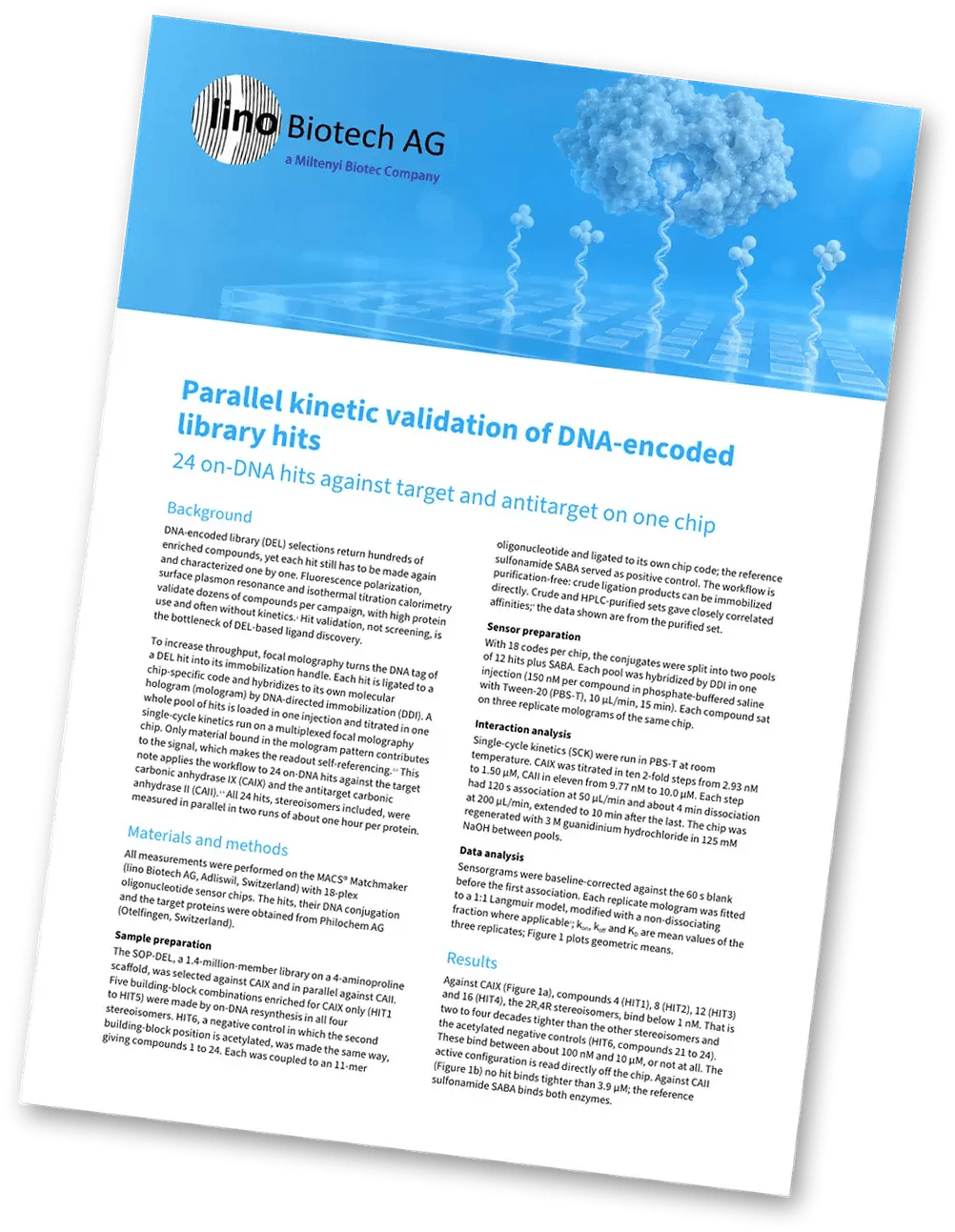
Parallel kinetic validation of DNA-encoded library hits
The MACS® Matchmaker validates DNA-encoded library (DEL) hits on their DNA tag. Twenty-four on-DNA hits were profiled against a target and an antitarget on one focal molography chip.
Get the application noteThe Challenge
DEL selections return hundreds of enriched compounds, yet each hit still has to be made again and characterized one by one. Fluorescence polarization, surface plasmon resonance (SPR) and isothermal titration calorimetry validate dozens of compounds per campaign, with high protein use and often without kinetics. Hit validation, not screening, is the bottleneck of DEL-based ligand discovery.
The Approach
Focal molography turns the DNA tag of each hit into its immobilization handle. Every hit is ligated to a chip-specific code and hybridizes to its own molecular hologram (mologram) by DNA-directed immobilization (DDI). A whole pool is loaded in one injection and titrated in one single-cycle kinetics run. Twenty-four on-DNA hits, stereoisomers included, were measured against carbonic anhydrase IX (CAIX) and the antitarget carbonic anhydrase II (CAII), in two runs of about one hour per protein.
Key Results
- Sub-nanomolar binders: the 2R,4R compounds of HIT1 to HIT4 bind CAIX with KD values of 0.3 to 0.8 nM.
- Selectivity: the same compounds are approximately 10,000- to 20,000-fold selective over CAII.
- Stereochemistry from the same runs: the other stereoisomers and the acetylated controls bind two to four decades more weakly, or not at all.
- Enrichment is not affinity: HIT5, despite its higher enrichment, binds CAIX at 230 ± 70 nM with a fast off-rate.
- Orthogonal agreement: fluorescence polarization reproduced the rank order and the selectivity trend.
Why It Matters
Because the DNA tag of a DEL member is all the MACS Matchmaker needs, the workflow scales to the full output of a selection, with kinetics for every hit and its stereoisomers on one chip.
Data from Favalli N et al., Journal of Medicinal Chemistry (2026), in collaboration with Philochem AG. https://doi.org/10.1021/acs.jmedchem.6c01097
More from our resource library you may like
 Oct 2026
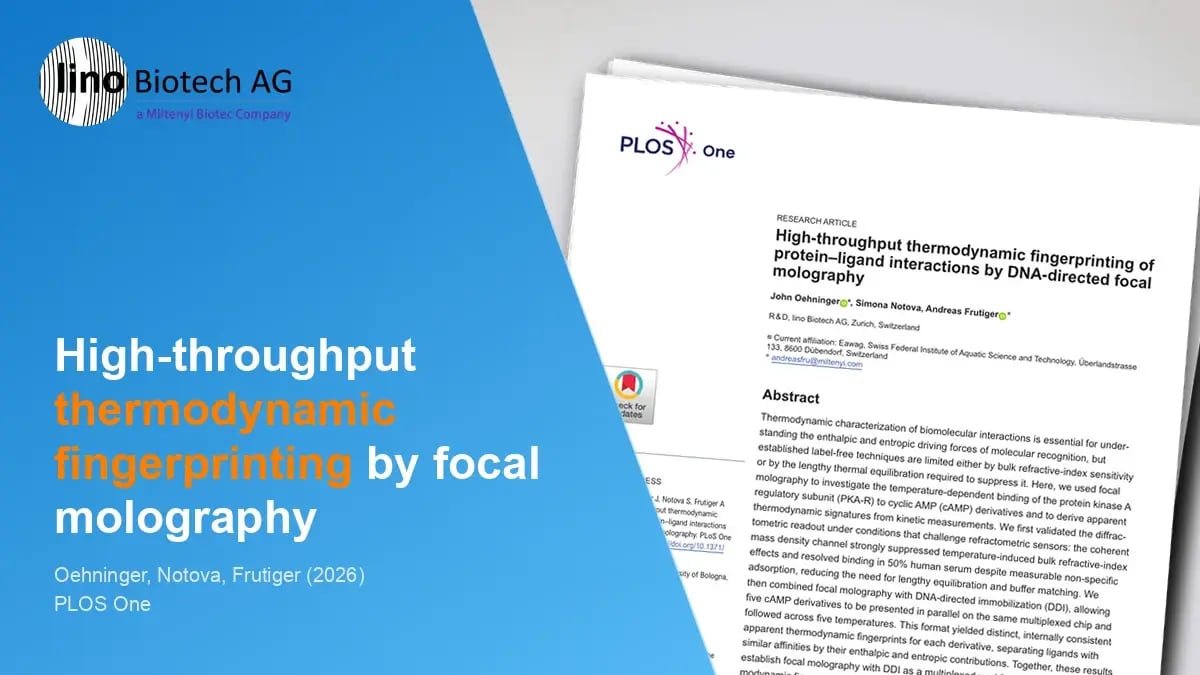
High-throughput thermodynamic fingerprinting of protein–ligand interactions by DNA-directed focal molography
Oehninger, J., Notova, S., & Frutiger, A. (2026). PLOS One, 21(10), e0354008. https://doi.org/10.1371/journal.pone.0354008
Download after a short form
 Oct 2026
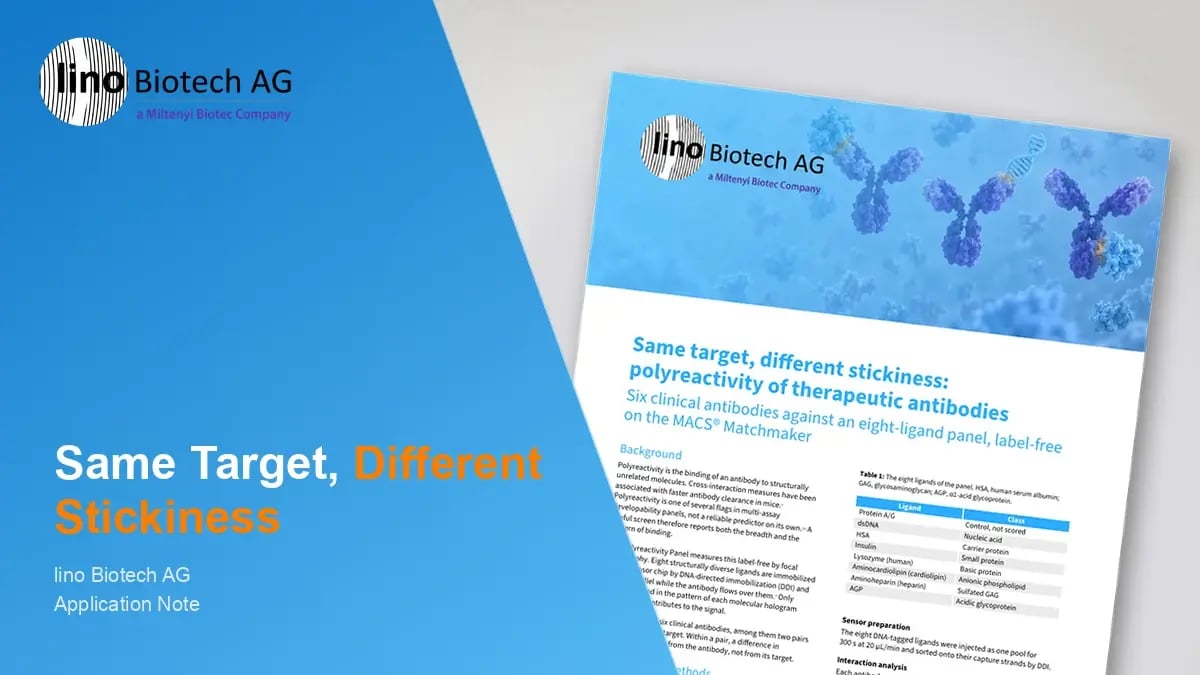
Same target, different stickiness: polyreactivity of therapeutic antibodies
Six clinical antibodies, including two same-target pairs, ranked by polyreactivity against an eight-ligand panel on one focal molography chip. Briakinumab scored 69-fold above ...
Download after a short form
 Oct 2026
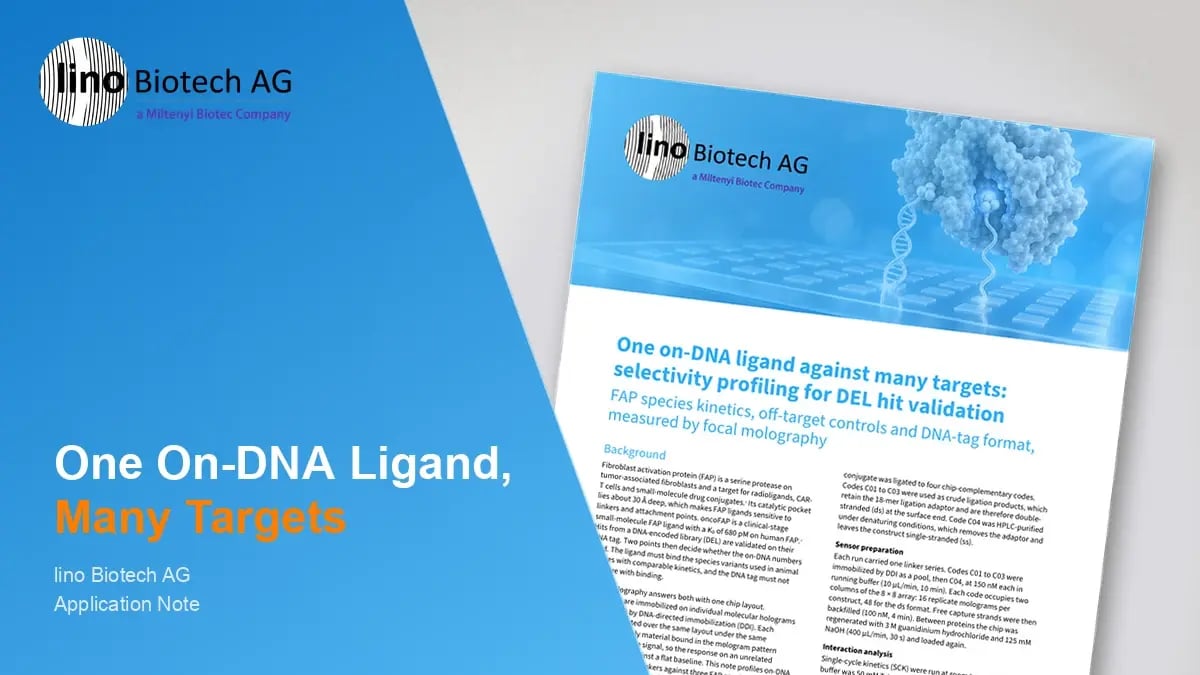
One on-DNA ligand against many targets: selectivity profiling for DEL hit validation
On-DNA oncoFAP profiled against human, mouse and canine FAP and five unrelated proteins on one focal molography chip layout. Full kinetics on every species variant, flat responses ...
Download after a short form