


Reichmuth et al. show that focal molography rejects non-specific binding in undiluted human plasma, with a limit of detection close to that in buffer. They also use peptide arrays to profile plasma from individual donors in real time.
The Challenge: Non-Specific Binding in Complex Samples
Most binding assays need washing steps, because non-specifically bound molecules are the main source of variation. This restricts the use of label-free assays to abundant biomarkers. It also makes direct measurement in unprocessed samples difficult.
The Approach: Affinity-Matched Molograms and Peptide Arrays
The authors made molograms whose ridges and grooves are chemically similar, so that non-specific binders bind both equally and create no coherent signal. They tested this in a model assay in PBS-T and in human plasma. A five-peptide array around the hemagglutinin tag then profiled plasma from six healthy donors.
Key Results in Undiluted Human Plasma
- Limit of detection: 153 pM in PBS-T and 179 pM in plasma after 150 minutes, averaged over 10 molograms, with plasma pooled from three donors.
- Longer incubation: about 40 pM, roughly 6 ng/mL, in undiluted plasma after 24 hours.
- Donor profiling: real-time binding curves separated donors that looked highly similar in endpoint measurements.
- Additional signal: molographic profiling also captured plasma components that stay invisible to a labeled IgG readout.
Why It Matters for Complex Biological Samples
Binding assays could run directly in unprocessed samples, without washing and labeling steps. The authors see this as useful for single and multiplexed biomarker analysis. They also expect value for molecular profiling of immunoglobulins and cell-free proteins.
More resources
 Oct 2026
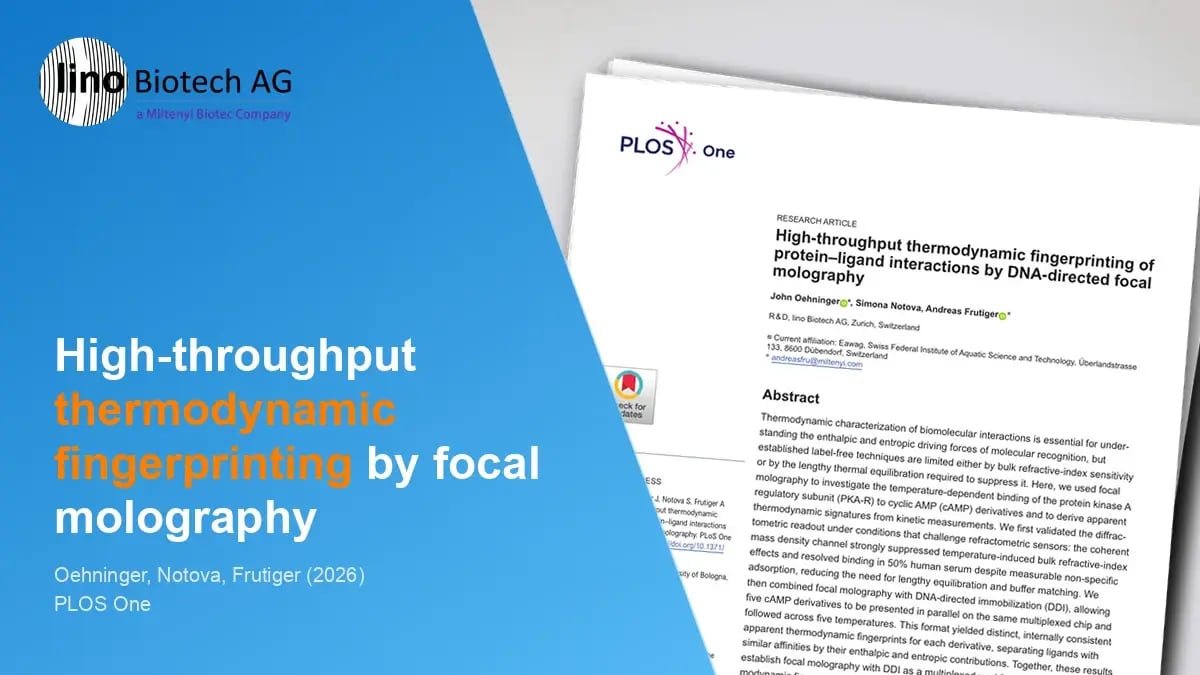
High-throughput thermodynamic fingerprinting of protein–ligand interactions by DNA-directed focal molography
Oehninger, J., Notova, S., & Frutiger, A. (2026). PLOS One, 21(10), e0354008. https://doi.org/10.1371/journal.pone.0354008
Download after a short form
 Oct 2026
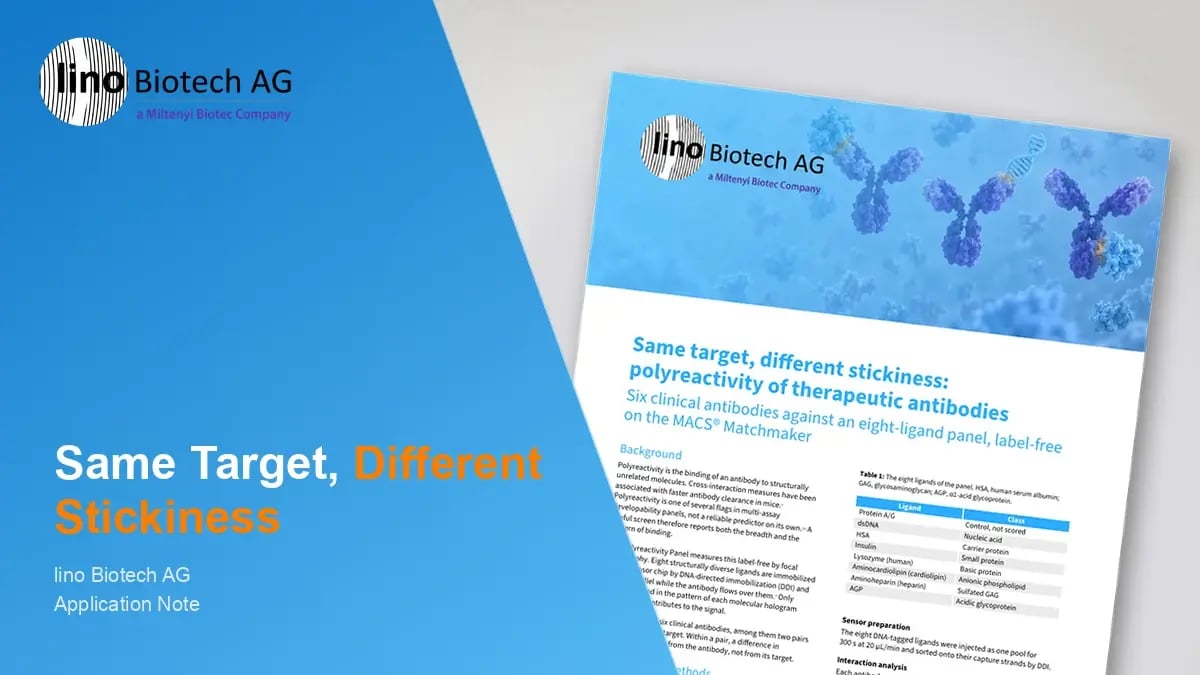
Same target, different stickiness: polyreactivity of therapeutic antibodies
Six clinical antibodies, including two same-target pairs, ranked by polyreactivity against an eight-ligand panel on one focal molography chip. Briakinumab scored 69-fold above ...
Download after a short form
 Oct 2026
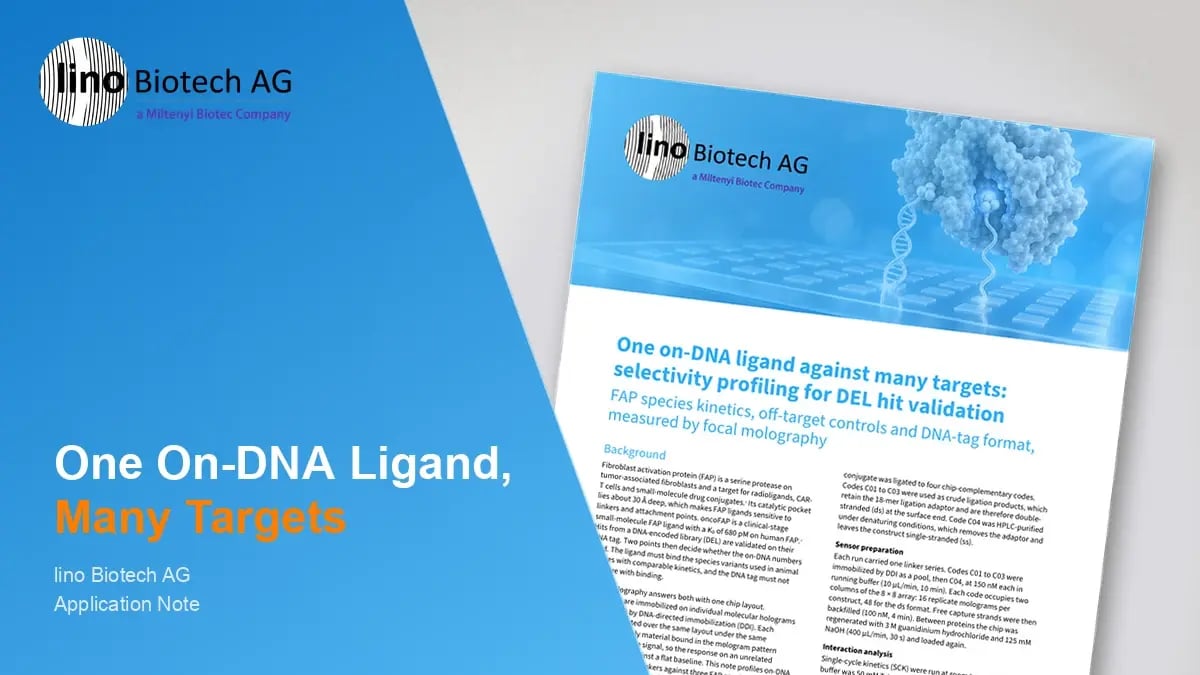
One on-DNA ligand against many targets: selectivity profiling for DEL hit validation
On-DNA oncoFAP profiled against human, mouse and canine FAP and five unrelated proteins on one focal molography chip layout. Full kinetics on every species variant, flat responses ...
Download after a short form