


Blickenstorfer et al. propose the coherent surface mass density as a common quantity for diffractometric biosensors. It plays the role of the refractive index unit (RIU) in refractometric sensors. Physical Review Applied listed the paper as an Editors' Suggestion.
The Challenge: No Common Scale for Diffractometric Sensors
Diffractometric biosensors reject refractive index fluctuations through self-referencing on the submicron scale. Yet the field lacked a general quantitative analysis. Without it, different diffractometric arrangements are hard to compare with each other or with refractometric sensors.
The Approach: A General Framework for Quantification
The authors build a framework that determines the coherent surface mass density for various diffractometric arrangements. They also give a practical guide with experimental considerations, so that readers of any background can apply the theory.
Key Results for Quantitative Diffractometric Biosensing
- Universal parameter: the coherent surface mass density does not depend on the assay, the type of diffraction grating or the sensor arrangement.
- Link to total mass: it can be converted to the total surface mass density, which allows comparison with other sensor technologies.
- Simple inputs: only the diffraction efficiency and the beam diameter need to be measured.
- Background analysis: the same formulas help to study surface roughness and non-specific binding.
Why It Matters for Biosensor Development
A shared quantity makes results from different sensors comparable. Careful characterization of a sensor configuration can also improve its resolution. The authors expect these tools to support diffractometric biosensors as an alternative to refractometric sensors, in particular in complex biofluids.
More resources
 Oct 2026
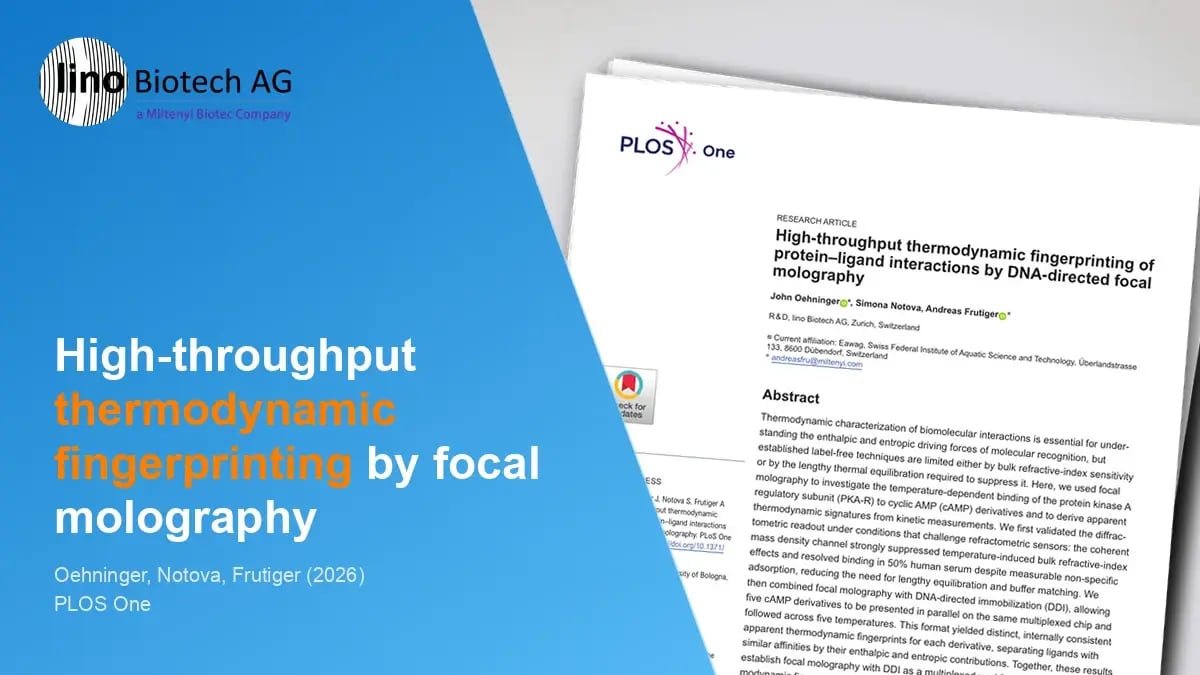
High-throughput thermodynamic fingerprinting of protein–ligand interactions by DNA-directed focal molography
Oehninger, J., Notova, S., & Frutiger, A. (2026). PLOS One, 21(10), e0354008. https://doi.org/10.1371/journal.pone.0354008
Download after a short form
 Oct 2026
Same target, different stickiness: polyreactivity of therapeutic antibodies
Six clinical antibodies, including two same-target pairs, ranked by polyreactivity against an eight-ligand panel on one focal molography chip. Briakinumab scored 69-fold above ...
Download after a short form
 Oct 2026
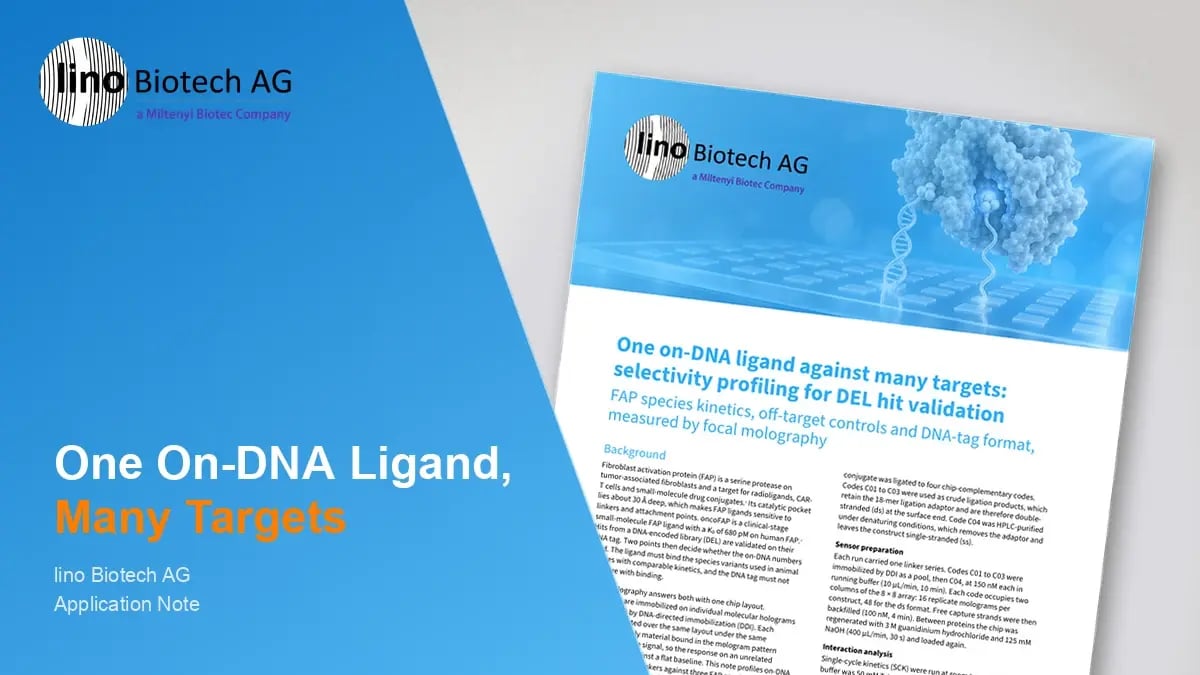
One on-DNA ligand against many targets: selectivity profiling for DEL hit validation
On-DNA oncoFAP profiled against human, mouse and canine FAP and five unrelated proteins on one focal molography chip layout. Full kinetics on every species variant, flat responses ...
Download after a short form