


Ultra Stable Molecular Sensors by Submicron Referencing and Why They Should Be Interrogated by Optical Diffraction—Part II. Experimental Demonstration

Frutiger et al. show experimentally that sensors using the spatial affinity lock-in and diffraction readout overcome drawbacks of refractometric biosensors. They compare an unstabilized diffractometric biosensor directly with a Biacore 8k instrument.
The Challenge: Cross-Sensitivity of Refractometric Biosensors
Surface plasmon resonance is the standard in label-free interaction analysis, despite a significant cross-reactivity to environmental and experimental noise. Part I proposed the spatial affinity lock-in as the answer. This paper tests the idea in the lab.
The Approach: Direct Comparison and a Combined Sensor
The authors compared the sensitivity to refractive index jumps and the surface mass resolution of both sensor types. A combined refractometric and diffractometric biosensor then measured both signals in the same experiments. A conceptual and quantitative discussion explains the physical reasons and defines a figure of merit.
Key Results Against Refractometric Detection
- Refractive index jumps: a 0.03 RIU discontinuity lowered the diffractometric signal by 2 to 3 pg/mm². That is more than three orders of magnitude below the refractometric response in the same experiment.
- Cross-sensitivity: calculated at 69.3 pg/mm²/RIU in water for the diffractometric sensor, against a measured 760 pg/mm²/RIU for the referenced Biacore 8k output.
- Drift: below 100 fg/mm² for the unstabilized diffractometric sensor, with some of the best Biacore flow cells on par.
- Combined sensor: baseline noise of 0.1 pg/mm² rms diffractometric against 100 pg/mm² rms refractometric.
- Precision: for the same mass resolution, a refractometric sensor needs a relative precision up to four orders of magnitude higher.
Why It Matters for Label-Free Sensing
Low-precision, unstabilized diffractometric devices reached the resolution of large stabilized refractometric sensors. The authors believe label-free optical sensors could therefore move beyond the drug discovery lab. They point to miniaturized, mass-produced environmental and medical sensors as possible uses.
More resources
 Oct 2026
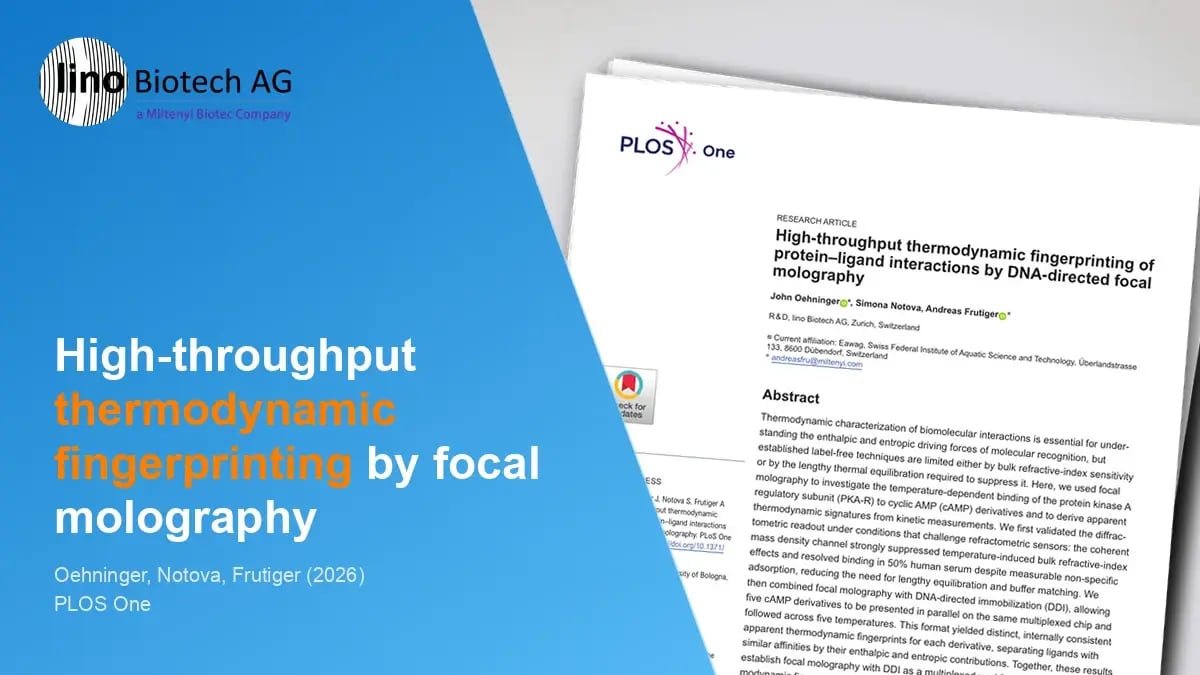
High-throughput thermodynamic fingerprinting of protein–ligand interactions by DNA-directed focal molography
Oehninger, J., Notova, S., & Frutiger, A. (2026). PLOS One, 21(10), e0354008. https://doi.org/10.1371/journal.pone.0354008
Download after a short form
 Oct 2026
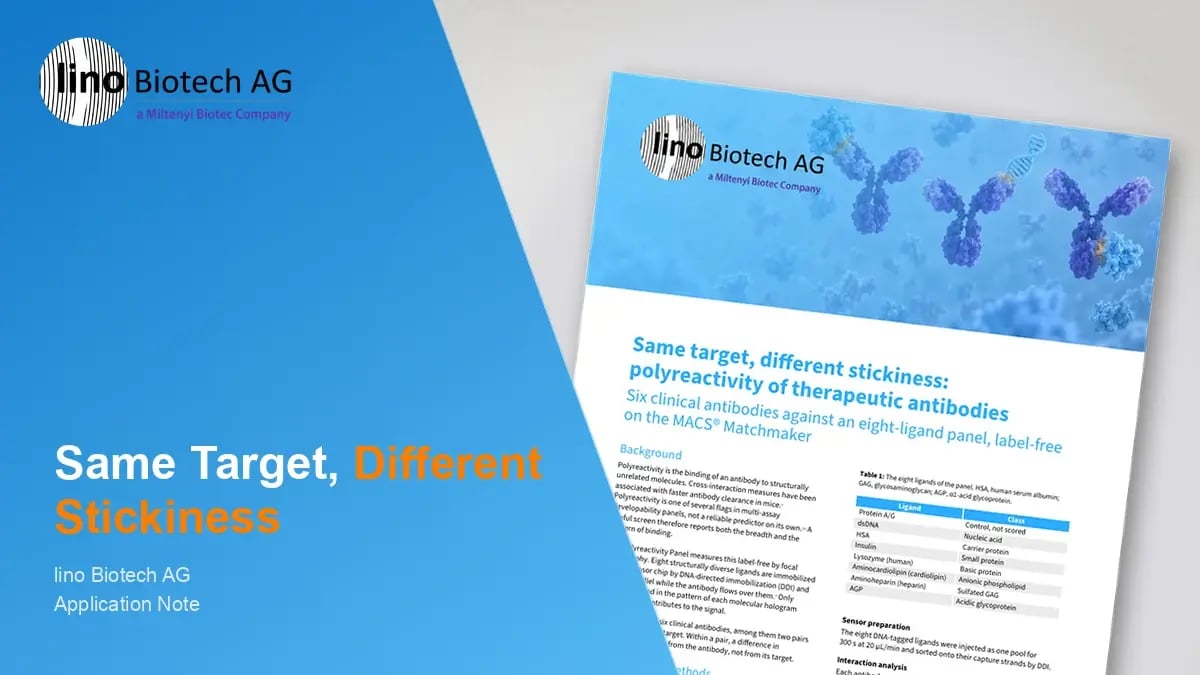
Same target, different stickiness: polyreactivity of therapeutic antibodies
Six clinical antibodies, including two same-target pairs, ranked by polyreactivity against an eight-ligand panel on one focal molography chip. Briakinumab scored 69-fold above ...
Download after a short form
 Oct 2026
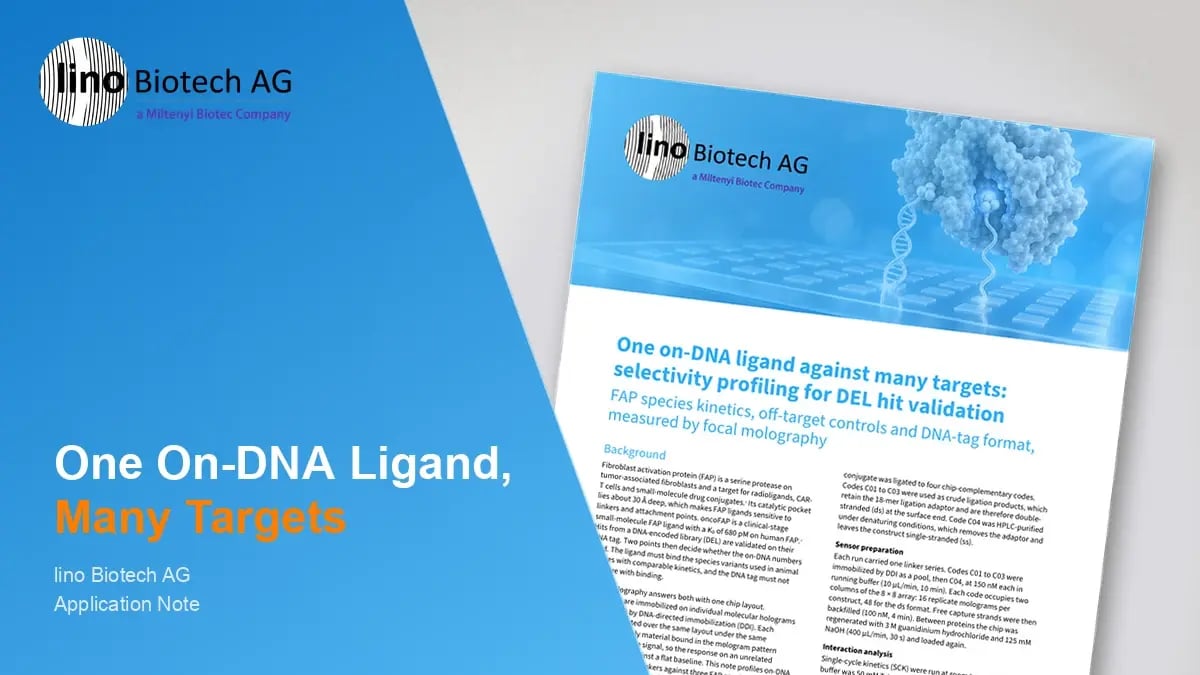
One on-DNA ligand against many targets: selectivity profiling for DEL hit validation
On-DNA oncoFAP profiled against human, mouse and canine FAP and five unrelated proteins on one focal molography chip layout. Full kinetics on every species variant, flat responses ...
Download after a short form