


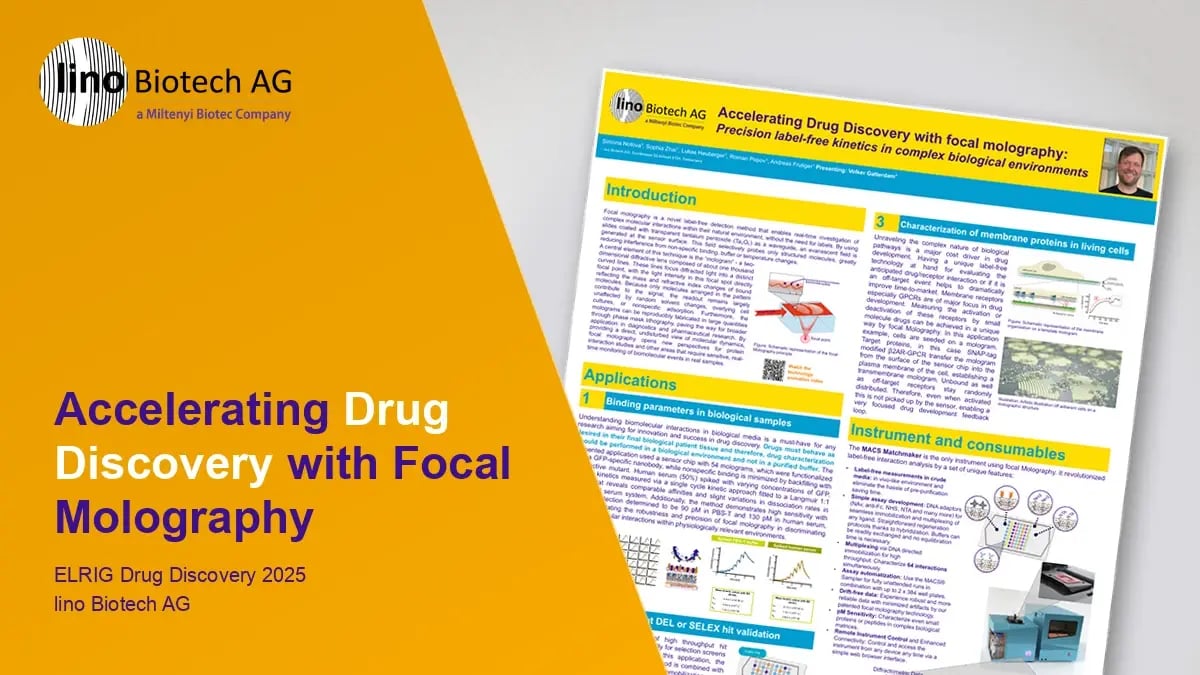
This poster shows three uses of focal molography in drug discovery: kinetics in human serum, hit validation, and membrane receptors in living cells. It was presented at ELRIG Drug Discovery 2025 in Liverpool, UK (October 21 to 22, 2025).
The Challenge: Purified Assays Can Mislead
A drug must work in biological tissue, yet it is often characterized in purified buffer. This simplification can lead to costly failures when candidates reach clinical stages. Hit validation after selection screens is a second bottleneck.
The Approach: Label-Free Detection of Ordered Binding
Focal molography reads binding through a mologram, a diffractive lens made of about one thousand curved lines on a Ta2O5 waveguide. Only molecules arranged in the pattern contribute to the signal. Sensor chips with up to 64 molograms use DNA-directed immobilization (DDI) for multiplexing.
Key Results in Serum, Hit Validation and Cells
- Kinetics in serum: a GFP-specific nanobody gave a mean KD of 1.2 nM in PBS-T (N = 54) and 2.6 nM in 50% human serum (N = 51).
- Sensitivity: limits of detection of 90 pM in PBS-T and 130 pM in human serum.
- Hit validation: three DNA-encoded library (DEL) hits against human carbonic anhydrase IX formed distinct clusters in the iso-affinity plot.
- Living cells: SNAP-tag modified β2AR GPCRs moved the mologram into the plasma membrane. Unbound and off-target receptors stayed randomly distributed and gave no signal.
Why It Matters for Drug Discovery
Measuring in crude media keeps molecules closer to their natural behavior and removes pre-purification steps. A sensor chip with 64 molograms takes up to 64 hits from DEL or SELEX (systematic evolution of ligands by exponential enrichment) screens. A single protein concentration series then characterizes them. Cell-based readouts give direct feedback on receptor activity.
More resources
 Oct 2026
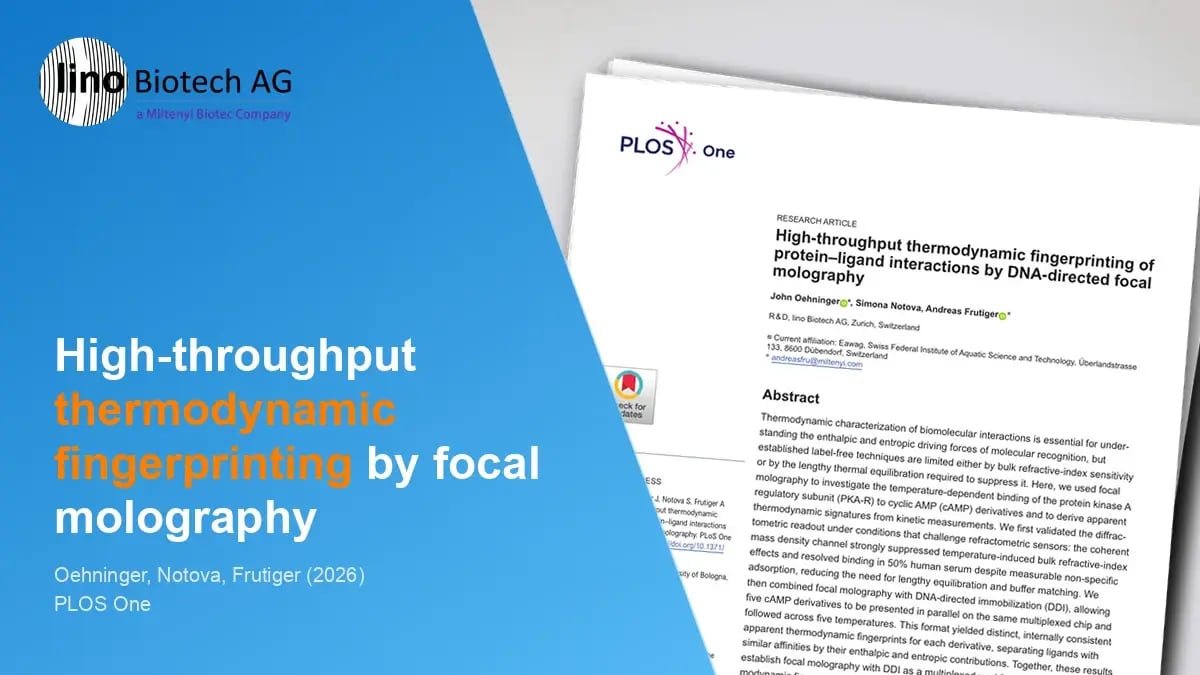
High-throughput thermodynamic fingerprinting of protein–ligand interactions by DNA-directed focal molography
Oehninger, J., Notova, S., & Frutiger, A. (2026). PLOS One, 21(10), e0354008. https://doi.org/10.1371/journal.pone.0354008
Download after a short form
 Oct 2026
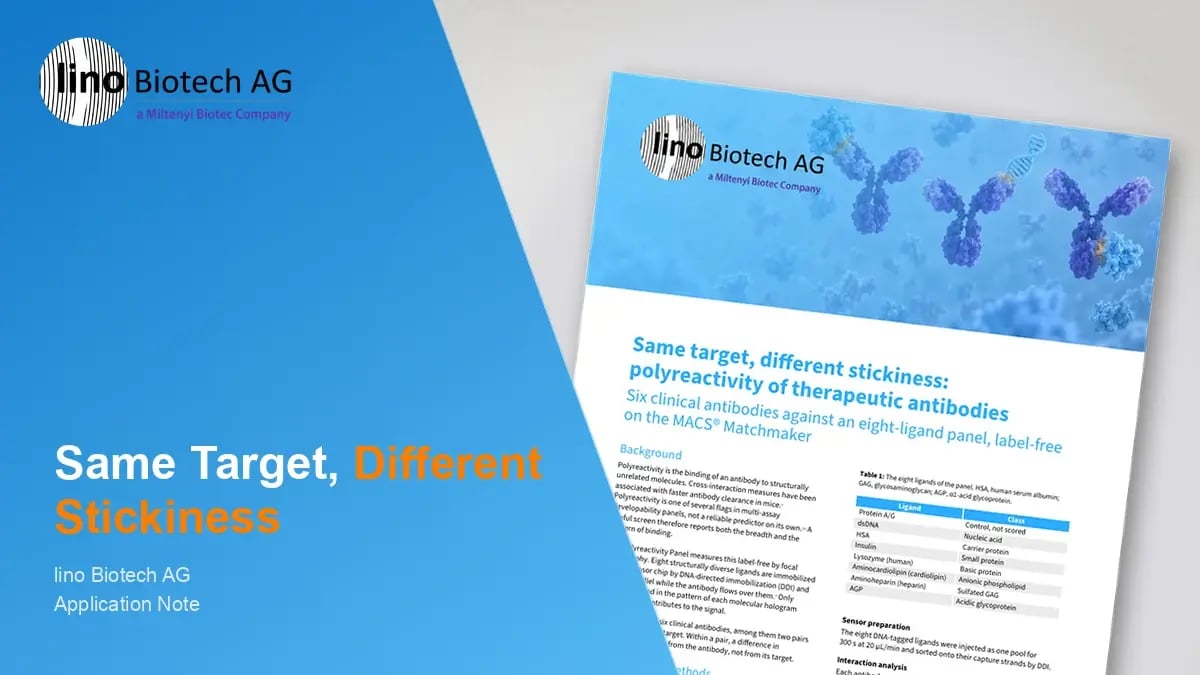
Same target, different stickiness: polyreactivity of therapeutic antibodies
Six clinical antibodies, including two same-target pairs, ranked by polyreactivity against an eight-ligand panel on one focal molography chip. Briakinumab scored 69-fold above ...
Download after a short form
 Oct 2026
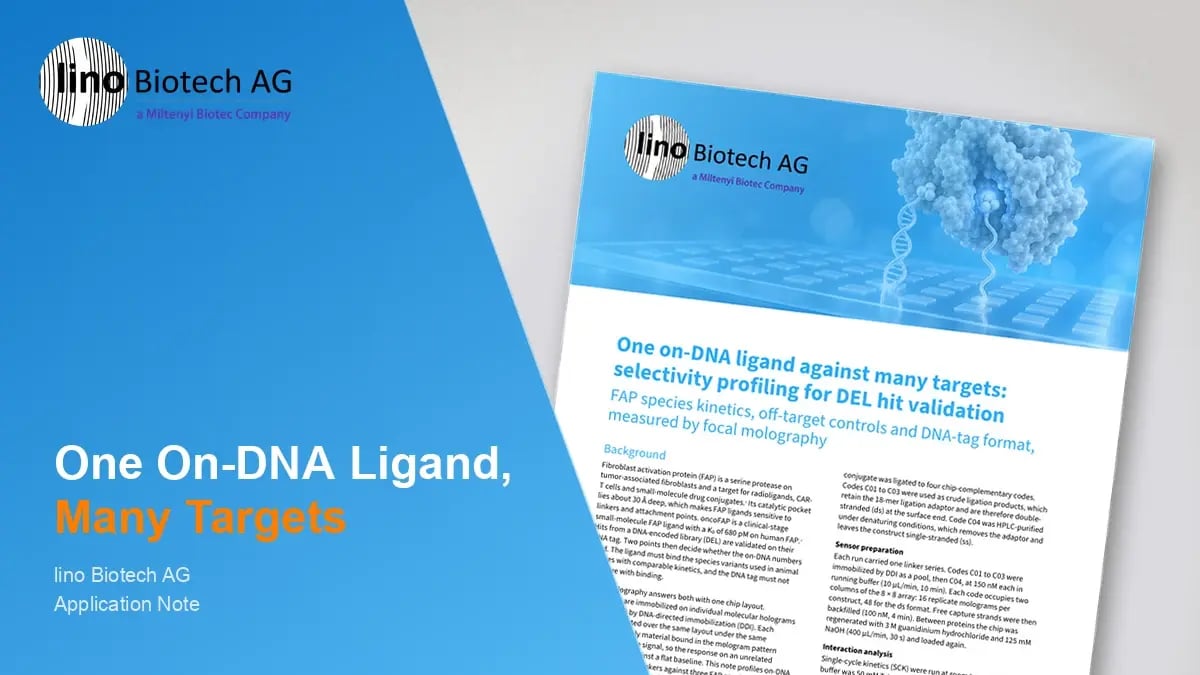
One on-DNA ligand against many targets: selectivity profiling for DEL hit validation
On-DNA oncoFAP profiled against human, mouse and canine FAP and five unrelated proteins on one focal molography chip layout. Full kinetics on every species variant, flat responses ...
Download after a short form