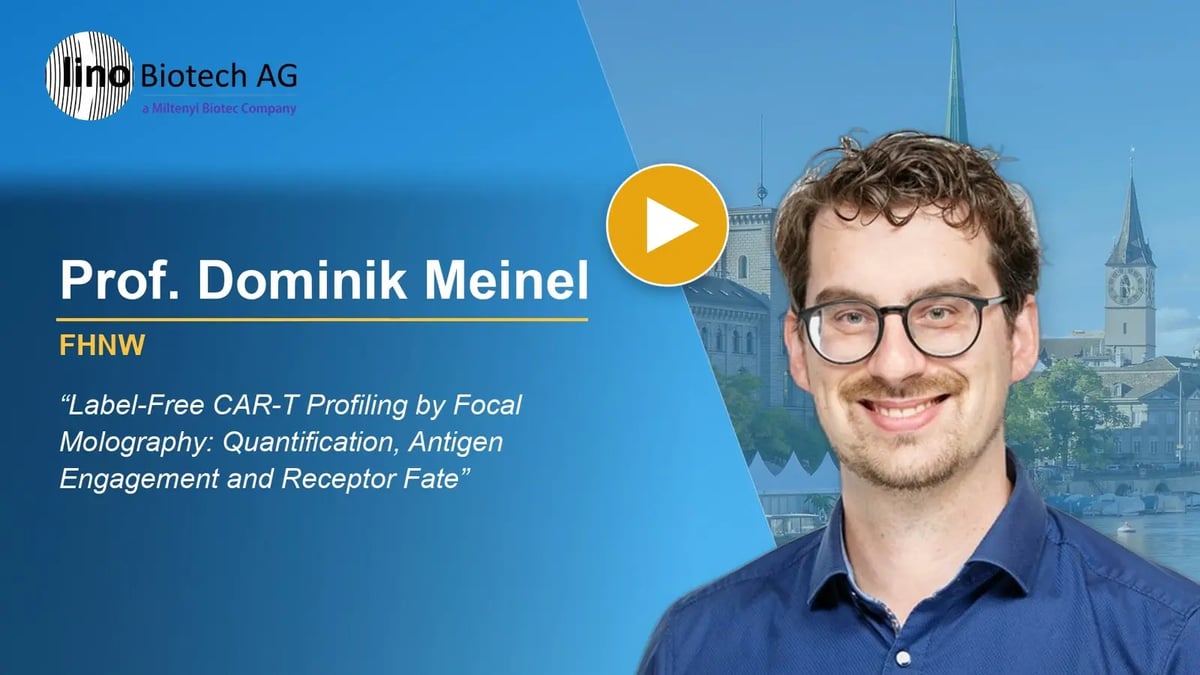
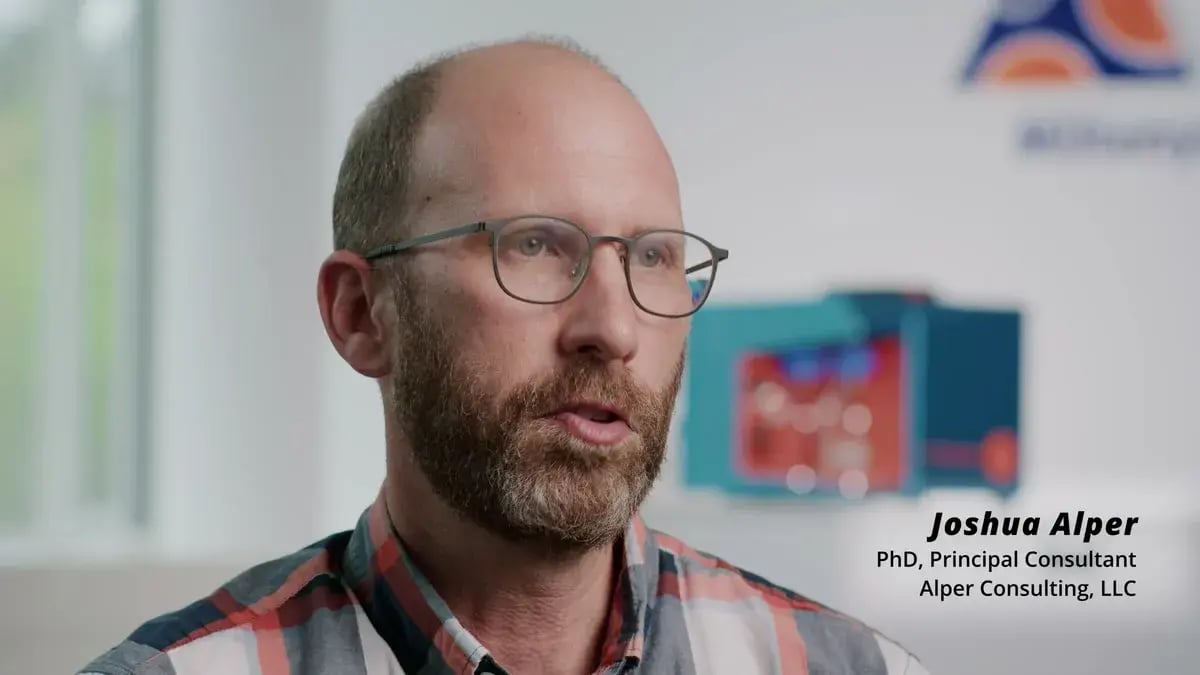
Prof. Dominik Meinel (FHNW) shows how focal molography profiles CAR-T cells label-free on living cells: how much CAR receptor a product carries, whether the receptor engages its antigen, and what happens to it after stimulation.
About the Talk
Recorded at the 3rd focal Molography User Meeting on September 9, 2026, in Adliswil, Switzerland. In this 28-minute talk, Dominik Meinel explains why quality control of CAR-T cell products is slow and tedious, and how his group captures CAR receptors directly on living cells on the sensor chip to address four questions within about one hour: quantity, antigen engagement, receptor fate and a first look at potency.
What the recording covers
- Receptors captured on living cells. T cells settle on the sensor chip, and the mobile receptors on their lower membrane are captured by binders on the mologram ridges, which turns them into an ordered biological grating. Protein L captures the CAR through its light-chain part and leaves the paratope free, while an anti-CD45 VHH serves as a loading control for all T cells.
- Quantifying CAR-T cells. A CAR-T preparation supplied by Miltenyi Biotec, diluted to lower CAR-T fractions, gave a dose-dependent signal. Images of the cells retained on the chip after the run matched the quantification.
- Antigen engagement within one hour. Adding CD19-Fc to the captured CAR-T cells increased the signal step by step, while the non-cognate CD22-Fc did not, showing specific receptor engagement on living cells.
- Receptor fate. With single-specificity CARs, stimulation with CD19-Fc made the signal drop. The group traced this to receptor internalization, which the dynamin inhibitor Dyngo-4a blocked in part.
- A first look at potency. Deliberately stressed CAR-T cultures were sampled day by day and compared with a Raji co-culture cytokine assay. Viability checks by FACS help explain where the two readouts differ. This part is exploratory.
- Beyond CAR-T. The approach is not specific to CAR-T cells and can be transferred to other cell types wherever receptor activation is of interest.
About the Speaker
Prof. Dr. Dominik Meinel is Professor for In Vitro Diagnostics and Molecular Bioanalytics at the FHNW School of Life Sciences in Muttenz, Switzerland. His group develops test kits for the early identification, diagnosis, and treatment of diseases. The CAR-T work presented was carried out with support from the lino Biotech team and Miltenyi Biotec, with project funding from Innosuisse.
Talk held at the 3rd focal Molography User Meeting, Wednesday, September 9, 2026, Adliswil, Switzerland.