


Although the term “biosensor” may seem quite clear on first glance, its meaning is less straightforward. A linguist might say a biosensor is a device that “senses life”, as its etymology would suggest. A biologist, on the other hand, would argue that the term “life” is too broad. A physicist would likely be puzzled by the meaning of “sensing”. The question then is: What is a biosensor?
A Definition for All
One of many official definitions states that a biosensor is “a device that uses specific biochemical reactions mediated by isolated enzymes, immunosystems, tissues, organelles, or whole cells to detect chemical compounds” (IUPAC definition). Put simply, this means that a biosensor utilizes molecular interactions from or based on those in living systems to detect a compound of interest.
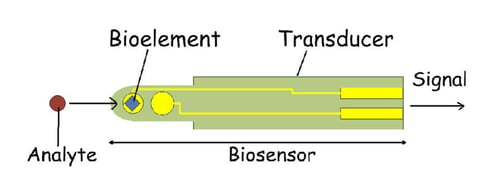
There is a myriad of ways to accomplish this, which is why finding a definition that suits all possible biosensors is a challenging task. There are however three basic elements all biosensors have:
- a bioreceptor: any biological compound capable of detecting the compound of interest (aka “analyte”, cf. figure). Typical examples include biomolecules such as enzymes, antibodies, but also living organisms such as cells.
- a signal processor: the part of the biosensor that will convert the physicochemical signal from the receptor to a quantifiable signal we can interpret.
- a transducer: the part of the biosensor that will link the bioreceptor detecting the compound to the signal processor.
Label vs. Label-Free Biosensors
Biosensors can be classified by several parameters: the type of bioreceptor, the type of transduction, or the signal processing mechanism. Although these classifications can be useful, they do not always provide the information that matters in practice. One broader way to categorize biosensors is by separating them into two big classes.
Label biosensors detect the presence and/or activity of molecules of interest thanks to a special tag, the label, that is attached to them. A typical example of such a sensing technology is ELISA (enzyme-linked immunosorbent assay). On the other hand, label-free biosensors detect the presence or activity of molecules of interest through their biophysical properties. Examples are molecular weight, refractive index (as in surface plasmon resonance) or charge. Other examples of label-free technologies include the microcantilever, quartz crystal microbalance and mass spectroscopy.
What is a label?
Think of a label as a type of tag for molecules. In a clothing store, each item has a tag with a barcode. The store needs it because it usually holds several copies of the same item. Barcodes tell identical items apart. That lets the store keep track of how many items it has and where each one is. Labels in biosensors have a similar function: they help us follow or detect a molecule of interest, so we can distinguish it from the others. In biosensors, the usual way to label a molecule is a color tag, most often a fluorescent molecule.
Beyond simple molecule distinction, labels also enable molecule detection in a simple, visible manner. Indeed, labels provide signal amplification. If the label is an enzyme specific for the molecule of interest, that enzyme creates many copies of the color tag. It does so every time it binds its target. One binding event therefore yields many copies of the color tag, which makes the analyte much easier to detect.
Which is better?
A label seems a smart and practical way to keep track of the molecules we are interested in. In biosensing, that is not always the case. Indeed, adding labels can cause problems in accurate and precise detection. Firstly, the labels we use are molecules themselves, and these tend to be quite chunky molecules. Attaching one to a molecule of interest creates a much larger and different molecule. That alters the intrinsic properties of the molecule: its transport, its activity, and sometimes its effect. By adding a label, we may no longer be measuring what we want to measure. Adding labels is also an extra, non-trivial step in preparing the biosensor, and it requires isolating and purifying the molecules of interest.
This is why label-free technologies are often preferred when the thermodynamic properties of a molecule matter more than its identity or concentration.
What concrete examples of label and label-free biosensors are there? How do these biosensors work, and what are their functions? Stay tuned and read more about these questions in the next blog article.