


Focal Molography: A New Frontier in Biosensing
The latest blog article introduced focal molography as a technology that detects molecular interactions without picking up environmental noise. Environmental noise here means temperature gradients, buffer changes, and non-specific binding. This removes a major hurdle that label-free biosensors have faced so far. What else does the technology bring? This article walks through its main advantages.
Advantages of Focal Molography
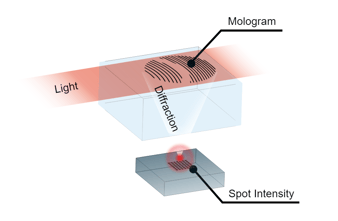
Focal molography differs from established label-free biosensors in one point: the molecules themselves assemble the structure that generates the signal. The core of the method is a pattern of binding sites, the mologram. Analyte molecules that bind to this pattern diffract a laser beam into one specific point in space, the focal point. By reading the intensity at this point, we observe all molecular interactions on the grating at once. Molecules without affinity for the binding sites do not assemble on the grating. The light they diffract is therefore not concentrated in the focal point but scattered in random directions.
Interactions we do not wish to detect, that is environmental noise, are simply not detected. This near-total rejection of environmental noise gives focal molography a number of advantages. The main ones are discussed below.
Stable
Most refractometric biosensors, SPR among them, measure environmental noise by design and are therefore strongly affected by it. Focal molography stays immune to these disturbances. As discussed in the article on SPR, refractometric biosensors detect molecular interactions through small changes in refractive index. Those changes are read across the entire volume of the evanescent field. That volume is very large compared to the volume of the molecules present. Any small change in this field, for example from environmental noise, therefore changes the sensor output considerably. Focal molography is different: its nano-sized, self-referencing principle gives it a signal stability that environmental influences barely touch.
Fast
In any other biosensor, signal acquisition is affected by environmental noise and drift. The measurement therefore usually has to be referenced against a second, parallel sensor that accounts for these external influences. Focal molography is self-referencing: it stabilizes its values on its own instead of comparing them with a known stable value from a separate reference sensor. No pre-equilibration with buffer and no temperature stabilization of the sensor are needed, so the measurement can start immediately. Refractive index jumps are not detected, so the refractive indices of different buffers do not have to be matched.
Robust
Focal molography is compatible with complex media such as cell culture media and buffers, so it combines easily with cell-based assays. A technology that tolerates crude, unprocessed biological samples such as body fluids opens a new source of data for scientists and clinicians.
Real-Time
Focal molography monitors biological interactions in real time, as they happen. What does that bring? On the molecular level, real-time measurements yield the affinity of an interaction. They also reveal small or rapid changes in the sample that could not be detected afterwards. And they deliver the result immediately. In diagnostics, for example, focal molography could read out viral or bacterial loads in patients on the spot, or screen for disease biomarkers routinely.
Label-Free
One of the earliest blog articles discussed the advantages of label-free biosensors over label-based ones. In short, label-free technologies detect the presence or activity of molecules through their biophysical properties, such as molecular weight, refractive index or charge. Label-based technologies need a tag, usually another molecule, attached to the molecule of interest. A label can alter the intrinsic properties of that molecule and compromise the readout, and attaching it is an extra, non-trivial preparation step. Label-free technologies are therefore preferred.
Multiplexing
Because it is label-free and works on the nanoscale, focal molography suits multiplexed assays, in which several assays run in parallel. This speeds up the readout and increases the amount of information one chip can deliver.
Miniaturization
Many biosensing technologies exist, but few have shown potential for miniaturization. Why? Insufficient sensitivity is commonly assumed to be the bottleneck, but that is mostly not the reason. Here again the limiting factor is cross-sensitivity, in particular to environmental influences. It creates a highly disproportionate ratio of sensing volume to the size of a single molecule. Current sensors lose sensitivity when miniaturized because they can no longer be stabilized against external signal sources. Focal molography needs no external stabilization thanks to its self-referencing principle. A miniaturized reader therefore performs like a large benchtop instrument, and miniaturization costs no accuracy.
Outlook
This article has set out the main advantages focal molography brings to biosensing. Figure 2 compares focal molography with other current biosensing technologies, SPR included, on the attributes discussed here.
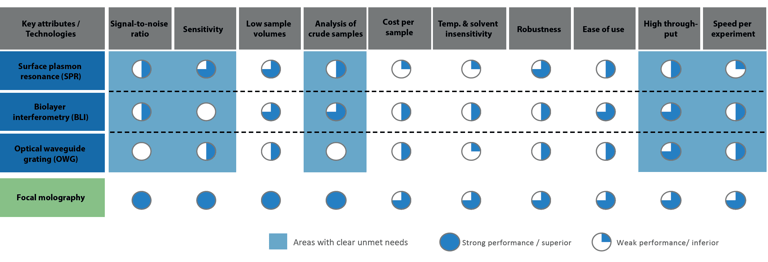
Focal molography offers a new set of possibilities for biosensing. What can the technology do that has not been done before? How can its attributes be put to use? Our next article answers these questions.
References
Frutiger, A., Fattinger, C. and Vörös, J., 2021. Ultra-Stable Molecular Sensors by Sub-Micron Referencing and Why They Should Be Interrogated by Optical Diffraction—Part I. The Concept of a Spatial Affinity Lock-in Amplifier. Sensors, 21(2), p.469.
Frutiger, A., Gatterdam, K., Blickenstorfer, Y., Reichmuth, A.M., Fattinger, C. and Vörös, J., 2021. Ultra Stable Molecular Sensors by Submicron Referencing and Why They Should Be Interrogated by Optical Diffraction—Part II. Experimental Demonstration. Sensors, 21(1), p.9.
2019 Kübrich Molographic Peptide Arrays Towards Label-free Protein Signaturing in Undiluted Blood Plasma